
 AI Governance
 Data Centers
 Drones
 Climate
 Privacy
 2026 Maine Senate
 Bob Dylan
Tariffs Test Collins’s Independence
Coverage from CBC News, Knewz, and others
U.
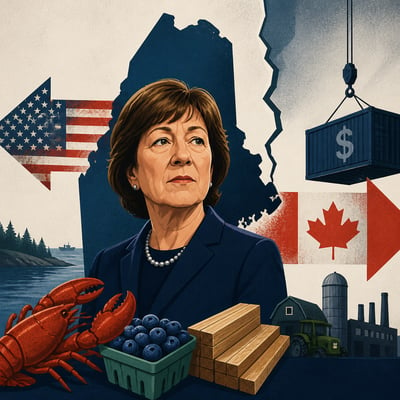
S.-Canada tariffs have become a prominent economic issue in the contest between Republican Susan Collins and Democrat Troy Jackson. Collins has opposed the tariffs and sought exemptions, warning of costs to Maine businesses, consumers, and communities; Jackson argues her response has been insufficient. The dispute matters because Canada is a major trade and energy partner for Maine, while the scale and duration of the tariffs’ effects remain unsettled.
If you read one thing
This broad local report connects Maine’s economic exposure to Canada with Collins’s response and Jackson’s campaign criticism.
Latest development
It adds the material new development of a Millinocket project paused amid tariff uncertainty.
The evidence
Its fact-check examines the specific voting-record dispute behind Jackson’s criticism of Collins.
Broad Maine exposure to Canada trade risks
Maine's dependence on Canadian trade leaves exporters, manufacturers, agriculture, and consumers exposed to tariffs and disruption. The coverage describes substantial cross-border flows in goods and fuel, while the scale and duration of specific costs remain unsettled.
Collins is pursuing opposition and targeted relief
Susan Collins is criticizing Canada's tariffs, urging renewed negotiations, and seeking carveouts while warning about effects on Maine. Her documented approach combines opposition and targeted relief rather than a complete break with the administration.
Tariff accountability is a contested campaign test
Troy Jackson uses the tariff dispute to question whether Collins has sufficiently challenged Trump and protected Maine interests. Collins has a counterargument in her record of opposing tariff measures; fact-checking found Jackson's account omitted four such votes, keeping the dispute focused on both her actions and their adequacy.
41% percent
Maine exports accounted for by Canada
“Canada is Maine’s biggest trading partner, accounting for 69% of imports and 41% of exports in 2025, according to the U.S. Census Bureau.”
More than 80% percent
Maine heating oil and gasoline imported from Canada
“More than 80% of the state’s heating oil and gasoline is imported from Canada, while wild blueberries, lobsters and lumber depend heavily on cross-border trade.”
$300 million
planned aquaculture project cost
“A $300 million U.S. aquaculture project, Great Northern Salmon, planned to reuse lagoons at the old mill site. Backed in part by Norwegian investors, it was about 80 per cent complete when the company announced it was pausing indefinitely, citing uncertainty caused by the Trump administration's tariffs. Much of its salmon-farming equipment was to be imported from Canada.”
50 people
initial planned employment
“Millinocket Chamber of Commerce president Gail Fanjoy said the project would initially have employed 50 people and called its suspension a major blow.”
80 per cent
project completion
“A $300 million U.S. aquaculture project, Great Northern Salmon, planned to reuse lagoons at the old mill site. Backed in part by Norwegian investors, it was about 80 per cent complete when the company announced it was pausing indefinitely, citing uncertainty caused by the Trump administration's tariffs. Much of its salmon-farming equipment was to be imported from Canada.”
Tariff uncertainty halts a nearly completed Maine aquaculture project
The tariff dispute has produced a concrete local investment setback: Great Northern Salmon paused its nearly completed Millinocket aquaculture project, citing uncertainty over tariffs on equipment imported from Canada. The suspension puts the project’s planned initial jobs at risk, moving the issue beyond potential costs and trade disruption to a halted development.
Previously
The 2026 Maine Senate contest is using the Trump administration's tariffs on Canada as a test of Susan Collins' independence and economic judgment. Collins warns that tariffs and possible Canadian retaliation could raise costs or damage Maine's lobster, blueberry, potato, lumber, manufacturing, farming, and border-related businesses, while Troy Jackson argues that she has not challenged President Donald Trump sufficiently. The issue matters because Canada is Maine's largest trading partner, although Canada's removal of seafood from planned tariffs eased the immediate threat to lobster interests.
A Millinocket aquaculture project was reportedly paused amid uncertainty over tariffs on Canadian equipment, giving the trade dispute a concrete local business impact. The coverage also highlights Maine’s reliance on Canadian supplies, including heating fuel, beyond export markets.
The current version largely confirms the existing framing, adding a more specific measure of Maine's Canadian trade dependence: roughly 40% of goods exports go to Canada.