
 AI Governance
 Data Centers
 Drones
 Climate
 Privacy
 2026 Maine Senate
 Bob Dylan
North Carolina Rewrites Data Center Rules
Coverage from The Charlotte Post, The INDY, and others
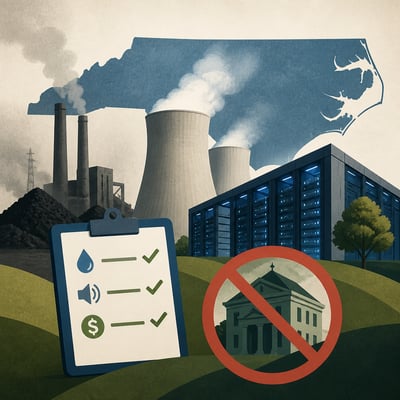
North Carolina is advancing statewide rules that would make large data centers cover more of the generation, transmission, and grid costs associated with their electricity demand while imposing tighter cooling, noise, siting, incentive, and ownership requirements.
Senate Bill 730 is also tied to Duke Energy’s coal-retirement and nuclear-generation plans, while state officials are pursuing legally binding tariffs for large loads. Local action, including Durham County’s nine-month moratorium, shows that scrutiny is extending beyond the legislature to project approvals and existing development pressure.
If you read one thing
It provides the clearest broad overview of the proposed rules, linking data-center costs, cooling requirements, site impacts, and energy planning.
Best explainer
It explains how officials are trying to turn voluntary commitments into enforceable tariffs that make data centers fund associated power infrastructure.
The local angle
It shows how Durham’s moratorium translates statewide concerns about siting, cooling, water, and research-oriented development into local rules.
The counter-case
It presents the restriction-oriented case by quantifying public revenue and infrastructure costs associated with data-center incentives.
Local moratoria and siting resistance
North Carolina communities are using moratoria, project withdrawals, and tighter review processes to address data centers' effects on land use, infrastructure, water, noise, and electricity. Durham's pause preserves smaller or research-related facilities while larger projects await permanent rules.
Large-load costs are shifting toward data centers
Lawmakers, regulators, Duke Energy, and political candidates are pressing for tariffs and contracts that make data centers fund generation, transmission, delivery, and other infrastructure associated with their demand. The unresolved issue is how fully voluntary commitments become enforceable protections for existing ratepayers.
Water, cooling, and environmental controls
Cooling systems, water quality and availability, wastewater, noise, and operational disclosures are becoming central conditions for data-center approvals. Closed-loop cooling is favored over evaporative systems but does not eliminate concerns about high-quality water, chemical use, or broader environmental effects.
Shift from broad incentives to fiscal scrutiny
North Carolina has ended the electricity sales-tax exemption while retaining equipment and capital-investment incentives. Remaining subsidies face intensified scrutiny as opponents connect foregone revenue and public infrastructure costs to rapid data-center expansion.
Load growth is reshaping energy planning
Data-center demand is being incorporated into decisions about nuclear development, coal-retirement timing, transmission expansion, rate design, and storage. The policy response remains mixed: officials are pursuing new supply and reliability measures while debating whether large-load growth should prolong fossil generation and how its costs should be allocated.
100,000 square feet
maximum facility size for an exemption
“The exemptions include allowing construction or expansion of data centers up to 100,000 square feet if they use closed-loop cooling and non-diesel backup power.”
4-1
commissioners' vote
“Durham County commissioners voted 4-1 on August 24 to impose a nine-month moratorium on new data center development, adding four exemptions intended to accommodate the local research economy, particularly Research Triangle Park (RTP), which hosts nearly 400 companies that rely heavily on data processing.”
nine-month months
moratorium duration
“Durham County commissioners voted 4-1 on August 24 to impose a nine-month moratorium on new data center development, adding four exemptions intended to accommodate the local research economy, particularly Research Triangle Park (RTP), which hosts nearly 400 companies that rely heavily on data processing.”
15-fold
increase in data-center construction
“According to CBRE, the incentives helped contribute to a 15-fold increase in data-center construction, much of it during Cooper’s term beginning in 2017.”
$112.4 million USD
additional funding directed to an industrial development fund
“In 2019, Cooper’s administration approved a Job Development Investment Grant for Apple’s data-center development in Maiden, North Carolina. The grant was valued at $845 million over 39 years, with an additional $112.4 million directed to an industrial development fund for rural infrastructure.”
Contested Issue
Should North Carolina continue facilitating new data-center development with targeted impact controls, or restrict or pause new projects because of their infrastructure, environmental, and community costs?
The corpus contains incompatible policy prescriptions. One side supports continued investment with targeted safeguards and exemptions, while the other supports moratoriums or broader restrictions until electricity, water, land-use, environmental, and public-cost concerns are addressed.
Managed continued development
North Carolina should allow data-center investment to continue while managing electricity, water, noise, and siting impacts through targeted requirements and exemptions.
Restrict or pause new projects
North Carolina and its communities should restrict or temporarily pause new data centers until infrastructure, water, electricity-cost, land-use, noise, and environmental effects are assessed and addressed.
The new Durham reporting adds calls for broader restrictions on smaller data centers but does not establish a material change beyond the existing moratorium and local scrutiny.
Previously
North Carolina's data-center buildout is colliding with rising concern over electricity bills, grid capacity, water, noise, and land use. State lawmakers are moving toward large-load contracts, developer-funded infrastructure, cooling and siting requirements, and reduced incentives, while Duke Energy's nuclear and coal strategy remains linked to future demand. Counties and cities are pausing or restricting projects, and the issue has become politically salient as operators defend investment and economic benefits.
The story has moved from broad proposals toward more enforceable mechanisms: officials are pursuing binding large-load tariffs, while Durham has formally implemented a defined moratorium. The legislation also more explicitly conditions coal retirement on progress toward new nuclear generation.
The story has become more politically salient, with named statewide political figures and industry representatives joining the debate over ratepayer exposure, local control, and data-center incentives. The underlying regulatory direction is otherwise largely confirmed rather than materially changed.