Counties Draw Lines Around Data CentersCounties Draw Lines Around Data CentersCoverage from CalMatters, WBFF, and others
00/00/0000
DailyWeekly
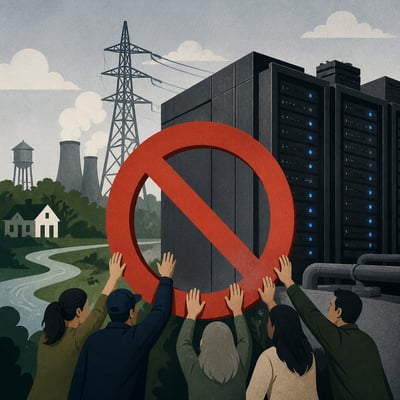
Maryland counties and cities are using moratoriums, zoning changes, conditional approvals, and proposed bans to slow or reshape data center development.
Officials are seeking more information on electricity capacity, utility costs, water withdrawals, noise, environmental effects, and community impacts before allowing large facilities to proceed. The direction is toward discretionary review, stronger siting limits, public input, and developer-funded mitigation, although several measures remain proposals and jurisdictions are taking different approaches.
It presents the strongest prohibition-oriented case through Harford County’s ban and its concerns about hyperscale power demand, grid reliability, and environmental effects.
It adds the political and community-opposition dimension, showing how disputes over data-center zoning are affecting elections, courts, and executive decisions.
WTOP News / Bryan P. Sears
Key Issues
01
Local governments are restricting new development
Maryland jurisdictions continue to use moratoria, approval pauses, zoning limits, and outright bans to slow or block new data-center construction. Harford has enacted a countywide ban, while Prince George’s and Montgomery maintain broad pauses and Baltimore County is considering an extension.
Stable
Drawn from 5 articles
02
Grid capacity and public power costs constrain siting
Hyperscale electricity demand, renewable-power requirements, and uncertainty over utility capacity and cost allocation remain central barriers to approval. Emerging proposals would require developers to demonstrate adequate utility capacity and assume more infrastructure or system costs.
Drawn from 4 articles
03
Approval is shifting toward conditional, impact-based siting
Where jurisdictions have not chosen outright bans, the emerging model replaces by-right approval with discretionary review, industrial-area limits, residential setbacks, utility-capacity tests, and enforceable mitigation or community-benefit commitments. Water, noise, emissions, environmental justice, and infrastructure impacts are increasingly built into approval standards.
Stable
Drawn from 5 articles
04
Economic benefits remain contested by community opposition
Projected tax revenue, jobs, infrastructure investment, and research capacity continue to support data-center development, but they have not secured local consent. Court challenges, political backlash, public hearings, and demands for enforceable community benefits continue to delay or constrain projects.
Mixed
Drawn from 5 articles
Contested Issue
1 open dispute
Should Maryland jurisdictions permit data centers under stricter siting and operating conditions, or prohibit or pause new development?
The corpus contains incompatible policy prescriptions. Some Maryland jurisdictions and officials support moratoria or permanent bans because of electricity-capacity, environmental, land-use, and community concerns. Other evidence supports retaining a permitting pathway through industrial-area siting, discretionary review, utility-capacity requirements, mitigation agreements, and community-benefit conditions.
Pause or prohibit development
4 articles · across 4 publications
New data centers should be paused or banned until infrastructure and community impacts are resolved, with some jurisdictions favoring permanent prohibitions.
Conditional and regulated development
3 articles · across 2 publications
Data centers should remain permissible through conditional approvals, industrial-area siting, discretionary review, infrastructure-capacity requirements, and enforceable mitigation or community-benefit commitments rather than blanket prohibitions.
Looking Back
121 Day Timeline
Articles published over time. Hover any bar for the period and its article count.
May 7
May 28
Jun 15
Jul 6
Jul 27
Aug 14
Sep 4
The Story So Far
No material change
The new reporting adds further detail on organized opposition to large data centers and Baltimore County’s consideration of stricter siting, water, noise, and development rules, but does not establish a material change beyond the existing pattern of regulatory review and community concern.
Previously
Maryland counties and cities are pausing, restricting, or considering bans on new data centers while officials study their effects on electricity demand, water use, land conversion, neighborhoods, and public costs. Baltimore County is weighing an extension of its moratorium alongside stricter siting and approval rules, while Harford and Montgomery counties are pursuing more permanent or broad prohibitions. The decisions are also producing a wider debate over tax revenue, jobs, infrastructure funding, and how much public review projects should receive before approval.
History
09/09/2026
The story is shifting from broad moratoriums and proposed bans toward more detailed, discretionary permitting frameworks, including industrial-zone limits, conditional approvals, and developer-funded mitigation. Prolonged reviews extending into 2027 are also increasing uncertainty over which projects can proceed.
09/04/2026
Maryland’s response has progressed from temporary pauses and general concern toward concrete moratoria, permanent-ban proposals, zoning restrictions, and more specific public-health review requirements. The story also expands beyond Maryland through Imperial County’s moratorium, litigation, and proposed state safeguards over a hyperscale project.
Imperial Valley Computer Manufacturing, LLC advances a hyperscale data center in Imperial County, as supervisors impose a 45-day moratorium amid a lawsuit and proposed state regulatory changes.
Imperial County imposed a 45-day moratorium on hyperscale data centers after backlash over the Imperial Data Center, triggering CEQA, zoning, and water litigation in California.
Maryland counties and Baltimore City imposed pauses, moratoria or bans on new data centers in 2020s response to concerns about farmland, energy demand, water use and local impacts.
Baltimore County, Maryland, will consider extending a data center moratorium and adopting stricter zoning and environmental oversight after a Planning Board hearing and vote in September.
Baltimore County staff presented a hyperscale data center impact report to the Planning Board on Thursday, with proposals affecting siting, noise, water use, and community contracting during a pause until 2027.
Prince George's County, Maryland adopted a two-year moratorium on hyperscale data center development after debate over siting, water supply impacts, and utility pressure.
Prince George's County Council approved a two-year moratorium on new data center development in Maryland after a public hearing, while the county executive halted permitting through September.
Baltimore City Council passed a one-year moratorium on data center construction of 10 MW or more, with a nine-month impact study, for mayoral approval.
Montgomery County, Maryland, plans council committee reviews of data center moratorium bills and zoning text changes on July 22, with full Council action scheduled for July 28.
Imperial County supervisors debated stronger building guidelines for data center proposals on Tuesday as residents urged a CEQA-based moratorium and multiple cities considered pauses.
Frederick and Calvert County primary election results in Maryland, driven by opposition to data center zoning and proposed pauses, increased momentum for moratoriums and tighter controls.
7/13/2026 • Community & Local Opposition • General
Baltimore Planning Commission members considered Council Bill 26-0174 on Thursday in Baltimore, debating conditional data center zoning and environmental review requirements before the city's moratorium expires next year.
Maryland counties, including Harford, Montgomery, and Frederick, have banned or paused data center approvals in 2025 amid disputes over power capacity, environmental impacts, and local land use.
On July 22, county committees advanced an 18-month data center moratorium and a zoning amendment banning data centers over 25 MW for a July 28 County Council vote.
Prince George's County, Frederick County, and Montgomery County in Maryland paused data center development or permitting while environmental impact analyses proceed.
CCAN Action Fund reports nine Maryland counties and Baltimore City enacted data center moratoria starting late 2025, citing electricity, water, and community impacts.
7/15/2026 • Community & Local Opposition • General
Maryland county governments are pausing or banning new data center approvals in recent months as residents and officials debate infrastructure, environmental, and land use impacts.
Prince George's County Council in Maryland approved a two-year hyperscale data center development moratorium after public testimony on water, environmental effects, and utility strain.
Prince George's County Council passed a two-year moratorium on hyperscale data centers in Maryland to reassess water, health, and utility impacts while crafting future legislation.
Prince George's County Chair Oriadha announced a proposed two-year moratorium on new data center operations in Prince George's County, Maryland, to complete reviews of land use, power, water, and environmental impacts.
Evan Glass and Will Jawando, seeking Montgomery County, Maryland county executive, proposed moratoriums on new data center permits amid concerns over water, air pollution, and energy costs.
Harford County Executive Bob Cassilly submitted legislation to permanently ban data centers in Harford County, Maryland, after county moratorium discussions and resident concerns.
Baltimore City Council advanced a one-year data center moratorium on pending full-council vote, targeting standards after committee discussion set a 10-megawatt threshold.
Baltimore City Council debates a moratorium on new data centers above 10 megawatts as Maryland funds Johns Hopkins for a $192 million Bayview ARCH expansion.
Harford County Executive Bob Cassilly announced proposed legislation to permanently prohibit data centers in Harford County, Maryland, citing energy, environmental, and water concerns.
Maryland lawmakers and local officials discussed data center moratoriums, electricity costs, and grid interconnection rules Wednesday at a conference in Ocean City, Maryland.
Prince George's County, Maryland, enacted a two-year moratorium on data center development while addressing environmental impacts and potential enforceable community benefits agreements.
7/20/2026 • Community & Local Opposition • General
Baltimore County residents testified at the Planning Board in Towson on new data center siting rules tied to a proposed 150-megawatt Woodlawn project, ahead of an Oct. 1 County Council recommendation.
5/22/2026 • Community & Local Opposition • General
Harford County, Maryland officials considered emergency legislation in 2026 to permanently ban data centers, citing energy, infrastructure, noise, and water concerns.
Baltimore County officials are holding public hearings this week on extending the data center moratorium and regulating future facilities in Baltimore County, Maryland.
Baltimore County residents and officials urged the Planning Board in Maryland to restrict data centers during a hearing on proposed regulations before a September 21 moratorium vote.
Maryland lawmakers, local governments and residents are scrutinizing data center expansion in 2025 as Quantum Frederick and other projects raise electricity, water and land-use concerns statewide.
8/28/2026 • Community & Local Opposition • General
Maryland communities and local governments debated expanding data-center development in July 2026 as projects increased pressure on land, electricity, water, and permitting systems.
8/25/2026 • Infrastructure & Site Development • General
Maryland energy officials recently urged counties with temporary data center moratoriums to negotiate community investments as PJM Interconnection warned of transmission constraints and potential grid disruptions statewide.
Maryland Board of Public Works approved a $9 million grant for Johns Hopkins to build a 25,000-square-foot data science and computer center in East Baltimore while Baltimore City Council weighs a 10-megawatt moratorium threshold.
In 2025, Maryland Gov. Wes Moore moderated support for data centers as Frederick County and communities near Adamstown raised concerns about electricity, water, land use, and infrastructure costs.

 AI Governance
 Data Centers
 Drones
 Climate
 Privacy
 2026 Maine Senate
 Bob Dylan