Marine Data Centers Test New SitingMarine Data Centers Test New SitingCoverage from CleanTechnica, The Register, and others
00/00/0000
DailyWeekly
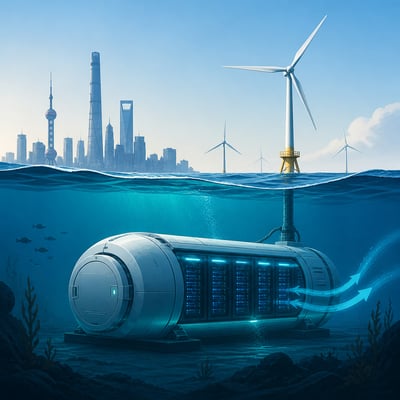
Developers in China and elsewhere are testing underwater and floating data centers as alternatives to land-based facilities constrained by electricity, water, land, and permitting requirements.
A Shanghai facility is reported to be operating at pilot scale with a planned capacity of 24 MW, while Samsung Heavy Industries and Mousterian are developing a 50 MW floating pilot near Houston and Samsung is targeting broader commercialization by 2028. The designs may reduce freshwater use and land requirements, but marine construction, power and fiber connections, corrosion, maintenance, environmental effects, storm resilience, and regulatory approvals remain unresolved.
Looking Back
82 Day Timeline
Articles published over time. Hover any bar for the period and its article count.
May 16
May 30
Jun 11
Jun 25
Jul 9
Jul 21
Aug 4
History
08/24/2026
The story now includes a substantially larger floating-data-center project near Houston and a concrete 2028 commercialization target, making the path beyond Shanghai more tangible. Texas grid-connection scrutiny also adds a specific regulatory constraint to the broader permitting concerns.
07/23/2026
The story shifts from a largely experimental niche to one showing limited commercial deployment, led by the Shanghai underwater facility now described as operating commercially. It also broadens to include more marine-based designs, but the core uncertainties around servicing, cables, and scaling remain unresolved.
Microsoft Project Natick and a Shanghai Lingang commercial underwater data-center show sealed marine cooling is feasible, while maintenance, cables, and environmental risks remain deciding constraints.
Highlander Digital Technology started operations of a 24 MW underwater data center off China, powered by an offshore wind farm and aimed at AI compute demand.
Datagrid's Makarewa AI campus faces electricity, groundwater, and diesel backup scrutiny as Samsung Heavy Industries pursues floating seawater-cooled AI data centers for 2028 commercialization.
Shanghai Lingang undersea data center began May operations off China’s Shanghai coast, using offshore wind delivery and seawater heat-exchanger cooling.
Samsung Heavy Industries and Mousterian Corporation signed an engineering agreement in 2026 for floating data centers beside a Houston, Texas, gas plant.
A Lingang Special Area offshore platform off Shanghai began commercial operation of a 2.3 MW underwater data center powered by offshore wind, targeting 24 MW capacity.
Panthalassa tests wave-powered, seawater-cooled floating data centers offshore near Washington as SpaceX proposes orbital data-center satellites for 2028.
HiCloud Technology and China Communications Construction completed mid-October construction of a 24 MW offshore wind-powered underwater data center off Shanghai.
China Communications Construction subsidiary switched on an underwater data center near Shanghai's Lin-hang Special Area after phase one completion, using offshore wind power and sealed ocean cooling.
Panthalassa is testing the Ocean-2 floating data center prototype off Washington state, aiming for commercial operations in 2027 using wave power and cold seawater cooling.
China launched a 24 MW offshore wind powered underwater data centre demonstration near Shanghai in May to reduce energy and freshwater use, with marine ecosystem impacts still uncertain.
Nautilus Data Technologies operates a nearshore floating data center in California while offshore deployments remain constrained by power, fiber connectivity, seawater engineering, and marine permitting.
HiCloud Technology and Chinese government partnership reportedly operates a 24 MW wind-powered underwater data center near Shanghai using once-through cooling and claiming large power, water, and land reductions.
HiCloud Technology and Chinese partners reportedly operate a wind-powered underwater data center off Shanghai, claiming reduced power, water, and land impacts.
Shanghai Lingang underwater data center powered by offshore wind reached full commercial operation in 2025 after February trials and June launch near 35-meter-deep subsea modules.
Samsung Heavy Industries plans a floating data center platform for AI computing demand, targeting Q2 2028 commercialization and near-shore deployments using land-based power supplies.
Mousterian Corporation and Samsung Heavy Industries signed an engineering contract for a floating 50 MW datacenter planned near Houston, Texas, as ERCOT connection approvals face a state audit.
8/5/2026 • Infrastructure & Site Development • General
China launched underwater data centers off Hainan and Shanghai to reduce cooling water demand while expanding AI computing capacity and managing power needs.
Samsung Heavy Industries plans first floating AI datacenter operations in 2028 with about 50 MW compute, seawater cooling, and maritime certification support from Lloyd's Register.
Samsung Heavy Industries and Mousterian Corporation signed an August 3 engineering agreement for 50 MW floating data centers planned for Texas and other US markets.
8/3/2026 • Infrastructure & Site Development • General

 AI Governance
 Data Centers
 Drones
 Climate
 Privacy
 2026 Maine Senate
 Bob Dylan