
 AI Governance
 Data Centers
 Drones
 Climate
 Privacy
 2026 Maine Senate
 Bob Dylan
Drones Briefing: Quick
Answering the key questions about the day.
Jet Drones Pressure Defenses as Counter-UAS Authority Broadens
of Play
The central drone trajectory remains an accelerating contest among mass production, rapid adaptation, autonomy, and countermeasures. New September figures strengthen the assessment that Russia's jet-powered attack drones currently impose an unfavorable interception and capacity burden on Ukraine, while prototype defensive successes remain too limited to show a reversal. Outside the battlefield, the clearest change is regulatory: U.S. state and local authorities now have a broader legal basis for counter-UAS action, but implementation—not authorization—is becoming the key uncertainty. Commercial and public-safety adoption otherwise remains bounded rather than broadly scaled.
What's New?
Jet-powered drones hold a near-term edge over defenses
Russia's operational use of faster, jamming-resistant Geran variants has created a harder-to-intercept attack tier: Ukraine reports intercepting about 55% of September's jet drones, versus reported rates above 90% against piston-engine Shaheds. Ukraine is fielding faster, machine-guided interceptors, but current evidence does not yet show that they can erase this advantage at scale or sustainable cost.
Ukraine-reported September rate
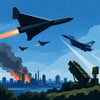
Mass and adaptation speed remain decisive battlefield capabilities
Drone advantage increasingly rests on inexpensive mass production and rapid software, hardware, and tactical iteration rather than static inventories. Ukraine's short development cycles and Russia's reported jet-drone production demonstrate that forces unable to integrate and modify systems quickly risk losing capability as defenses and electronic warfare evolve.
Civilian expansion remains bounded as counter-drone security broadens
Commercial delivery and public-safety adoption remain organized around specific programs and operating environments rather than unrestricted scale. Counter-UAS policy is moving further: new federal authority for state and local action near airports and major venues broadens the set of institutions able to respond, although operational capability will depend on implementation.


What's Changed?
Evidence of the jet-drone threat materially strengthened
The prior assessment of an emerging Russian attacker advantage now has a broader operational basis: Ukraine reports more than 2,730 jet-drone launches in September, a 55% interception rate, and Russian production reportedly approaching 3,000 per month. Reported first kills by a new Ukrainian interceptor show a defensive response, but not yet a reversal of the unfavorable balance.
Local counter-UAS authority crossed a legal threshold
The Safer Skies Act reportedly took effect, moving state and local counter-drone action near airports and major venues from a proposed policy direction to an operative legal basis. This is a meaningful regulatory change, although the evidence does not yet establish widespread deployment or successful engagements.
- Provide an operative legal basis for state and local counter-drone action near airports and major venues
- Establish widespread deployment
- Establish successful engagements
Implementation and operational effectiveness remain unproven.

What Matters?
The air-defense cost and capacity problem is worsening
Jet drones reduce the effectiveness of Ukraine's established low-cost interceptor layer and increase reliance on faster interceptors, fighters, or scarce missiles. If Russia sustains the reported launch and production volume, the challenge becomes not merely technical interception but whether Ukraine can generate affordable defensive capacity quickly enough to prevent repeated infrastructure pressure.
Counter-drone policy is shifting from federal scarcity to local execution
Broader legal authority could make counter-UAS protection more available at civilian infrastructure and major events. It also shifts the principal uncertainty toward implementation—whether local agencies obtain suitable systems, training, coordination, and engagement procedures—rather than whether they possess a legal basis to act.
- Suitable systems
- Training
- Coordination
- Engagement procedures
What's Next?
Can faster interceptors close the jet-drone gap?
Watch whether Ukraine's machine-guided interceptors achieve repeatable kills against Geran-4 and Geran-5 variants under electronic-warfare conditions and at sustainable cost. Rising interception rates without greater reliance on fighters or expensive missiles would weaken the attacker-advantage assessment; persistently low rates would strengthen it.
Rising interception rates without greater reliance on fighters or expensive missiles
Persistently low interception rates
Will reported Russian production translate into sustained mass?
Watch whether Russia sustains production near the reported 3,000 jet drones per month and converts its planned 2027 spending into recurring high-volume attacks. Continued launch growth would indicate a durable industrial advantage; lower output or component constraints would narrow the threat.
Will local counter-UAS authority produce operational capability?
Watch for state and local procurement, deployment, engagement rules, and successful interventions under the Safer Skies Act. Concrete operations at airports or major venues would confirm that the law changed defensive capacity; prolonged implementation without fielded systems would leave the change primarily legal.
Concrete operations at airports or major venues
Prolonged implementation without fielded systems