
 AI Governance
 Data Centers
 Drones
 Climate
 Privacy
 Bob Dylan

Drones Quick Briefing
2026-11-17
Drone Use Expands, but Reliable Deployment Remains Uneven
of Play
Military drone warfare continues to reward scale and rapid adaptation, while changing threats challenge existing defenses. The clearest new institutional development is a planned expansion of U.S. local counter-drone training, though accreditation remains a barrier. A reported large Ukrainian attack is consistent with the existing campaign, but its scale and effects remain uncertain; commercial delivery expansion likewise does not establish sustained network viability.
What's New?
Military drone advantage depends on adaptation as well as scale
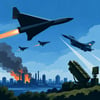
Ukraine’s mass-produced, inexpensive drones have imposed costs across multiple target types, while producers reportedly adapt systems rapidly to battlefield conditions. Defensive effectiveness remains threat-specific: interceptors credited against piston-engine Shaheds face a speed disadvantage against jet variants.

U.S. local counter-drone capacity is still being built
Eligible agencies have conducted about 60 federally supported operations since July, but accreditation remains a barrier to mitigation authority. Funding alone does not authorize agencies to disable drones.
Commercial delivery expansion faces local constraints
Amazon’s delivery expansion continues alongside local pushback and oversight. Expansion activity alone does not establish that a broader delivery network can sustain service or operate economically.


What's Changed?
FBI plans a larger counter-drone training effort
The FBI plans 10 classes for approximately 320 state, local, tribal and territorial officers, more than tripling training according to the report. This is a planned capacity increase, not evidence that agencies have already gained accreditation or operational authority.
Russia reports a very large Ukrainian drone attack
Russia claimed it intercepted 1,336 Ukrainian drones in an attack targeting areas including the Kerch Bridge and oil facilities. The report adds an episode to the previously identified strike campaign, but the claimed interception total and Ukraine’s assertion that more than 55% of Russian refining capacity was disabled do not establish the attack’s independent scale or sustained economic effect.


What Matters?
Defensive success against one drone type may not transfer
The reported effectiveness of inexpensive interceptors against piston-powered Shaheds does not resolve the challenge posed by faster jet variants. This sustains the prior assessment that drone economics depend on adaptation by both attackers and defenders, rather than on a fixed cost advantage.
Training and funding do not by themselves deliver mitigation authority
The FBI plan addresses a capacity constraint, but its effect depends on agencies completing accreditation and obtaining the applicable authority. Separately, one analysis of Part 124 says its stated privacy protections do not cover passive detection in the same way as authorized interception, making oversight a distinct implementation question.
What's Next?
Test faster interceptors against jet-powered threats
Watch for repeated operational intercepts and their cost, rather than isolated successes. Those results would clarify whether low-cost Ukrainian defenses can retain their advantage as target speeds rise.
Track whether training produces authorized local operations
Watch class completion, agency accreditation and the number of independently authorized operations. Progress would show whether the planned training expansion translates into usable local capacity.
Assess whether delivery expansion sustains service
The existing commercial watchpoint remains unresolved: evidence of sustained service across sites, local acceptance and viable economics would strengthen the case for network-wide scalability.