Bob Dylan Songs in Folk-RockBob Dylan Songs in Folk-RockCoverage from Far Out Magazine, MusicRadar, and others
00/00/0000
DailyWeekly
Bob Dylan’s “Mr.
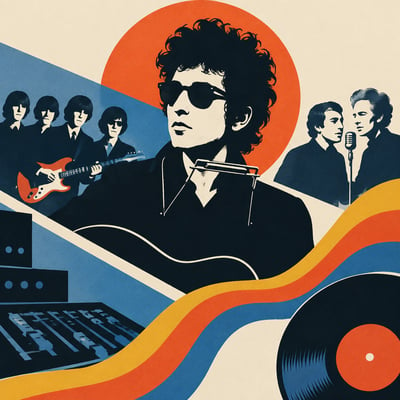
Tambourine Man” became a landmark of folk-rock through The Byrds’ 1965 electric cover. Roger McGuinn’s jangling 12-string guitar, a changed rhythmic feel, concise arrangement, and layered harmonies recast Dylan’s folk composition as a chart-topping pop recording. The song’s story also includes Dylan’s early recordings and performances, the musicians involved in its creation, and continuing discussion of its lyrics and inspiration. Together, these histories show how a songwriter’s work can take on new musical forms and cultural meanings through reinterpretation.
It broadens the coverage beyond the Byrds with Manfred Mann’s commercially successful reinterpretation of “The Mighty Quinn.”
Parade / Jacqueline Burt Cote
Key Issues
01
The Byrds’ cover as the canonical folk-rock crossover
The Byrds’ electric 1965 adaptation of “Mr. Tambourine Man” remains the central example of Dylan’s songwriting reaching a mass audience through folk rock. Its chart success and transformed arrangement are repeatedly described as a genre-defining breakthrough.
Stable
Drawn from 5 articles
02
Cover versions extend Dylan songs beyond their originals
Other performers have given Dylan compositions prominent lives beyond his own recordings through commercially successful reinterpretations. The Byrds’ “Mr. Tambourine Man” and Manfred Mann’s “The Mighty Quinn” are recurring examples of that wider circulation.
Stable
Drawn from 5 articles
03
Arrangement and performance reframe meaning
Instrumentation, delivery, and performance context shape how Dylan songs are heard. The Byrds’ electric rearrangement and accounts of later live versions illustrate how interpretation can alter a song’s perceived character and meaning.
Stable
Drawn from 5 articles
Looking Back
1524 Day Timeline
Articles published over time. Hover any bar for the period and its article count.
Sep '22
May '23
Feb '24
Oct '24
May '25
Feb '26
Oct '26
The Story So Far
No material change
The new retrospective revisits the song’s imagery and its connection to Bruce Langhorne, details already present in the current Topic state; it provides no evidence of a material underlying change.
Previously
Bob Dylan's Mr. Tambourine Man anchors a heavily retrospective body of work about The Byrds' 1965 electric adaptation, its chart success, and its reported influence on Dylan's turn toward electric instrumentation. Related material traces changing live arrangements, McGuinn's later collaborations with Dylan, and the wider circulation of Dylan songs through covers, film, and other performers.
History
10/27/2026
The update adds specific production attribution, identifying the Wrecking Crew as providing much of the Byrds’ instrumental backing. It also brings the song’s imagery into focus, noting that its meaning remains unsettled.
Bob Dylan and The Byrds influenced each other's music during the 1960s, while a planned Self Portrait session failed after Columbia Records communication problems.
9/1/2026 • Collaborations & Other Artists • Collaboration
Gene Clark described the Byrds' 1960s folk-rock songwriting process, including Dylan-based Mr. Tambourine Man, and explained the creation of Eight Miles High.
Bob Dylan's Mr. Tambourine Man helped define youthful cultural freedom in 1965, including through Paul McCartney's experience at London's Royal Albert Hall.
The Byrds released a folk-rock version of Bob Dylan's Mr. Tambourine Man in 1965 in the United States, reaching No. 1 and broadening the song's influence.
8/6/2026 • Collaborations & Other Artists • Cover Version
The Byrds' Mr. Tambourine Man single in April 1965 topped U.S. and U.K. charts, accelerating folk rock and coinciding with Dylan's 1965 electric shift.
In 1968, Manfred Mann turned Bob Dylan's 1967 Basement Tapes song The Mighty Quinn into a chart-topping single in the United Kingdom and a U.S. Top 10 hit.
The article analyzes Bob Dylan's Mr. Tambourine Man and Chimes of Freedom through recordings from the 1964 Newport Folk Festival to a 2010 performance.
Bob Dylan recorded Mr. Tambourine Man at Columbia Records studios in New York in June 1964; The Byrds later adapted the original recording into a 1965 US and UK No. 1.
In 1964, Bob Dylan wrote and recorded Mr. Tambourine Man after traveling through New Orleans and visiting Eric Von Schmidt in Sarasota, and the Byrds later made it a number-one hit.
During the mid-1960s recording of The Byrds' Mr. Tambourine Man in a studio, Bob Dylan heard Roger McGuinn's 4/4 folk-rock arrangement and praised its danceable rhythm.
10/23/2026 • Collaborations & Other Artists • Cover Version
As a Maryland teenager in the 1960s, David Byrne heard the Byrds' recording of Bob Dylan's Mr. Tambourine Man, a song that helped inspire his artistic path to New York.
10/4/2026 • Collaborations & Other Artists • Cover Version
Roger McGuinn, born July 13, 1942, helped popularize the Byrds' electric Mr. Tambourine Man and later collaborated with Bob Dylan on Pat Garrett and the Rolling Thunder Revue.
Roger McGuinn's arrangement work on The Byrds' cover of Bob Dylan's Mr Tambourine Man is linked to Dylan's turn to electric performance and later reunion discussions.
Roger McGuinn helped the Byrds reach Hot 100 No. 1 on June 26, 1965 with Mr. Tambourine Man, a Dylan song that supported a later Dylan shift toward electric guitar.
In an October 2026 Guitar Player interview, Roger McGuinn described how the Byrds recorded Bob Dylan's Mr. Tambourine Man in 1965 with Los Angeles session musicians.
Paul McCartney discussed Bob Dylan's Mr. Tambourine Man during a BBC Tracks Of My Years appearance, recalling the 1965 song and wishing Dylan performed it live.
8/20/2026 • Songs & Songwriting • Artist Commentary
David Crosby recalled that The Byrds recorded Dylan’s unreleased Mr Tambourine Man in 1965, a number-one debut that helped define the folk-rock direction before Dylan’s own full shift.
In 1965, producer Tom Wilson secretly overdubbed The Sounds of Silence with session musicians including Dylan drummer Bobby Gregg, leading to a 1966 Billboard No. 1.

 AI Governance
 Data Centers
 Drones
 Climate
 Privacy
 Bob Dylan