Last Update: 08/01/2026 at 1:00 PM EST

World Cup Surveillance Raises Privacy Risks

Coverage from Nytimes, Fast Company, and others

Articles

6

Active Days

78

The Topic

World Cup Surveillance Raises Privacy Risks topic image

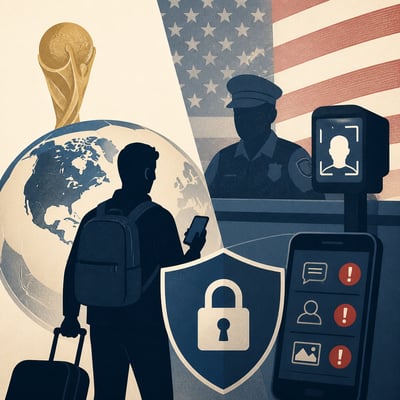
Civil rights organizations and privacy advocates are warning that visitors to the 2026 FIFA World Cup in the United States could face heightened surveillance, electronic screening, device searches, profiling, detention, or deportation. At the same time, more than $1 billion in reported security investment is supporting expanded monitoring around stadiums, transit hubs, and host cities, including facial recognition, drones, CCTV, and AI-assisted analytics. The central concern is that systems introduced for tournament security may collect sensitive data with limited transparency over access, retention, sharing, or post-event use.

First Article: 04/23/26

Latest Article: 07/09/26

Summary

  • More than 120 civil society organizations and soccer fan groups issued travel guidance warning visitors about detention, deportation, profiling, electronic screening, and other risks.
  • Reported U.S. World Cup security spending exceeds $1 billion and supports monitoring around stadiums, transit hubs, and surrounding areas.
  • The described surveillance environment includes facial recognition, expanded CCTV, AI video analytics, law-enforcement drones, data-fusion systems, and camera-equipped robotic platforms.
  • Advisories recommend removing sensitive information from devices, disabling biometric unlock features, and sharing itineraries with trusted contacts.
  • Immigration enforcement, travel restrictions, social-media screening, and policies affecting transgender and nonbinary travelers are presented as additional entry and safety concerns.
  • FIFA and U.S. officials reject the warnings and point to human-rights frameworks and preparations for a safe tournament.
  • A persistent unresolved issue is whether surveillance capabilities, collected data, and public-private partnerships will remain after the World Cup.

History

07/23/2026

The story is largely unchanged, but the framing has sharpened around surveillance data governance: the current version more explicitly centers concerns about transparency, access, retention, sharing, and post-event use of collected data. It also slightly broadens the security description with additional monitoring technologies and host-city scope.

07/23/2026

The story has become more concrete and broader: it now centers on a coordinated wave of travel guidance from rights groups, paired with more detailed security spending and surveillance deployment across U.S. host cities. The biggest unresolved issue is now the post-tournament governance and persistence of those systems and data.

Full History

Featured

Timeline: 78 Days

Apr 23May 7May 21Jun 11Jun 25Jul 9

Additional Articles

⭐⭐⭐⭐⭐

Techdirt / Anne Toomey McKenna07-09-2026
AI facial recognition, drones, and CCTV analytics are expected to expand surveillance around 2026 World Cup host cities, with privacy and profiling risks and limited oversight.
Techdirt / Anne Toomey McKenna07-09-2026
In the United States, World Cup security spending expanding facial recognition, drone monitoring, and AI CCTV raises privacy governance concerns amid limited oversight.

⭐⭐⭐

ABC7 News04-25-2026
Civil rights organizations issued a 2026 FIFA World Cup travel advisory for U.S. matches in mid-June, warning about immigration detention and invasive screening risks.