
 AI Governance
 Data Centers
 Drones
 Climate
 Privacy
 2026 Maine Senate
 Bob Dylan
Apple’s Glasses Bet Meets Consent
Coverage from TechTarget, Eweek, and others
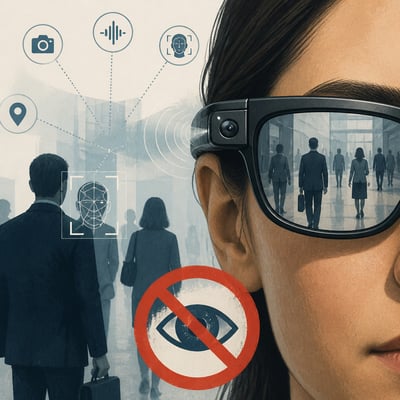
Apple is reportedly delaying its first smart glasses while refining how cameras, AI processing, recording controls, and captured data will be handled.
Proposed safeguards include on-device processing, visible recording indicators, limits on storing or using footage for AI training, and avoiding facial recognition. The approach reflects wider concerns about unnoticed recording, biometric collection, human review of footage, and restrictions on camera-equipped eyewear in sensitive public settings.
If you read one thing
It provides the clearest broad introduction to Apple’s privacy-by-design challenge as it enters the smart-glasses market.
Best explainer
It explains how ambient capture and cognitive inference can undermine consent beyond the wearer’s intended use.
The counter-case
It presents the contested case that local processing and design controls may still fail to protect bystanders from recording and surveillance.
The evidence
It shows how smart-glasses data can create concrete enterprise, healthcare, cloud-transmission, and AI-training risks after capture.
The local angle
It grounds the broader privacy debate in emerging US laws and venue restrictions addressing camera-equipped eyewear.
Apple is trading speed for privacy-by-design
Apple's reported smart-glasses launch remains aimed at 2027 while the company refines on-device processing, constrained sensing, recording indicators, and limits on facial recognition, video capture, and AI-training use of captured footage. Camera-less or less capable configurations remain under consideration.
Ambient capture still outpaces practical consent
Camera- and microphone-equipped glasses can capture bystanders and conversations without clear awareness, while recording indicators may be overlooked or bypassed. Consent, notice, and public trust therefore remain persistent barriers to routine use.
Downstream data exposure remains a core weakness
After capture, smart-glasses data may be transmitted to third-party clouds, retained in voice or image systems, used for AI training, or exposed to human reviewers. Sensitive workplace, healthcare, financial, and personal content therefore remains vulnerable even when recording is visible.
Governance is fragmented across laws and venues
Existing privacy rules leave gaps around bystander-generated audiovisual and biometric data, while responses are emerging piecemeal through proposed recording-indicator laws, courthouse bans, and workplace or healthcare restrictions. Protection and deployment rules therefore vary by setting rather than forming a uniform standard.
Contested Issue
Can visible recording indicators and related device controls provide sufficient protection for bystander consent?
Some reporting presents recording indicators, constrained sensing, and privacy-by-design controls as measures intended to reduce covert recording and improve social acceptability. Other evidence says indicators can be missed, misunderstood, removed, or bypassed, and that at least one court system found them insufficient for camera-equipped eyewear.
Controls can mitigate covert recording
Visible recording indicators combined with restricted recording, on-device processing, and limits on downstream data use can reduce privacy exposure and support consent.
Indicators are insufficient
Recording lights and similar visible cues do not reliably establish consent because bystanders may not notice or understand them, and users or researchers may bypass or disable them.
The new article raises biometric privacy concerns about a proposed Apple smart home display, but does not materially change the topic’s focus on smart-glasses privacy, recording safeguards, and consent.
Previously
Apple is reportedly delaying its first smart glasses while refining how cameras, AI processing, recording controls, and captured data will be handled. Proposed safeguards include on-device processing, visible recording indicators, limits on storing or using footage for AI training, and avoiding facial recognition. The approach reflects wider concerns about unnoticed recording, biometric collection, human review of footage, and restrictions on camera-equipped eyewear in sensitive public settings.
The story adds more concrete detail about Apple’s privacy architecture, including potentially keeping routine camera data off Apple’s servers and avoiding storage. It also indicates that venue restrictions have moved from emerging concerns to implemented 2026 rules, while the broader narrative remains largely confirmatory.
The main change is a sharper privacy-specific redesign story for Apple’s smart glasses: the project is now framed as being delayed while Apple tests additional safeguards, including more restrictive camera and data-use controls. The current version also adds a clearer operational constraint, with courts and sensitive venues increasingly restricting eyewear use.