AI Surveillance Expands Across…AI Surveillance Expands Across InstitutionsCoverage from C4ADS, CA Privacy Watch, and others
00/00/0000
DailyWeekly
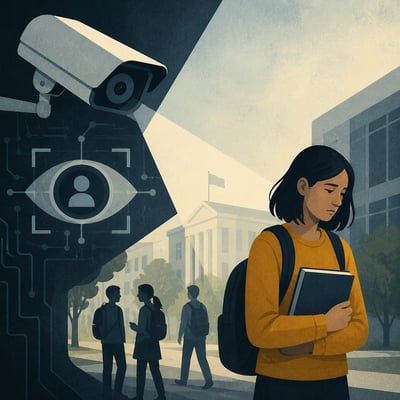
AI surveillance is expanding across educational institutions, campuses, workplaces, public spaces, and event security operations.
Systems can analyze faces, movement, behavior, online activity, and other signals to support security or educational functions, while also creating detailed profiles that may affect people without clear notice or meaningful control. The central privacy questions concern data accuracy, retention, vendor and government access, secondary use, and whether temporary or limited deployments become persistent infrastructure.
Looking Back
169 Day Timeline
Articles published over time. Hover any bar for the period and its article count.
Feb 13
Mar 13
Apr 10
May 8
Jun 5
Jul 3
Jul 31
History
08/05/2026
The story now places more emphasis on how AI surveillance can combine data, generate inferred traits or risk scores, and extend its use beyond the original purpose. It also adds a clearer governance concern around vendor and government access, later analytics, and model training.
08/04/2026
The story now includes a concrete new implementation example: MIT’s large-scale camera rollout with defined retention, alongside a paused school robot-teacher pilot in New York. It also broadens from education/workplace surveillance to more explicit public-space and social-media monitoring, sharpening the privacy concerns around inferred data and contesting AI-generated conclusions.

 AI Governance
 Data Centers
 Drones
 Climate
 Privacy
 2026 Maine Senate
 Bob Dylan