Last Update: 08/01/2026 at 1:00 PM EST

DHS Expands ICE Biometric Surveillance

Coverage from Futurism, Houston Public Media, and others

Articles

67

Active Days

182

The Topic

DHS Expands ICE Biometric Surveillance topic image

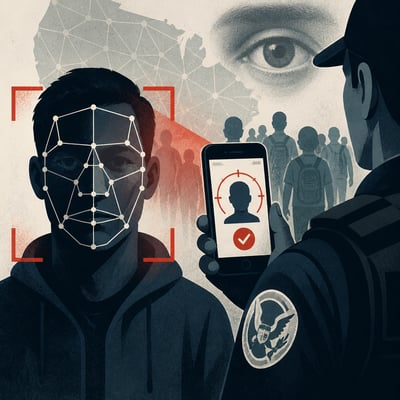
The Department of Homeland Security and Immigration and Customs Enforcement are expanding the use of facial recognition, iris scanning, mobile biometric applications, and potentially wearable devices for immigration enforcement. These systems can compare people encountered in the field against large government databases and may be extended to local police participating in ICE task forces. The developments matter because they broaden biometric collection beyond identified immigration targets, create long-term records that may include citizens and protesters, and raise questions about accuracy, retention, legal safeguards, and oversight.

First Article: 01/28/26

Latest Article: 07/28/26

Summary

  • DHS is funding or planning expanded biometric capabilities for ICE, including facial recognition, iris scanning, and wearable field devices.
  • The ICE Task Force Module would allow participating local police to scan people they stop and compare images against more than 250 million government records.
  • Mobile Fortify already supports field identification through facial images and contactless fingerprints matched against federal and state databases.
  • DHS has requested more than 1,500 iris scanners and a $25 million no-bid contract with BI2 Technologies for iris-recognition systems.
  • Captured images from the ICE Task Force Module are reportedly retained in an internal DHS system for 15 years.
  • Privacy and civil-liberties experts warn that false matches, dragnet scanning, and inclusion of U.S. citizens could chill protest and other public activity.
  • Commercial location-data markets provide a related pathway through which government agencies can obtain sensitive movement information outside traditional communications-company warrant processes.

History

07/23/2026

The story now adds concrete scale and procurement details: ICE’s field biometric program is no longer just broadly expanding, but is tied to a large-volume face database, a major iris-scanner purchase, and a specific BI2 Technologies contract. It also more clearly frames the local-police task-force access and commercial location-data angle as operationally relevant parts of the same enforcement ecosystem.

07/22/2026

The story has shifted from a broad account of immigration-enforcement surveillance to a more concrete account of DHS rolling out specific biometric field tools, including local-police access, long retention periods, and proposed wearable identification tech. The new emphasis is on direct operational deployment and the risk that bystanders and citizens will be scanned and retained in government systems.

Full History

Featured

Timeline: 182 Days

Jan 28Feb 25Apr 8May 6Jun 17Jul 15

Additional Articles

⭐⭐⭐⭐⭐⭐⭐⭐

WSJ / Shane Shifflett05-01-2026
DHS and ICE expand domestic surveillance for immigration enforcement using data-linking apps, biometrics, and phone and messaging exploitation amid federal legal challenges.
CNN / Clare Duffy02-24-2026
Recent reporting shows DHS authorities deploying Mobile Fortify facial recognition in field operations by ICE and CBP, raising privacy concerns and prompting calls for transparency.

⭐⭐⭐⭐⭐

NPR / Meg Anderson05-27-2026
DHS awarded BI2 Technologies a $25 million no-bid contract to expand iris scanning for immigration enforcement and identity verification, prompting privacy concerns about stored biometric databases.
NPR / Meg Anderson06-19-2026
DHS disclosed a Privacy Threshold Analysis for the ICE Task Force Module, enabling local police facial scans against 250M records with 15-year photo retention.
Fortune / Catherina Gioino05-12-2026
DHS requested $7.5 million to develop smart glasses for ICE real-time biometric identification, while the ICE Out of Our Faces Act would ban ICE and CBP facial recognition.
The Conversation04-21-2026
U.S. federal agencies increase AI-enabled surveillance by buying data from brokers and expanding direct collection through technology partnerships.
Naturalnews05-12-2026
ICE and CBP use Mobile Fortify and Penlink for biometric and geofence tracking, according to privacy research and reporting amid concerns about mission creep and oversight.
Kosu / Jude Joffe-Block06-10-2026
In Portland, Maine, NPR reviewed ICE and DHS documents indicating collection of biographic and biometric data about protesters and observers during immigration-related enforcement actions.
Representative Delia Ramirez07-15-2026
Ramirez and Johnson led a congressional hearing on ICE technology for mass surveillance, citing Palantir contracts and DHS biometric data systems and calling for safeguards and funding limits.
Gadget Review / Alex Barrientos04-16-2026
Since 2012, Seguritech expanded Plataforma Centinela surveillance in Mexico and, after an April 2022 Texas-Chihuahua memorandum, enabled Texas access to Centinela vehicle-tracking data and intelligence sharing.
Know Your Rights05-20-2026
DHS is scheduled to receive $7.5 million in fiscal year 2027 funding to develop AI smart glasses for real-time biometric identification, with critics warning of broader surveillance implications in the USA.
Techdirt / Tim Cushing07-28-2026
A 404 Media leak describes DHS ICE and CBP access to brokered cell-location data, Clearview AI facial recognition, and license-plate and geolocation tracking tools.
WYSO06-10-2026
NPR reported that ICE acting director Todd Lyons signaled collection and retention of biographic and biometric information on protesters and observers in the U.S., despite denials of a protest database.
Webpronews / Emma Rogers05-03-2026
DHS surveillance systems using Palantir ELITE and facial recognition tools have expanded immigration enforcement as Congress seeks details on data integrations and safeguards.
KPBS / Jude Joffe-Block06-10-2026
DHS officials and an April 21 ICE letter described retention of biographic and biometric identifiers collected during protest and observer encounters in the 2020s.
Raw Story05-13-2026
ICE awarded Edge Ops a $12.2 million no-bid contract for Project SAFE HAVEN to track immigrants' routines and real-time locations, amid allegations of vendor website fabrications reported by The Lever.
Jacobin / Katya Schwenk04-15-2026
ICE awarded Edge Ops LLC a $12.2 million contract in 2020s procurement for Project SAFE HAVEN, an AI tool using passive location data to profile immigration targets.
Newsmax / Solange Reyner06-15-2026
The Secret Service tests the Sentry smartphone biometric app for threat identification, using AI face and fingerprint matching, amid concerns raised over privacy and consent practices.
WIRED / Maddy Varner07-22-2026
DOJ sued five states and Philadelphia during the Trump administration over ICE officer identification laws, citing facial-recognition and doxing risks tied to ICESpy.
Wyoming Public Media / Meg Anderson06-19-2026
DHS Privacy Threshold Analysis describes ICE Task Force Module facial recognition for local police immigration enforcement using federal identity databases and 15-year storage.
Newstarget05-12-2026
ICE used biometric and geofencing tools, including Mobile Fortify and Penlink, in immigration enforcement while drawing criticism under Fourth Amendment precedents.
Fast Company04-23-2026
The federal government expands AI surveillance investment while oversight decreases as data from everyday devices is brokered and analyzed for predictive inferences in the USA.
Truthout / Shireen Akram-Boshar05-21-2026
ICE agents used DHS Mobile Fortify facial recognition during warrantless detentions of farm workers in Oregon, with court testimony and ACLU warnings highlighting false-match privacy risks in 2025.
MRT.com / Anne Toomey McKenna04-22-2026
Homeland Security, ICE, and the FBI are described as expanding AI-driven surveillance in the USA using brokered data and contractor tools.
Filter / Tana Ganeva05-11-2026
In May, a Trump administration National Drug Control Strategy proposes AI and medical-record scanning for overdose and trafficking enforcement, drawing privacy and discrimination criticism.
Startup Fortune / Elroy Fernandes04-22-2026
US intelligence agencies in 2025 formalize AI-enabled purchases of commercial data broker records, enabling warrant-bypassing access for behavioral profiling.
Startup Fortune / Judith Murphy04-28-2026
Federal AI surveillance funding, DHS biometric expansions, and FBI data broker purchases in the USA raise privacy oversight concerns as enforcement frameworks lag.
Alternet / Thom Hartmann07-09-2026
ICE expands interior immigration checkpoints and surveillance technology across U.S. cities, using profiling and location-tracking tools to demand identity proof away from borders.
Reason05-06-2026
Georgetown Law Center research and reported contracts describe how ICE surveillance tools used for immigration enforcement expanded into identification and location tracking of Americans and protesters.
Resistbot05-28-2026
Advocacy leaders called for ICE to cancel the Edge Ops LLC Project SAFE HAVEN contract in the United States after reports of AI patterns of life surveillance.
The Fulcrum07-10-2026
DHS and ICE plans to expand the Task Force Module facial-recognition system to about 1,300 local police agencies, with 15-year federal photo retention.
Good Men Project05-10-2026
During immigration protests in Minneapolis and other U.S. cities, federal immigration enforcement and related vendors reportedly used biometric and license plate reader surveillance, raising Fourth Amendment and data-broker concerns.
Just Security / Faiza Patel07-21-2026
In May 2026, the Pentagon pursued AI deployments on classified networks while courts and policy debates continued over warrants for purchased location and communications data.
Salon.com / Anne Toomey McKenna04-23-2026
DHS and FBI reportedly use AI plus commercial data broker purchases to expand surveillance, including airport biometrics and geospatial 911 analysis.
Sahan Journal / Shubhanjana Das01-28-2026
In Minnesota, ICE and CBP are using facial recognition, mobile tracking tools, and commercial data broker records to conduct expansive, largely warrantless immigration surveillance across communities.
Armstrong Economics / Martin Armstrong07-27-2026
Forbes reports Cognyte sold FalcoNet cellular interception systems to Texas law enforcement, enabling device identification and location tracking.
AInvest / Clyde Morgan03-31-2026
ICE 2025 budget spending of $28.7 billion funds Palantir ImmigrationOS, Clearview AI facial recognition, and BI2 iris-scanning tools amid privacy lawsuit risk.
L.A. TACO04-30-2026
Daily Memo reports more than 80,000 Flock cameras and new Los Angeles and Anaheim surveillance tools in California are sharing vehicle data used for ICE targeting.
Armstrongeconomics05-06-2026
DHS used a Tariff Act of 1930 customs summons in a cross-border case seeking Google location and account records tied to a Canadian ICE critic.

⭐⭐⭐

L.A. TACO05-19-2026
ICE hunger strikes begin May 18 at Adelanto and are planned for Desert View Annex in California amid reports of Palantir-linked AI targeting.
The Lever / Katya Schwenk05-21-2026
House Homeland Security Committee leaders sent an information request to ICE about a $12 million Edge Ops LLC contract for Project SAFE HAVEN location tracking.
Yahoo / Josh Ackley07-13-2026
ICE shootings in Maine and Houston are discussed alongside immigration database expansion using facial recognition, location data, and commercial data broker sources.
Yahoo07-27-2026
In Minneapolis during federal immigration enforcement in 2017-2018, residents coordinated monitoring using Signal after reports of surveillance, masked detentions, and ICE shootings.
Futurism / Joe Wilkins04-29-2026
Courts in multiple US states are allowing police to access Flock Safety AI license plate reader searches without warrants amid limited privacy regulation.
Advocate / Josh Ackley07-13-2026
Josh Ackley argues that ICE shootings in Maine and Houston reflect broader growth in facial recognition, biometric records, and inter-agency data sharing in immigration enforcement.
Center for Democracy & Technology07-24-2026
An explainer assesses how the Trump Administration increases beyond-targeted sharing toward government data consolidation, raising personal privacy, surveillance, and cybersecurity risks.
Top Documentary Films / Adam Sean07-28-2026
Laura Poitras filmed Hong Kong meetings with Edward Snowden in June 2013, revealing NSA mass surveillance programs and triggering Espionage Act charges and asylum in Russia.
Imba Missouri Insights / Ava Sinclair06-20-2026
US surveillance reporting highlights national security statutes, FISA Section 702 collection practices, and international cooperation under Five Eyes amid concerns over privacy and civil liberties.
Parriva07-16-2026
Privacy advocates and courts debate how Fourth Amendment limits and federal privacy statutes apply to ICE biometric and data broker-based surveillance.
Alternet / Thom Hartmann07-09-2026
A U.S.-focused analysis argues ICE checkpoint operations within a 100-mile border band use biometric and location-based surveillance while weakening Fourth Amendment protections.
Raw Story / Thom Hartmann07-08-2026
ICE interior immigration checkpoints expand stops and identity demands within a U.S. hundred-mile zone while related surveillance technologies collect location data.
Randall Travel Award Missouri Insights / Ethan Brooks07-04-2026
Surveillance examples from physical infiltration to PRISM, facial recognition, and Stingrays highlight contested privacy and civil-liberties tradeoffs under evolving legal standards.
Slate07-27-2026
Minneapolis residents organized against Operation Metro Surge after alleged ICE and DHS surveillance and shootings, coordinating with encrypted Signal alerts.
CounterPunch06-26-2026
After September 11, 2001, US emergency policies expanded surveillance through the USA PATRIOT Act, fusion centers, and facial recognition, weakening privacy safeguards.
CounterPunch06-26-2026
The piece argues that the USA PATRIOT Act and post-9/11 emergency authorities expanded surveillance and weakened privacy safeguards in the USA.
The Hill / Lindsey Granger06-11-2026
President Trump signed a $70 billion immigration enforcement funding bill, while privacy concerns focus on ICE body cameras, facial recognition use near New Jersey detention facilities, and potential protester data collection.
Thegrio / Gerren Keith Gaynor04-09-2026
ICE acting director Todd Lyons confirmed Graphite spyware and biometric tools are used by HSI inside the United States, prompting congressional civil liberties concerns.
Free Press03-25-2026
ICE deployed 100 to 150 agents at U.S. airports during prolonged TSA wait times, while Border Patrol location-data purchases and FISA Section 702 reauthorization concerns raised privacy risks.
RochesterFirst04-06-2026
DHS plans to hire contractors for AI-assisted skip tracing to support ICE arrests, a process criticized for opaque data sources and disputed accuracy safeguards.
Alternet / Thom Hartmann07-03-2026
Immigration enforcement expansion in the US couples interior checkpoints with identity and location surveillance technologies, supported by federal funding and supported by recent court interpretations.
Smirking Chimp / Robert Reich07-08-2026
ICE increased raids and arrests in multiple U.S. cities while using facial recognition technology to scan thousands of immigrants and protesters, raising warrantless-search and database concerns.
Tillamook County Pioneer07-04-2026
The United States expanded post-9/11 surveillance and counterterrorism authorities, raising ongoing privacy and oversight concerns as AI and biometric identification advance.

⭐️⭐️

VisaHQ04-26-2026
DHS-led federal agencies are contracting for AI surveillance tools, including airport facial recognition and CBP biometric scanners, expanding intrusive identity checks at U.S. ports of entry.
American Civil Liberties Union / Mike Zamore02-24-2026
ACLU and lawmakers scrutinize immigration enforcement privacy practices in 2025-2026 across Minnesota and Wilder Idaho.