

Last Update: 06/03/2026 at 4:01 AM EST
AI Governance Turns Toward State Action
Coverage from NBC News, Washington Post, and others
Articles
45
Latest Article
06/02
Active Days
16
Executive Summary
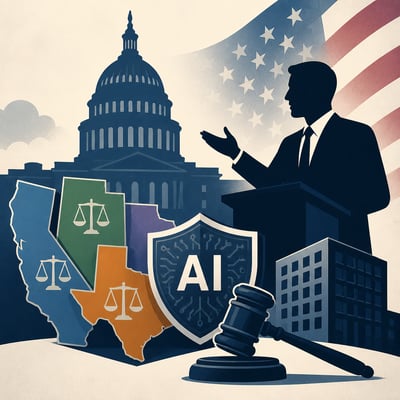
AI governance is shifting from broad debate to concrete rulemaking, with US states, federal agencies, and allied governments advancing safety, audit, disclosure, and liability frameworks. Industry lobbying, especially by major AI companies and trade groups, is shaping the details of those rules.
Key Points
- State-level AI bills are now the most active policy arena, especially in Illinois, New York, New Jersey, California, and Texas.
- Frontier AI oversight is converging on audits, incident reporting, transparency reports, whistleblower protections, and safety protocols.
- Industry influence is a major counterforce, with OpenAI, Anthropic, and TechNet pushing to shape bill language and avoid broad liability exposure.
- Federal action is moving too, but mostly through executive guidance, procurement rules, agency oversight, and possible model licensing rather than a single statute.
- Privacy, youth safety, deepfakes, and discrimination remain the most consistent issue areas linking AI governance to existing legal regimes.
- Internationally, governance is also tied to export controls, interoperable standards, and alliance-based coordination rather than purely national regulation.
- The overall signal is coherent and moderately dense, with a strong current focus on implementation details rather than abstract principles.
Featured Article
Illinois proposes safety frameworks, annual audits, and incident reporting for frontier AI as U.S. policymakers consider federal AI model licensing.
Coverage Timeline: 16 Days
Hover over any logo to see coverage summary, click for full article.
Additional Articles
⭐⭐⭐⭐⭐
Illinois lawmakers advanced a bill requiring independent third-party safety audits, catastrophic risk disclosures, and 72-hour critical incident reporting for large frontier AI developers.
Executive Order 14365 drives US efforts to review and potentially preempt state AI rules while Congress considers modular bills amid continued state legislation and evolving enforcement.
Pope Leo XIV, alongside Anthropic leaders, supports international AI governance based on FATF-style norms because internal company controls do not address collective-action incentives.
OpenAI supported Illinois SB3444 in April, while Anthropic opposed the bill’s threshold-based safe harbor for frontier AI developer liability.
Illinois lawmakers approved legislation requiring independent third-party audits, risk disclosures, and 72-hour reporting of critical safety incidents for large frontier AI developers.
Illinois lawmakers passed SB 315 in 2026 to require frontier AI firms to publish safety plans, undergo independent testing, and report critical incidents to the state.
Connecticut Governor Ned Lamont signed SB 5 on May 27, 2026, creating phased AI transparency and responsibility requirements enforced by the attorney general.
Multiple U.S. states and Congress introduced 21 new AI bills in late May 2026, alongside newly signed laws on automated decision-making, education, healthcare, and government AI use.
UN ODET launched the AI Governance for Humanity Lab in Valencia, Spain, to produce interoperability-focused AI governance outputs for the 2026 Global Dialogue in Geneva.
Defense Department Directive 3000.09 is evaluated against international humanitarian law requirements for human judgment in autonomous weapons governance.
Regulatory comparisons across the EU, Argentina, and the U.S. assess AI policing authorization controls and fragmented deepfakes governance.
UN-led AI governance bodies are proposed for Geneva in July 2026, combining multistakeholder internet-governance ideas with stronger risk-based rules for autonomous AI.
Countries and the United Nations pursue interoperable AI governance mechanisms as misdiagnosis and asylum decision risks highlight accountability gaps across borders.
UN member states will convene a Global Dialogue on AI Governance in Geneva in July, aiming to improve coordinated multilateral oversight and reduce fragmentation.
Illinois lawmakers advanced SB 315 in the 2020s, requiring independent third party safety audits for frontier AI labs before the governor’s expected signature.
Regulators and legislators at US privacy and security events emphasize sensitive data and children's AI risks while coordinated state enforcement expands and federal preemption remains unlikely.
Illinois passed legislation in the 2020s requiring annual independent third-party audits for large frontier AI developers, with catastrophic-risk disclosures and 72-hour critical safety incident reporting.
Michael Kratsios announced details of a US American AI Export Program at the 2026 India AI Impact Summit, emphasizing allied governance, data interoperability, and AI safety baselines.
In the United States, OMB memoranda, GSA frontier-model procurement, and the 2026 Department of Defense AI Acceleration Strategy are accelerating federal AI adoption despite fragmented governance.
TechNet lobbyists opposed New Yorks AI Act and other state measures, while supporting federal deepfake and consumer-safety proposals and arguing for national AI standards.
OpenAI lobbyist Chris Lehane outlines reverse federalism targeting state legislatures and governors in California, New York, and Illinois after stalled federal AI talks.
Illinois Senate Bill 315 would require frontier AI developers to complete annual independent safety audits and disclose catastrophic risk capabilities, after passage in the state Senate.
Researchers from major universities analyzed 2023 to 2025 AI policy coverage and reported 27 corporate capture patterns around EU AI Act negotiations, UK, South Korea, and France.
⭐⭐⭐
J. D. Vance warned Air Force cadets in Colorado Springs that humans must retain decision authority in AI-enabled warfare while White House cybersecurity testing plans remained in flux after Anthropic model vulnerability disclosures.
Americans for Responsible Innovation launched a six-figure ad campaign in Illinois in 2020s-era AI legislation talks involving Rep. Lori Trahan and Rep. Jay Obernolte amid SB 315 auditing and transparency mandates.
Mapping AI tracks roughly 1,800 US AI policy stakeholders, governance stances, and ecosystem connections after a proposed pre-release AI model review executive order was scrapped.
Illinois Governor JB Pritzker urged AI safeguards and support for Senate Bill 315 as Illinois advances state AI oversight and accountability measures.
New York candidates Alex Bores and Jack Schlossberg dispute RAISE Act AI guardrails and related automated decision-making and health-data bills in a 2020s campaign.
Beacon Research and Shaw & Company Research polled 1,002 U.S. registered voters in May 2026 on AI regulation urgency and public-interest priorities.
Pope Leo XIV, alongside Anthropic leaders, calls for disarmament and regulation of AI through global governance with independent assessment and consequences.
Amandeep Gill and the UN Office for Digital and Emerging Technologies launched the AI Governance for Humanity Lab in Valencia, Spain, alongside Valencia Dialogues.
White House and US political leaders debate a uniform national AI governance framework as state officials oppose preemption and model vetting proposals.
JD Vance urged human judgment in warfare at the U.S. Air Force Academy in Colorado Springs while the Trump administration debated frontier AI cybersecurity testing and military guardrails.
JD Vance told Air Force cadets in Colorado Springs that humans must control AI-enabled warfare, while a proposed Trump cybersecurity testing executive order was not signed after Anthropic disclosures.
JD Vance told Air Force Academy cadets in Colorado Springs to keep human control in future AI-enabled warfare as White House model testing and cybersecurity oversight plans continued.
A UN-centered approach is proposed for coordinating fragmented international AI governance and adopting stronger risk-based rules for autonomous high-risk uses.
HaystackID targets DSAR processing, privacy discovery, and cross-border evidence authenticity to help European enterprises comply with GDPR, NIS2, DORA, and the EU AI Act.
Colorado and Connecticut enacted 2026 AI acts on ADMT transparency, consent, AI companions safety requirements, and generative AI provenance, with phased effective dates through 2028.
Congress is urged to strengthen NIST and CISA and establish AI-ISAC to counter AI-enabled cyber threats and foreign model IP theft.
JD Vance addressed Air Force cadets in Colorado Springs on AI in warfare and described cybersecurity-driven oversight plans after Anthropic's Mythos Preview findings.
JD Vance told Air Force Academy cadets in Colorado Springs to keep humans in charge of warfare while White House AI oversight shifted toward cybersecurity evaluation after Anthropic model vulnerabilities.
Polymarket bettors assign 13 percent odds that Congress will sign a federal AI safety bill by December 31, 2026, while New York and Illinois move faster on AI laws.
JD Vance urged Air Force cadets in Colorado Springs to keep human control over AI in warfare during policy tensions after Anthropic Mythos Preview cybersecurity findings.
Beacon Research and Shaw & Company Research polled 1,002 voters in May 2026, finding strong support for US AI regulation and near-equal views on international coordination.