U.S. AI Regulation Fragments Across…U.S. AI Regulation Fragments Across StatesCoverage from Orange County Register, NBC New York, and others
00/00/0000
DailyWeekly
U.
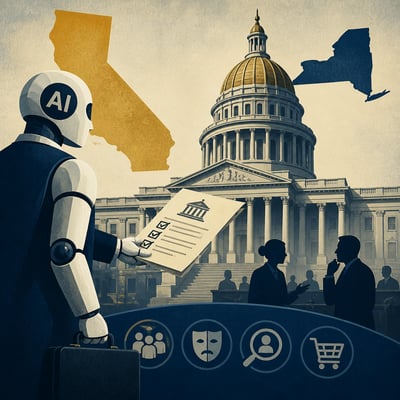
S. AI governance is advancing through state-level bills and targeted safeguards for transparency, child safety, employment, healthcare, and incident reporting. California and New York provide the clearest examples, while divergent industry lobbying and limited federal action leave the national framework fragmented.
Looking Back
71 Day Timeline
Articles published over time. Hover any bar for the period and its article count.
May 19
May 31
Jun 12
Jun 24
Jul 4
Jul 16
Jul 28
History
09/11/2026
The story broadens beyond state safeguards as proposed federal incident-reporting and cloud-security measures emerge, while EU implementation changes add an international reference point. State activity remains the dominant U.S. regulatory channel.
07/23/2026
The story now includes a clearer political dimension: AI regulation is affecting congressional campaigning and bipartisan activity among younger state lawmakers, not just policy and industry lobbying. The core picture of fragmented state action remains largely unchanged.
California lawmakers advance AI measures on generative content disclosure, chatbot self-harm response, and AI content labeling, with liability and oversight issues as session closes.
7/28/2026 • Legislation & Regulatory Policy • General
TechNet lobbyists opposed New Yorks AI Act and other state measures, while supporting federal deepfake and consumer-safety proposals and arguing for national AI standards.
5/19/2026 • Legislation & Regulatory Policy • General
Young state lawmakers from multiple US states met at Future Caucus in Washington to discuss AI regulation and children online safety, including proposed mental-health framework requirements.
7/10/2026 • Legislation & Regulatory Policy • General
US lawmakers and 2028 candidates increased emphasis on AI regulation in Washington, D.C., with proposals centered on AI safety oversight and child chatbot protections.
7/28/2026 • Legislation & Regulatory Policy • General
Anthropic increases state lobbying for stricter AI regulations, with Cesar Fernandez citing New York, Illinois, and Massachusetts bill language amid ongoing federal legislative gridlock.
7/15/2026 • Legislation & Regulatory Policy • General
Nathaniel Moran introduced the AI Incident Reporting Act to require developers to report critical AI incidents to the U.S. Commerce Department within seven days, amid related U.S.-EU AI governance changes.
6/26/2026 • Legislation & Regulatory Policy • General
New York candidates Alex Bores and Jack Schlossberg dispute RAISE Act AI guardrails and related automated decision-making and health-data bills in a 2020s campaign.
6/1/2026 • Legislation & Regulatory Policy • General
Executives including Dario Amodei, Sam Altman, and Marc Benioff cite emerging AI guardrails as California SB 53 and NYC Local Law 144 advance transparency and bias-audit requirements.
6/4/2026 • Legislation & Regulatory Policy • General
Apple filed a U.S. lawsuit against OpenAI on alleged trade-secret theft and breach of contract involving former Apple employees working on OpenAI hardware.
7/13/2026 • Legislation & Regulatory Policy • General

 AI Governance
 Data Centers
 Drones
 Climate
 Privacy
 2026 Maine Senate
 Bob Dylan