
 AI Governance
 Data Centers
 Drones
 Climate
 Privacy
 2026 Maine Senate
 Bob Dylan
Congress Tests Federal AI Preemption
Coverage from Gizmodo, AI Weekly, and others
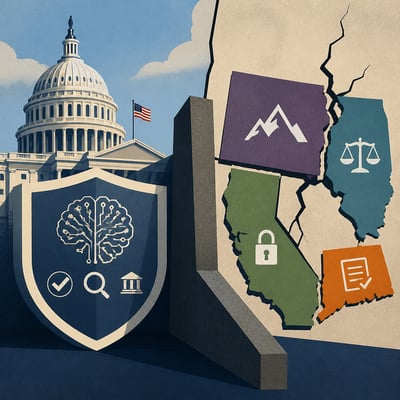
A bipartisan House discussion draft, the Great American AI Act, would establish federal requirements for frontier AI developers covering safety frameworks, pre-deployment reporting, audits, cybersecurity, and serious incident disclosure.
Its proposed three-year preemption of some state laws governing AI model development is the central point of contention, as supporters present federal uniformity as a competitiveness measure while critics warn it could limit state responses to emerging harms. The draft also proposes expanded federal research, workforce, education, and standards functions through the Commerce Department and other agencies.
The draft’s framing has tightened: it is now described as a bipartisan public-comment discussion draft with more explicit preservation of state authority outside AI model development, while adding clearer federal roles for Commerce and NIST. The controversy also broadened from a general preemption fight to specific concerns about discrimination, fraud, deepfakes, and youth harms.
The story has narrowed from a broad fight over competing federal frontier-AI bills into a more specific House discussion draft centered on the Great American AI Act and its state-preemption fight. The new version also adds implementation details around federal standards capacity and related policy areas like workforce, data centers, and competitiveness.
- Great American AI Act discussion draft identified as the central proposal
- Three-year restriction on some state AI model-development rules
- CAISI expansion within NIST and related agency roles
- Additional provisions on watermarking, fraud penalties, whistleblowers, and education
- Policy debate tied to data-center expansion and energy costs
The story has sharpened from a broad debate over AI regulation into a more specific fight over competing federal frontier-safety bills, with concrete mechanisms like audits, incident reporting, emergency pauses, and shutdown powers now central. The most important new development is delay: Senate action has slipped, leaving preemption and the scope of federal authority unresolved.
- FRONTIER Act would authorize licensed independent auditors and emergency pauses.
- AI Kill Switch Act adds throttling, shutdown, and evidence-preservation requirements.
- Senate action on comprehensive AI legislation has been postponed.
- OpenAI, Anthropic, and Google now differ over preemption and government authority.
- European Union transparency enforcement is active during the U.S. debate.
The story now centers more sharply on a federal-versus-state clash over pre-release scrutiny of advanced AI models, with the Great American AI Act, Commerce Department standards, and major company proposals all pointing toward a more formal national regime. The update also adds litigation/enforcement as a live test of AI liability, broadening the story beyond legislation alone.
The story has shifted from a primarily congressional-federal framework debate to a broader, more operational regulatory landscape that now visibly includes state implementation and agency enforcement. The biggest new development is that several states are moving ahead with targeted AI rules while federal actors remain split between voluntary review, proposed standards, and possible preemption.
- Colorado is narrowing its AI law toward transparency obligations.
- Connecticut has adopted use-case-specific AI requirements.
- Administration review of advanced models is described as voluntary, not a licensing regime.
- FTC and civil-rights enforcement are now part of the oversight picture.
- Federal procurement and litigation are shaping AI governance alongside legislation.
The story has shifted from a broad push for federal AI governance to a more concrete compliance-and-enforcement agenda, with reporting, audits, incident disclosure, and implementation authority now more explicitly central. It also broadens into more distinct sectoral and national-security tracks, while the state-preemption fight remains unresolved.
- Third-party audits and incident notifications are now explicit federal governance mechanisms.
- Congressional proposals increasingly target frontier-model developers directly.
- CAISI is now linked to the Commerce Department as the oversight hub.
- Sectoral governance now includes cybersecurity and defense applications.
- Some executive-branch follow-on steps are stalled or incomplete.
The story broadened from a draft federal frontier-AI bill and Google’s proposal into a wider, more active policy landscape that now includes OpenAI, sector-specific bills, and explicit state-law tension. The core frame has shifted toward an ongoing national framework fight over preemption, enforcement, and institutional roles rather than a single legislative vehicle.
- OpenAI has entered the federal AI governance debate.
- Congressional activity now includes sector-specific liability and consumer-protection bills.
- State AI laws in Colorado, Utah, Illinois, California, and New York are now explicitly in view.
- Military AI guardrails and human-control requirements are now part of the story.
- CAISI is increasingly treated as the institutional hub for federal oversight.
The story has sharpened around a specific legislative vehicle: the draft Great American AI Act, now paired against Google’s separate industry proposal. The new emphasis is on the concrete shape of federal oversight—especially audits, reporting, and CAISI expansion—and the preemption fight over state AI laws.
- Draft Great American AI Act is the main legislative vehicle.
- Bill has bipartisan sponsors and a public-comment phase.
- Independent verification organizations would conduct audits.
- Google proposes FARO, a federally overseen frontier AI body.
- CAISI would add reporting and enforcement functions.
The story broadens from a mostly Congress-versus-states fight over frontier AI rules into a more structured federal governance picture centered on CAISI, NIST, audits, and incident reporting. It also adds a second major corporate voice, Google, and a separate military-AI policy track.
Congress is moving toward a national AI framework centered on frontier-model oversight, independent audits, and federal coordination, with the strongest current proposal seeking to preempt some state AI development laws for three years. The debate is shaped by competing priorities: uniform federal standards, state experimentation, safety enforcement, and limits on industry capture. State laws in Colorado, Connecticut, Illinois, and California continue advancing in parallel, underscoring a fragmented regulatory landscape.