
 AI Governance
 Data Centers
 Drones
 Climate
 Privacy
 2026 Maine Senate
 Bob Dylan
Public Ownership Debate Shapes AI Policy
Coverage from The Wire China, Washington Technology, and others
U.
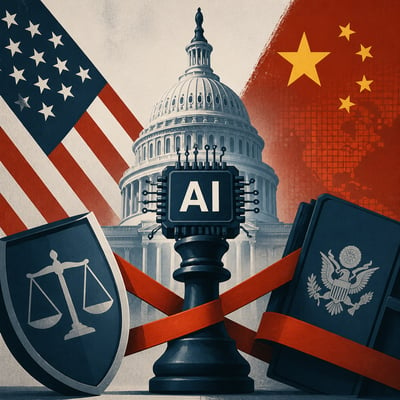
S. policymakers and AI companies are debating whether the public should receive ownership or financial benefits from the growth of major AI firms, while federal officials develop new requirements and review processes for frontier systems. The debate includes sharply different proposals from Bernie Sanders, Donald Trump, and industry leaders, as well as calls for third-party audits, deployment restrictions, and national security review. Opposition to data center expansion over electricity, water, environmental, and tax concerns shows that AI policy is also becoming a local infrastructure and economic-distribution issue.
The story now places greater emphasis on federal execution: lawmakers are not just debating AI wealth-sharing and safeguards, but building concrete review processes for frontier systems before release. It also reframes the infrastructure angle as a broader local political fight over public costs and incentives, not just utilities strain.
The story has broadened from competing AI governance ideas into a more concrete policy agenda covering public ownership proposals, frontier-model oversight, and tougher deployment controls. It also adds a clearer labor-and-infrastructure dimension, with AI’s power, water, and worker impacts now more central.
- Sanders proposed a 50% stock stake in qualifying large AI companies.
- Congressional framework adds third-party audits and federal standards funding.
- Amodei urged government power to block unsafe AI deployments.
- State and local challenges now target tax incentives for data centers.
- AI debate now explicitly includes worker protections and inequality.
The story has broadened from mostly executive-branch AI controls and contracting disputes to a wider political fight over a first federal AI framework, including possible preemption of state laws. It also newly emphasizes the physical infrastructure backlash around data centers, power, water, and environmental costs.
- Congress has released a bipartisan framework for a first broad federal AI approach.
- Possible preemption of many state AI laws is now explicitly on the table.
- Public-ownership and public-benefit ideas are now part of the AI debate.
- State and local resistance to AI data centers is now a major theme.
- Electricity, water, and environmental costs are newly central concerns.
This topic centers on U.S. government moves to tighten, redirect, or contest rules around artificial intelligence, especially in national security, federal contracting, and high-risk deployment. It also includes legal and institutional friction around those moves, with state lawsuits, agency directives, and market pressure on frontier AI firms shaping the direction of oversight. A second thread compares U.S. developments with Chinese labor rulings, academic draft laws, and renewed U.S.-China safety discussions.