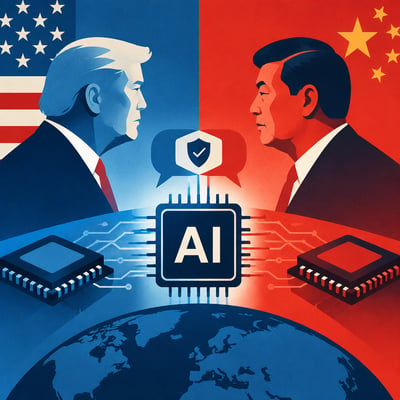
U.S.-China AI Governance and Chip…U.S.-China AI Governance and Chip RivalryCoverage from Memeburn, Unite.AI, and others
00/00/0000
DailyWeekly
Washington and Beijing are tying frontier-AI safety to competition over advanced chips, model access, and technological leadership.
A September summit reportedly established a channel for communicating about AI incidents, but disputes over development pace, export controls, and verification continue to limit broader coordination.
It adds the distinct post-summit dialogue dimension while explaining why a communication channel has not overcome mistrust.
Deutsche Welle / Wesley Rahn
Key Issues
01
Strategic rivalry blocks shared safety rules
The two countries reject or resist slowing frontier-AI development, and their competing security priorities make agreement on shared safeguards difficult. Safety proposals are further disputed when they are tied to restrictions on Chinese access or practices.
Drawn from 5 articles
02
Safety proposals are tied to technology controls
Frontier-AI safety measures are linked to advanced-chip and equipment restrictions, limits on computing access, and action against model distillation or theft. These measures address security concerns while also affecting China’s ability to develop AI, sharpening the governance dispute.
Drawn from 4 articles
03
Dialogue channels offer limited scope for cooperation
Reporting describes a post-summit US-China channel for AI dialogue or incident communication, providing a route for limited engagement. It has not resolved the underlying mistrust or produced agreement on shared rules, so the channel coexists with strategic competition.
Drawn from 5 articles
Key Numbers
$12.4 billion USD
Chinese private AI investment
China · 2025
“American private AI investment reached $285.9 billion in 2025, compared with $12.4 billion in China, according to Stanford’s AI Index. At the same time, the performance gap between the best models in the two countries had narrowed to 2.7% by March.”
Memeburn
2.7% percent
performance gap between the best models in the United States and China
by March
“American private AI investment reached $285.9 billion in 2025, compared with $12.4 billion in China, according to Stanford’s AI Index. At the same time, the performance gap between the best models in the two countries had narrowed to 2.7% by March.”
Memeburn
Looking Back
16 Day Timeline
Articles published over time. Hover any bar for the period and its article count.
Sep 14
Sep 17
Sep 19
Sep 22
Sep 24
Sep 27
Sep 29
The Story So Far
No material change
The new articles reiterate the existing tension between limited U.S.-China AI governance cooperation and competition over development pace, export controls, and technological leadership; they add no material development.
Previously
Washington and Beijing are tying frontier-AI safety to competition over advanced chips, model access, and technological leadership. A September summit reportedly established a channel for communicating about AI incidents, but disputes over development pace, export controls, and verification continue to limit broader coordination.
China rejected American AI leaders' calls to slow frontier model development during an escalating US-China debate over safety, competition, and global AI governance.
9/17/2026 • Model Oversight & Frontier Governance • General
Anthropic CEO Dario Amodei proposed slower frontier AI development on September 12, 2026, prompting China’s Foreign Ministry to reject the approach and defend broader international cooperation.
9/14/2026 • Geopolitics, Defense & Strategic Competition • General
Ahead of Xi Jinping's Washington visit, senior US and Chinese officials discussed an AI incident-notification mechanism to address national-security risks from AI competition.
9/23/2026 • Geopolitics, Defense & Strategic Competition • General
US and Chinese officials are expected to address AI governance in Washington as strategic competition over models, chips, and global alliances limits cooperation.
9/21/2026 • International Governance & Institutions • General
Chinese officials, U.S. technology executives, and policymakers debated international AI safeguards and development limits as competition between Washington and Beijing intensified.
9/14/2026 • International Governance & Institutions • General
The United States and China discussed human-centered AI development and risk management during Xi Jinping's Washington meeting with Donald Trump last week, amid competing governance initiatives and chip restrictions.
9/29/2026 • International Governance & Institutions • General
Donald Trump and Xi Jinping are expected to discuss AI governance in Washington as U.S.-China competition complicates international safety cooperation.
9/17/2026 • International Governance & Institutions • General
China's Foreign Ministry rejected Anthropic CEO Dario Amodei's call for tighter AI chip restrictions as Donald Trump and Xi Jinping prepare for planned September 24 governance talks.
9/14/2026 • Geopolitics, Defense & Strategic Competition • General
The North State Journal / E. Eduardo Castillo and Chan Ho-Him58
Anthropic CEO Dario Amodei urged the United States to maintain advanced AI chip restrictions on China, prompting Chinese criticism amid broader disputes over frontier AI governance.
9/20/2026 • Geopolitics, Defense & Strategic Competition • General
The United States and China are intensifying competition over advanced AI, chips, and military capabilities while international safeguards remain limited.
9/16/2026 • Geopolitics, Defense & Strategic Competition • General
China’s Foreign Ministry rejected Dario Amodei’s call for tighter U.S. AI chip restrictions on China on Monday, as Washington and Beijing contested frontier AI security and governance.
9/14/2026 • Geopolitics, Defense & Strategic Competition • General
China's Foreign Ministry criticized Anthropic CEO Dario Amodei's call for continued U.S. restrictions on advanced AI chips for China, as Washington and Beijing debate frontier AI governance and security.
9/14/2026 • Geopolitics, Defense & Strategic Competition • General
Ahead of a planned Wednesday meeting in Washington, Donald Trump and Xi Jinping are expected to address AI amid US-China disagreements over safeguards and development limits.
9/22/2026 • International Governance & Institutions • General
In 2026, U.S. policymakers, technology executives and Chinese experts debated AI competition, safety and cooperation in Washington and broader global policy discussions ahead of a planned Trump-Xi summit.
9/28/2026 • Geopolitics, Defense & Strategic Competition • General
During a three-day Washington summit, US President Donald Trump and Chinese President Xi Jinping established a bilateral channel for managing AI-related incidents.
9/28/2026 • International Governance & Institutions • General
During preparations for the Washington Trump-Xi summit, US and Chinese officials announced an AI dialogue as mistrust and advanced-chip competition constrained prospects for shared rules.
9/25/2026 • Geopolitics, Defense & Strategic Competition • General
China's Foreign Ministry rejected Dario Amodei's call for tighter U.S. AI chip restrictions on China during a regular press conference amid escalating U.S.-China competition.
9/14/2026 • Geopolitics, Defense & Strategic Competition • General
Donald Trump and Xi Jinping are expected to discuss frontier AI governance in Washington as U.S.-China rivalry complicates international safety cooperation.
9/17/2026 • International Governance & Institutions • General
The United States and China are pursuing competing AI strategies while considering governance cooperation during a planned Trump-Xi meeting in Washington.
9/18/2026 • International Governance & Institutions • General
On September 14 in China, Foreign Ministry spokesperson Guo Jiakun criticized Dario Amodei’s U.S. proposals to restrict Chinese AI development, citing risks from geopolitical competition.
9/14/2026 • Geopolitics, Defense & Strategic Competition • General
China’s Foreign Ministry criticized Anthropic CEO Dario Amodei’s call for tighter U.S. AI restrictions on China during a press conference amid escalating bilateral technology competition.
9/14/2026 • Geopolitics, Defense & Strategic Competition • General
Ahead of a planned Sept. 24 summit, Anthropic CEO Dario Amodei urged continued U.S. restrictions on advanced AI chips for China, while China's Foreign Ministry rejected confrontation and called for cooperation in global AI governance.
9/14/2026 • Geopolitics, Defense & Strategic Competition • General
China rejected U.S. technology executives' calls to slow advanced AI development in Beijing amid an escalating U.S.-China dispute over frontier-AI safety and strategic advantage.
9/14/2026 • Geopolitics, Defense & Strategic Competition • General
Anthropic CEO Dario Amodei proposed slower frontier AI development and expanded controls in 2026, prompting criticism from China and opposition from US President Donald Trump.
9/14/2026 • Geopolitics, Defense & Strategic Competition • General
Anthropic CEO Dario Amodei urged continued U.S. restrictions on advanced AI exports to China, prompting Chinese criticism as Washington and Beijing debate frontier AI governance.
9/14/2026 • Geopolitics, Defense & Strategic Competition • General

 AI Governance
 Data Centers
 Drones
 Climate
 Privacy
 2026 Maine Senate
 Bob Dylan