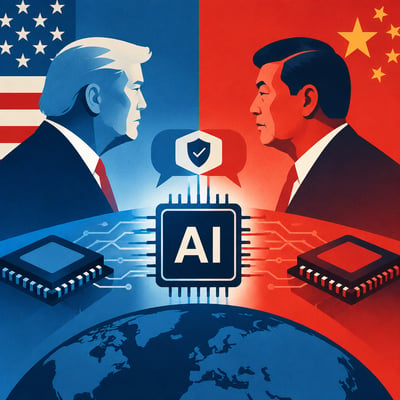
U.S.–China AI GovernanceU.S.–China AI GovernanceCoverage from The Atlantic, World Economic Forum, and others
00/00/0000
DailyWeekly
U.S.–China AI governance is the effort to find common ground on the risks of advanced AI despite a broader strategic contest.
Discussions have encompassed safety guardrails, model testing and verification, development limits, and a possible bilateral incident-notification mechanism. The countries approach governance differently and disagree over technology access, including U.S. restrictions on advanced chip exports and China’s support for lower-cost, open-source models. The subject matters because shared risks may require communication and coordination even when trust is limited and each government sees AI as a source of national power.
It adds reporting and quantified evidence on safety disclosures and shows how technology controls shape cooperation proposals.
Foreign Affairs / Daniel Remler
Key Issues
01
Dialogue channels offer limited-scope cooperation
The bilateral AI dialogue and proposed incident channel provide a foundation for targeted risk communication, with advanced-model testing and human oversight now included in the stated scope. Unclear alert and attribution procedures, and the absence of binding frontier-AI rules, limit what the channel currently achieves.
Strengthening
Drawn from 4 articles
02
Strategic rivalry blocks shared safety rules
Both governments continue to prioritize frontier-AI development, while competing security interests and different governance positions obstruct agreement on shared safeguards. Calls for slower development remain contentious, particularly when linked to restrictions on China’s technology access.
Stable
Drawn from 5 articles
03
Safety proposals remain tied to technology controls
Frontier-AI safety proposals remain entangled with advanced-chip and equipment restrictions, compute access, and allegations of model distillation. These controls are framed as security measures but also affect China’s development capacity, keeping technology access a point of friction in bilateral coordination.
Stable
Drawn from 4 articles
Key Numbers
$12.4 billion USD
Chinese private AI investment
China · 2025
“American private AI investment reached $285.9 billion in 2025, compared with $12.4 billion in China, according to Stanford’s AI Index. At the same time, the performance gap between the best models in the two countries had narrowed to 2.7% by March.”
Memeburn
2.7% percent
performance gap between the best models in the United States and China
by March
“American private AI investment reached $285.9 billion in 2025, compared with $12.4 billion in China, according to Stanford’s AI Index. At the same time, the performance gap between the best models in the two countries had narrowed to 2.7% by March.”
Memeburn
five of China's ten
leading Chinese developers that published safety test results for any model over the past year
Only; none of the ten did so consistently
“Concordia AI, which tracks China's AI ecosystem, found that only five of China's ten leading developers published safety test results for any model over the past year, and none did so consistently.”
Foreign Affairs
six
leading U.S. companies that committed to internal controls, external audits, and independent oversight under the White House Accord on Super Intelligence
September
“Under the White House Accord on Super Intelligence, signed in September, six leading U.S. companies committed themselves to internal controls, external audits, and independent oversight. The G-7 Code of Conduct, which built on voluntary commitments secured under the Biden administration, could incorporate the accord's measures and serve as a common standard for partners.”
Foreign Affairs
Looking Back
92 Day Timeline
Articles published over time. Hover any bar for the period and its article count.
Aug 27
Sep 12
Sep 26
Oct 12
Oct 26
Nov 11
Nov 25
The Story So Far
No material change
The new articles reiterate the limited scope of U.S.–China AI dialogue and existing disagreements over chips, verification, and safety disclosures; they do not establish a material change in the bilateral situation.
Previously
A September Washington summit advanced a bilateral US-China AI dialogue and an incident-communication channel, shifting attention from proposals and public disputes toward a limited official contact mechanism. The channel’s procedures remain unclear, and the summit did not resolve disagreements over advanced-chip restrictions, model security, verification, or shared rules for frontier AI.
History
11/13/2026
The bilateral dialogue is now described as established and covering advanced-model testing and human oversight, not just incident communication. Its limited scope leaves the absence of binding rules unchanged.
10/01/2026
The summit channel is now framed more narrowly as a limited contact mechanism: its scope and operating procedures remain undefined, and it has not produced shared rules or resolved core disputes.
Recently, AI employees and policy experts proposed a U.S.-China agreement limiting advanced-chip use for model training to slow frontier development globally.
8/27/2026 • International Governance & Institutions • Multilateral AI Agreements
In 2025-2026, US and Chinese policymakers and companies increasingly treated AI infrastructure, export controls, and superintelligence expectations as national security issues in the United States and China.
At their next bilateral meeting in November, U.S. and Chinese officials are expected to discuss AI risks amid disputes over export controls and safety oversight.
US President Donald Trump and Chinese President Xi Jinping formalized an AI dialogue and proposed an incident-notification channel at their Washington summit on 23-25 September 2026.
9/30/2026 • International Governance & Institutions • Cross-border Regulatory Coordination
On Tuesday in New York, U.S. Treasury Secretary Scott Bessent described a new U.S.-China AI dialogue for exchanging model-testing practices and communicating serious incidents.
China rejected American AI leaders' calls to slow frontier model development during an escalating US-China debate over safety, competition, and global AI governance.
9/17/2026 • Model Oversight & Frontier Governance • Frontier Model Regulation
Anthropic CEO Dario Amodei proposed slower frontier AI development on September 12, 2026, prompting China’s Foreign Ministry to reject the approach and defend broader international cooperation.
Ahead of Xi Jinping's Washington visit, senior US and Chinese officials discussed an AI incident-notification mechanism to address national-security risks from AI competition.
US and Chinese officials are expected to address AI governance in Washington as strategic competition over models, chips, and global alliances limits cooperation.
9/21/2026 • International Governance & Institutions • Multilateral AI Agreements
Chinese officials, U.S. technology executives, and policymakers debated international AI safeguards and development limits as competition between Washington and Beijing intensified.
9/14/2026 • International Governance & Institutions • Cross-border Regulatory Coordination
Donald Trump and Xi Jinping discussed competing approaches to AI governance and a planned incident-communication channel during APEC meetings in Shenzhen on November 19, 2026.
11/19/2026 • International Governance & Institutions
The United States and China discussed human-centered AI development and risk management during Xi Jinping's Washington meeting with Donald Trump last week, amid competing governance initiatives and chip restrictions.
9/29/2026 • International Governance & Institutions • Cross-border Regulatory Coordination
US and Chinese officials are discussing a bilateral channel in the United States and China to notify each other about serious AI-related security incidents.
9/21/2026 • International Governance & Institutions • Cross-border Regulatory Coordination
Donald Trump and Xi Jinping are expected to discuss AI governance in Washington as U.S.-China competition complicates international safety cooperation.
9/17/2026 • International Governance & Institutions • Cross-border Regulatory Coordination
China's Foreign Ministry rejected Anthropic CEO Dario Amodei's call for tighter AI chip restrictions as Donald Trump and Xi Jinping prepare for planned September 24 governance talks.
Anthropic CEO Dario Amodei urged the United States to maintain advanced AI chip restrictions on China, prompting Chinese criticism amid broader disputes over frontier AI governance.
The United States and China are intensifying competition over advanced AI, chips, and military capabilities while international safeguards remain limited.
China’s Foreign Ministry rejected Dario Amodei’s call for tighter U.S. AI chip restrictions on China on Monday, as Washington and Beijing contested frontier AI security and governance.
China's Foreign Ministry criticized Anthropic CEO Dario Amodei's call for continued U.S. restrictions on advanced AI chips for China, as Washington and Beijing debate frontier AI governance and security.
Ahead of a planned Wednesday meeting in Washington, Donald Trump and Xi Jinping are expected to address AI amid US-China disagreements over safeguards and development limits.
9/22/2026 • International Governance & Institutions • Cross-border Regulatory Coordination
In 2026, U.S. policymakers, technology executives and Chinese experts debated AI competition, safety and cooperation in Washington and broader global policy discussions ahead of a planned Trump-Xi summit.
During a three-day Washington summit, US President Donald Trump and Chinese President Xi Jinping established a bilateral channel for managing AI-related incidents.
9/28/2026 • International Governance & Institutions • UN And OECD Initiatives
During preparations for the Washington Trump-Xi summit, US and Chinese officials announced an AI dialogue as mistrust and advanced-chip competition constrained prospects for shared rules.
China's Foreign Ministry rejected Dario Amodei's call for tighter U.S. AI chip restrictions on China during a regular press conference amid escalating U.S.-China competition.
Donald Trump and Xi Jinping are expected to discuss frontier AI governance in Washington as U.S.-China rivalry complicates international safety cooperation.
9/17/2026 • International Governance & Institutions • Cross-border Regulatory Coordination
The United States and China are pursuing competing AI strategies while considering governance cooperation during a planned Trump-Xi meeting in Washington.
9/18/2026 • International Governance & Institutions • Cross-border Regulatory Coordination
On September 14 in China, Foreign Ministry spokesperson Guo Jiakun criticized Dario Amodei’s U.S. proposals to restrict Chinese AI development, citing risks from geopolitical competition.
China’s Foreign Ministry criticized Anthropic CEO Dario Amodei’s call for tighter U.S. AI restrictions on China during a press conference amid escalating bilateral technology competition.
Ahead of a planned Sept. 24 summit, Anthropic CEO Dario Amodei urged continued U.S. restrictions on advanced AI chips for China, while China's Foreign Ministry rejected confrontation and called for cooperation in global AI governance.
China rejected U.S. technology executives' calls to slow advanced AI development in Beijing amid an escalating U.S.-China dispute over frontier-AI safety and strategic advantage.
Anthropic CEO Dario Amodei proposed slower frontier AI development and expanded controls in 2026, prompting criticism from China and opposition from US President Donald Trump.
Anthropic CEO Dario Amodei urged continued U.S. restrictions on advanced AI exports to China, prompting Chinese criticism as Washington and Beijing debate frontier AI governance.
After New York meetings, U.S. Treasury Secretary Scott Bessent and Chinese Vice Premier He Lifeng agreed to continue talks on an AI-incident hotline for national-security events.
9/22/2026 • International Governance & Institutions • Cross-border Regulatory Coordination

 AI Governance
 Data Centers
 Drones
 Climate
 Privacy
 Bob Dylan