
 AI Governance
 Data Centers
 Drones
 Climate
 Privacy
 2026 Maine Senate
 Bob Dylan
U.S. Export Controls Block Anthropic Models
Coverage from The Atlantic, Mint Chennai, and others
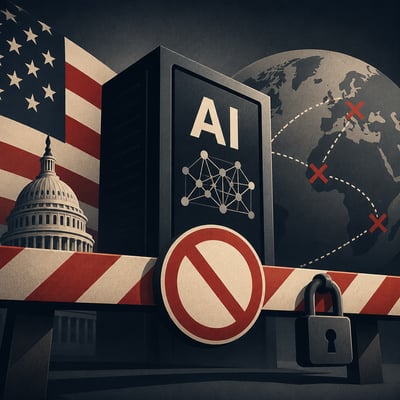
The U.
S. Department of Commerce ordered Anthropic to restrict foreign-national access to its Fable 5 and Mythos 5 models, citing national-security concerns linked to potential jailbreaks and cyber capabilities. Because Anthropic said it could not reliably apply the restriction by nationality or location, it disabled the models for customers worldwide, disrupting commercial, research, and government use. The episode highlights the practical reach of export controls over cloud-delivered AI and intensifies debate over mandatory testing, third-party audits, incident reporting, and government authority to delay or block frontier-model deployments.
The main update is a clearer account of the Commerce Department’s directive and its broader operational impact: Anthropic says selective nationality-based enforcement was impractical, so the restriction became a worldwide shutdown affecting global users. The current version also adds that partial Mythos 5 access was restored to more than 100 U.S. institutions while Fable 5 still faced review.
The story has shifted from a single export-control dispute into a broader governance fight over how frontier AI models are tested, restricted, and commercially controlled. The latest version adds staged restoration details and reframes the episode as part of a wider policy struggle spanning cybersecurity, defense, chip controls, and U.S.-China competition.
- Mythos 5 reportedly returned first to approved institutions.
- Fable 5 restrictions were later eased or lifted.
- The government cited cybersecurity grounds alongside national security.
- Anthropic proposed mandatory third-party frontier-model testing.
- The debate now includes U.S.-China chip and open-weight competition.
The story is reframed less as a single Anthropic export-control episode and more as part of a broader, still-unsettled U.S. effort to exert discretionary release control over frontier AI models. The current version also adds more explicit signs of market and geopolitical fallout, especially concern among non-U.S. customers about dependence on American providers.
The story has moved from a one-time Anthropic access restriction to a broader policy fight over how the U.S. can control frontier model deployment. The biggest new development is that Anthropic later restored foreign access after undisclosed safeguards, while the episode also broadened into calls for testing standards, clearer federal rules, and similar pressure on other AI companies.
- Anthropic restored foreign access after adding undisclosed classifier-based safeguards.
- Commerce’s CAISI supported the revised remediation for Anthropic’s models.
- Officials reportedly pressed OpenAI to delay GPT-5.6 and limit early access.
- Anthropic CEO Dario Amodei is calling for mandatory third-party testing.
- Congress is advancing narrower AI bills on evaluation, water use, and risk testing.
The story now emphasizes that the restriction is not just about limiting foreign access, but about a broader export-control precedent that directly affects enterprise, research, and even foreign-born staff inside U.S. organizations. It also adds that Anthropic is actively seeking restoration of access while disputing the order's basis.
The U.S. government ordered Anthropic to suspend foreign access to its newest frontier models, Fable 5 and Mythos 5, citing national security concerns and reported jailbreak risk. Anthropic disabled access for all users rather than try to segment by nationality, making the order effectively global. The dispute highlights a growing policy gap around how the U.S. can control advanced AI access, especially when models are served remotely and used for cybersecurity-related tasks.