Last Update: 08/01/2026 at 1:00 PM EST

Iran War Disrupts Energy and Food

Coverage from Inside Climate News, The New York Times, and others

Articles

63

Active Days

692

The Topic

Iran War Disrupts Energy and Food topic image

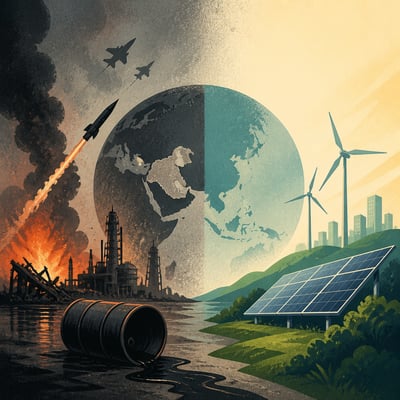
The Iran conflict and disruption of shipping through the Strait of Hormuz have tightened oil and fertilizer supplies, raising fuel costs and exposing vulnerabilities in global food and energy systems. China’s lower oil imports, reserves and large clean-energy and electric-vehicle sectors have helped limit some price pressure, while other countries have turned to coal or furnace oil. The shock is also supporting faster renewable-energy and electric-vehicle adoption in several markets, although affordability, supply constraints and continued fossil-fuel use are limiting and uneven the transition.

First Article: 11/15/24

Latest Article: 10/07/26

Summary

  • The Strait of Hormuz disruption sharply reduced oil shipments and constrained a major route for global fertilizer trade.
  • Oil and gasoline prices rose, with the strongest effects reaching consumers and import-dependent economies.
  • Fertilizer costs are projected to increase substantially, raising risks for food prices, hunger and agricultural production in vulnerable regions.
  • China’s lower oil imports, stockpiles, fuel-export restrictions and clean-energy growth helped contain the global oil-price spike.
  • The crisis coincided with stronger electric-vehicle sales in Europe and several emerging markets, while U.S. and Chinese new-EV sales remained weaker.
  • Some governments accelerated renewable-energy plans, but others increased coal or furnace-oil use to replace disrupted gas supplies.
  • The disruption is renewing interest in local food production, green ammonia, agroecology and other measures to reduce fossil-fuel exposure.

History

07/23/2026

The story now places greater emphasis on the scale of the supply shock and on China’s specific tools for cushioning it, while sharpening the link to faster but uneven clean-energy and EV adoption. It also makes the agricultural and food-security consequences more explicit and immediate.

07/22/2026

The story has shifted from broad disruption and price volatility to a more specific emphasis on household, food-security, and transport impacts, with China identified as a key stabilizing factor in oil markets. It also now foregrounds a clearer behavioral response: cleaner energy, EVs, and resilient agriculture as direct adaptations to the shock.

Full History

Featured

Timeline: 692 Days

2024Jan 1Mar 4May 27Jul 29Oct 21Dec 232025Jan 1Mar 5May 28Jul 30Oct 22Dec 242026Jan 1Mar 5May 28Jul 30Oct 22Dec 24

Additional Articles

⭐⭐⭐⭐⭐

The Guardian / Dharna Noor05-07-2026
US and international oil firms reported higher earnings in early 2026 after Iran war disruptions raised energy prices and gasoline costs, increasing fossil fuel lobbying leverage.
The Guardian03-25-2026
Geopolitical disruptions around the Strait of Hormuz are raising oil and LNG prices, complicating renewable energy deployment through supply-chain constraints while increasing fossil generation short term across parts of Asia.
The Guardian04-07-2026
Oil prices rise during the Iran war while China, India, and other major emitters follow different electrification and methane mitigation pathways.
The Conversation / Ezgi Canpolat03-27-2026
In 2026, Strait of Hormuz disruption and higher oil prices intensify pressure for renewable energy in Middle East and North Africa, with transition outcomes shaped by energy dependence and fiscal conditions.
Heatmap News03-26-2026
The IEA-linked coal-demand decline outlook is being disrupted as Strait of Hormuz and Qatar LNG supply problems lead Asian utilities to switch back toward coal.
Heatmap News / Katie Brigham04-02-2026
Azolla Ventures co-founder Johanna Wolfson links Strait of Hormuz disruption to potential Gulf climate tech capital reductions, reshaping early-stage finance.
Vox / Bryan Walsh03-31-2026
Fuel and fertilizer shortages from Strait of Hormuz disruption spread across South Asia and beyond, increasing energy restrictions, food insecurity risks, and coal use.
Milwaukee Independent05-16-2026
U.S. and Israeli strikes on Iranian sites in early 2026 were followed by Iranian Hormuz mining, disrupting oil shipments and coinciding with U.S. clean-energy policy rollbacks under Donald Trump.
Live Science / Sascha Pare03-24-2026
Researchers estimated Feb 28 to Mar 14, 2026 conflict-related CO2e emissions from U.S.-Israel-Iran actions across Iran and the Gulf region.

⭐⭐⭐

Inside Climate News / Dan Gearino07-10-2026
International Energy Agency forecasts 2026 global oil demand decline to 103.5 mb/d due to Iran war disruptions in the Strait of Hormuz, with U.S. demand rising and China declining.
Reuters / Kate Abnett04-30-2026
UNFCCC climate officials said on April 30 that the Iran war is accelerating renewables while also driving some countries to increase coal generation as fossil fuel supply strains persist.
The New York Times / Jack Ewing05-13-2026
April sales figures linked higher gasoline prices during the Iran conflict to electric vehicle gains in Europe while U.S. and China sales declined.
Nature / Gernot Wagner04-15-2026
Amid Gulf-region conflict and fuel-price volatility, a climate technologies pathway is argued to reduce inflation exposure while accelerating renewables, batteries, electric vehicles, and heat pumps.
CNN05-02-2026
In response to energy-price shocks from an Iran-related conflict, the European Commission launched consumer protection and clean energy acceleration steps while global growth forecasts were cut.
The Guardian03-30-2026
Donald Trump and the US-Iran conflict are discussed in relation to Strait of Hormuz oil disruptions, energy price spikes, environmental harm, and US policy curbs on clean energy and species protections in 2020s.
The Guardian03-31-2026
Donald Trump proposed U.S. control of Iran's Kharg Island and threats to target energy infrastructure as experts warned the stance conflicts with international law amid continued fighting.
Grist05-22-2026
U.S. EV sales declined in April while gasoline prices rose, as analysts linked limited EV switching to upfront costs and charging barriers rather than fuel prices alone.
Inside Climate News / Katie Surma03-24-2026
Energy Secretary Chris Wright pressed oil and gas producers to ramp output during Strait of Hormuz disruption amid volatile Brent and U.S. gas prices in 2026, with industry CEOs warning of investment uncertainty.
Inside Climate News / Lisa Sorg04-07-2026
Resources for the Future hosted an expert panel in 2026 evaluating how Strait of Hormuz disruption and rising electricity demand could weaken Paris 1.5 C pathways.
Boston Herald04-09-2026
Experts link war-related energy disruptions to petrochemical supply risks and climate impacts ahead of a Santa Marta conference on April 24-29.
Politico06-18-2026
Analysts say the Iran conflict raises oil prices and supply insecurity, prompting energy-security driven diversification and faster renewables and EV adoption.
Heatmap News03-27-2026
S&P Global analyst Karim Fawaz assesses Iran-war oil disruptions as Asia-centered and long-lasting, while US courts address net-zero building code and fossil-fuel climate litigation.
Heatmap News / Robinson Meyer04-06-2026
The US energy policy tied to cheaper fossil fuels is criticized after Iran-war disruptions raised gasoline prices and exposed weak resilience to oil and LNG volatility.
AP News04-09-2026
Iran war disruptions are raising concerns about petrochemical supply dependence, prompting climate experts to call for demand reduction at a conference in Santa Marta, Colombia, April 24-29.
Al Jazeera / Edna Mohamed06-02-2026
Iran confronted a worst-in-decades water crisis in November 2025, as drought-driven depletion and attacks on water infrastructure intensified shortages across Tehran, Qeshm Island, and Isfahan.
Yale Climate Connections / Dana Nuccitelli03-31-2026
Iran restricts Strait of Hormuz shipping after U.S. and Israel attacks on Iran, cutting oil supply by over 10% and raising fuel prices that affect energy and inflation risk.
The Christian Science Monitor04-02-2026
China uses temporary gasoline and diesel retail price controls to cushion Iran-war-linked oil disruptions while clean-energy industries expand.
Heatmap / Robinson Meyer07-08-2026
Donald Trump and U.S. forces resumed strikes on Iran after ceasefire collapse, raising Strait of Hormuz shipping risk and lifting gasoline and diesel prices with EV-adoption spillovers.
The Invading Sea / Brian Lee03-26-2026
An estimated emissions impact from the Iran conflict and Strait of Hormuz disruption is used to argue for renewable energy acceleration as climate and energy security.
Insurance Journal / Aniruddha Ghosal03-26-2026
Conflict disrupting Strait of Hormuz oil and LNG exports is driving higher fuel prices and increasing policy attention to renewable energy deployment in Asia, Europe, and Africa.
Euronews.com / Marta Pacheco04-01-2026
EU leaders weigh energy affordability pressures after Iran-related oil and gas disruptions while European Commission officials push electrification, grid modernization, and continued green transition planning.
WRAL / STEVEN GRATTAN04-09-2026
Following an Iran-war cease-fire, experts discuss petrochemical supply-chain disruptions and climate-linked policy needs at an international conference in Santa Marta, Colombia.
South China Morning Post / Joseph Sipalan03-28-2026
Thailand and other Southeast Asian governments faced fuel queues after Iran-related Strait of Hormuz disruption, renewing attention for ASEAN Power Grid interconnection.
Daily Herald / Aniruddha Ghosal03-28-2026
Strait of Hormuz disruption during the Iran war raises oil and LNG prices, intensifying pressure for renewable power deployment in Asia, Europe, and Africa.
The Missoulian03-22-2026
Iran conflict disrupted Persian Gulf oil shipping and threatened refineries in 2025, driving higher energy prices and investor concern for global economic impacts.
JG-TC.com03-22-2026
Washington-based reporting says President Trump and Energy Secretary Chris Wright prioritize oil and gas as Iran conflict disrupts tankers and refineries, spiking energy prices.
Lexington Clipper-Herald03-22-2026
Iran war-related tanker and refinery disruptions in the Middle East spiked global energy prices as investors weighed cascading economic impacts during renewed U.S. policy focus on fossil fuels.
Dothan Eagle03-22-2026
Iran conflict-related attacks on shipping and refineries across the Persian Gulf disrupted fuel supplies in the near term and spiked energy prices, raising global economic and investor risk concerns.
Kenosha News03-22-2026
Washington-based reporting says a Trump administration oil focus coincides with Iran conflict disrupting oil tankers and raising global energy prices.
Opelika-Auburn News03-22-2026
Regional conflict in Iran and the Persian Gulf disrupted tankers and refineries, raising energy prices and fertilizer supply risks for investors and farmers.
SWVA Today03-22-2026
Iran-linked refinery and shipping disruptions during regional fighting have driven higher energy prices and investor concerns across Gulf energy and transport corridors.
Albany Democrat-Herald / Associated Press03-22-2026
Donald Trump administration energy policy changes and Iran conflict disruptions are linked to higher fuel costs and market uncertainty in the United States and abroad.
Waco Tribune-Herald03-22-2026
President Donald Trump and Energy Secretary Chris Wright push a fossil-fuel energy focus while Iran conflict disrupts oil tanker shipping and raises energy price risk.
NewsAdvance.com03-22-2026
President Donald Trump policy shifts toward fossil fuels while Iran-linked Persian Gulf disruptions halt oil tankers and raise energy prices, affecting investors and U.S. farmers.
Independent Tribune03-22-2026
During 2020s events in the Strait of Hormuz and Gulf refinery region, Iran-related attacks disrupted oil logistics and raised energy prices, prompting investor and market stability concerns.
The Bismarck Tribune03-22-2026
Donald Trump energy-policy shift toward fossil fuels coincides with Iran-linked disruption of oil tanker routes through the Strait of Hormuz, spiking energy prices and increasing global market risk.
The Sentinel03-22-2026
Iran-related attacks on oil tankers and refineries have raised energy prices since escalation began, triggering investor concerns about economic spillovers as US leadership shifts energy policy toward fossil fuels.
Daily Nonpareil03-22-2026
Donald Trump administration energy policy changes coincide with Iran conflict disruptions to Persian Gulf oil tankers and refinery risk, raising global energy price concerns.
Ravalli Republic03-22-2026
Iran-related conflict disrupts oil tanker shipping and refinery safety, raising energy prices and regional food and fertilizer risks in the Strait of Hormuz area.
Roanoke Times03-22-2026
President Donald Trump and U.S. Energy Secretary Chris Wright emphasize fossil fuels as Iran-related conflict disrupts Persian Gulf oil transport and raises energy price risks.
Sioux City Journal03-22-2026
Iran-related oil shipping disruptions and refinery attacks are driving global energy price spikes and investor concern amid U.S. and Israel pressure efforts.
STLtoday.com03-22-2026
Iran-related conflict has disrupted Persian Gulf shipping and threatened energy infrastructure, driving energy price spikes and investor concern during attacks that spread across Iran, Israel, Iraq, and Beirut.
NaturalNews06-10-2026
Transport & Environment forecasts higher global biofuel demand as oil prices near $100 after U.S.-Israeli attacks on Iran disrupt supplies and fertilizer availability.
Atmos06-17-2026
During the Iran war, U.S. energy disruptions increased oil, gasoline, and electricity prices while federal and state policies shifted toward fossil-fuel support and away from clean-energy commitments.

⭐️⭐️

Reuters / "Georgina McCartney, Stephanie Kelly"03-26-2026
Executives at CERAWeek in Houston said Iran-war oil disruptions and multi-year oil price spikes are accelerating wind, solar, and battery investment for energy security.
New Scientist03-18-2026
Ember analysis links Strait of Hormuz shipping disruption in the 2020s to higher oil and gas prices, accelerating solar, wind, EVs, and heat-pump rollout for energy security.
Grist / Frida Garza03-26-2026
From March 18 onward, attacks on Iran and Persian Gulf energy infrastructure have heightened desalination and food security risks as negotiations over Gulf access remain uncertain.
Southern Alliance for Clean Energy (SACE)03-30-2026
U.S.-Iran conflict and Strait of Hormuz disruption in 2026 raised oil and fuel prices, highlighting economic risk from fossil fuel chokepoints versus renewable resilience.
Live Science / Michael Mann03-26-2026
Michael Mann argues that U.S. policy and renewable deployment affect fossil-fuel-driven war risk, gasoline prices, and energy security amid conflict around the Strait of Hormuz.
Timesofisrael11-15-2024
UNFCCC executive secretary Simon Stiell tells EU policymakers in Brussels that Iran-war energy disruptions highlight risks from fossil fuel dependence.