Last Update: 08/01/2026 at 1:00 PM EST

Methane Mega-Leaks And Monitoring

Coverage from The Guardian, Eos, and others

Articles

8

Active Days

148

The Topic

Methane Mega-Leaks And Monitoring topic image

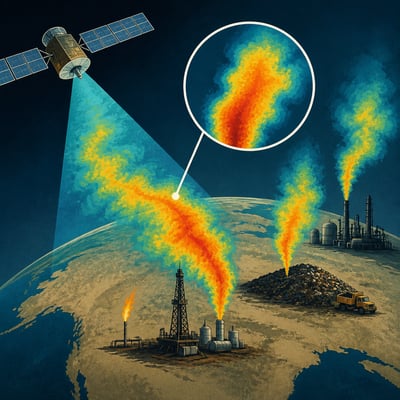
Satellite and measurement campaigns are exposing large methane leaks from oil, gas, and landfill sites, with Turkmenistan and Texas repeatedly appearing among the biggest sources. The current signal combines detection, source attribution, and policy pressure to fix leaks quickly because methane reductions have near-term climate benefits.

First Article: 02/20/26

Latest Article: 07/17/26

Summary

  • Satellite-based monitoring is repeatedly identifying large methane plumes from oil and gas operations, especially in Turkmenistan and Texas.
  • Landfill methane plumes appear alongside fossil-fuel leaks, showing that the emissions problem is not confined to one sector.
  • The same monitoring tools are increasingly used to attribute emissions to specific facilities, companies, and countries.
  • A recurring claim across the material is that many leaks are repairable with existing technology and maintenance practices.
  • The policy and market angle is gaining strength: cutting methane is presented as a fast way to reduce warming and recover saleable gas.
  • A smaller but important research thread uses satellite data to refine methane budgets and atmospheric-loss estimates, indicating measurement uncertainty remains relevant.

History

05/30/2026

The story is mostly stable, but the framing has shifted slightly toward a broader attribution-and-policy narrative. The current version adds a research thread on refining methane budgets and atmospheric-loss estimates, while keeping the core hotspot findings unchanged.

Featured

Timeline: 148 Days

Feb 20Mar 20Apr 17May 15Jun 12Jul 10

Additional Articles

⭐⭐⭐⭐⭐

American Chemical Society / Fionna Samuels02-20-2026
Qiang Fu and Cong Dong estimate stratospheric methane loss from satellite observations in 2007-2010, affecting the global methane budget.

⭐⭐⭐

democraticunderground03-17-2026
UCLA's Stop Methane Project reported 2025 satellite detections of global methane mega-leaks, dominated by Turkmenistan and including a major Texas source emitting 5.5 tonnes per hour.
Gizmodo / Ellyn Lapointe03-18-2026
Researchers using Carbon Mapper remote sensing data identified 25 2025 methane mega-leaks, led by Turkmenistan-based facilities emitting over 10 metric tons per hour.
The Conversation06-03-2026
Oxford University Climate Policy Monitor analysis and International Energy Agency findings report weak methane enforcement across 37 jurisdictions, including the US, EU, Japan, and California.
Greenpeace / Nick Smith03-23-2026
Greenpeace USA reported 2025 methane hotspots in Texas, linking the largest detected U.S. emissions to Energy Transfer gas plants near the Permian Basin.