Last Update: 08/01/2026 at 1:00 PM EST

Asia's Uneven Shift From Coal

Coverage from The Guardian, IEA, and others

Articles

10

Active Days

192

The Topic

Asia's Uneven Shift From Coal topic image

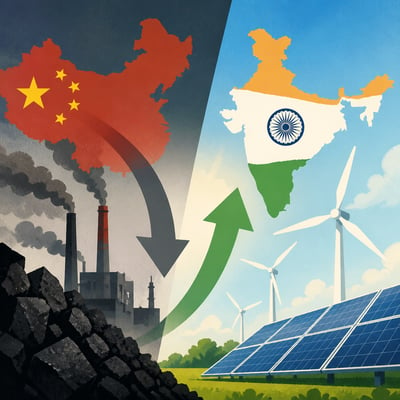
Asia's energy transition is advancing unevenly. China and India recorded declines in coal-fired generation as rapid solar, wind, hydropower and electric-vehicle growth began meeting rising demand, while Southeast Asia is expected to remain a major source of energy-demand growth with coal, gas and oil still supplying much of the increase. The central tension is whether renewables, electrification, grids and regional cooperation can expand quickly enough to improve energy security without prolonging fossil-fuel dependence or increasing exposure to climate and supply disruptions.

First Article: 01/13/26

Latest Article: 07/23/26

Summary

  • Coal generation fell in both China and India, the first simultaneous decline in decades, as renewable additions outpaced demand growth.
  • China's rapid expansion of solar, wind and electric vehicles is separating economic and electricity-demand growth from emissions, although coal capacity remains a rebound risk.
  • Southeast Asia is projected to provide about one-fifth of global energy-demand growth to 2035, with fossil fuels meeting roughly 60% of incremental demand under stated policies.
  • Coal and gas remain important to Southeast Asian power systems because of rising industrial, cooling and data-centre demand, as well as concerns about reliability and affordability.
  • Import dependence and concentrated fuel supply routes leave Southeast Asia vulnerable to price shocks, LNG tightening and disruptions affecting refining, power generation and cooking fuels.
  • Grid constraints, high financing costs and climate-related flood exposure could slow renewable deployment and weaken power-system resilience.
  • Regional interconnections, storage, efficiency and electrification are presented as ways to reduce fossil-fuel exposure while accommodating demand growth.

History

07/23/2026

The update sharpens the Asia energy-transition story with a more specific and more security-focused outlook: Southeast Asia is now framed as a large, quantifiable source of future demand growth that fossil fuels will still dominate, while regional cooperation and system flexibility are presented as part of the response. It also strengthens the China-India coal decline as a confirmed milestone rather than just a trend.

07/22/2026

The story broadens from a China–Southeast Asia coal-and-grid tension into a wider Asia-wide transition, with India now showing the same coal-decline pattern as China. The framing also shifts toward cleaner power, storage, efficiency, and fuel-supply disruption as the key determinants of whether the transition can hold.

Full History

Featured

Timeline: 192 Days

Jan 13Feb 24Mar 24May 5Jun 2Jul 14

Additional Articles

⭐⭐⭐⭐⭐⭐⭐⭐

Forbes / Ken Silverstein02-01-2026
Forbes reports in February 2026 that Chinas carbon emissions have plateaued despite rising electricity demand, driven by rapid renewable deployment and electric vehicle adoption, without mentioning heat pumps.
Story china building coal plants despite solar wind boom 12980510202-03-2026
The Centre for Research on Energy and Clean Air and Global Energy Monitor reported in 2025 that China sharply expanded coal capacity despite record wind and solar growth.
The Crucial Years / Bill McKibben01-22-2026
In a 2020s Substack commentary, Bill McKibben discusses global energy transitions and climate impacts worldwide but never addresses heat pump technologies, economics, or policies.

⭐⭐⭐⭐⭐

AP News01-22-2026
The Associated Press recently reported from Vietnam and Indonesia on rising coal demand and energy transition deals in Southeast Asia, without addressing heat pump technologies or policies.
OilPrice.com / Robert Rapier06-29-2026
A viral social media claim about China and annual CO2 growth is assessed against Our World in Data and energy system data.

⭐⭐⭐

Richard Katz / Richard Katz07-23-2026
Richard Katz reports that Japan’s AZEC-focused fossil fuel support in Southeast Asia may hinder emissions progress as ASEAN renewables expand and China leads clean-energy supply by 2030.

⭐️⭐️

South China Morning Post / Victoria Bela01-21-2026
China halted overseas coal financing in 2021, while domestic coal units expanded to stabilise grids amid renewable energy growth.