Last Update: 08/01/2026 at 1:00 PM EST

Permafrost Thaw Reshapes Carbon Balance

Coverage from ScienceDaily, State of the Planet, and others

Articles

10

Active Days

146

The Topic

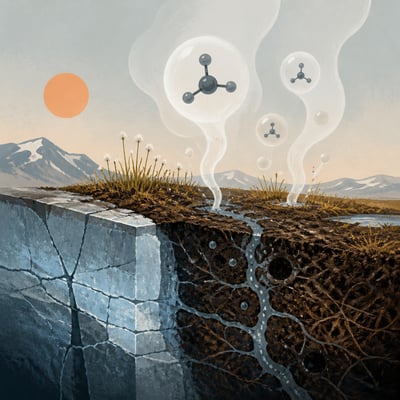
Permafrost Thaw Reshapes Carbon Balance topic image

Research is refining the picture of permafrost thaw from a straightforward carbon-release process to a set of interacting biological and geological changes. Thaw can increase carbon dioxide and methane emissions by exposing stored organic matter, while also accelerating rock weathering that removes some carbon dioxide in certain river systems. The overall balance remains uncertain, with updated models suggesting northern permafrost could become a net carbon source earlier than previously projected and with several important feedbacks still incompletely represented.

First Article: 01/26/26

Latest Article: 06/20/26

Summary

  • Thawing permafrost can increase the permeability of frozen ground, allowing stored carbon dioxide and methane to escape more readily.
  • Updated modeling suggests northern permafrost could shift from a net carbon sink to a net source around the 2050s under high-emissions scenarios.
  • Rock weathering on the Qinghai-Tibet Plateau offset about 35% of river carbon dioxide emissions on average, with larger offsets in some discontinuous-permafrost catchments.
  • The carbon balance depends on interacting biological, geological, hydrological, and fire-related processes that are not fully represented in current models.
  • Paleoclimate reconstructions indicate that permafrost thaw contributed substantially to atmospheric carbon dioxide increases after the last Ice Age.
  • Microbial activity on glaciers can darken ice and accelerate melt, adding another pathway through which cryosphere ecosystems respond to warming.

History

07/23/2026

The story has shifted from mainly describing permafrost as a carbon-release risk to emphasizing a more complex balance of biological emissions, geological carbon uptake, and other feedbacks. The current version also broadens the framing to say current models still incompletely represent these interacting processes.

07/22/2026

The story now extends beyond permafrost emissions and weathering to add a new glacier-microbe pathway, while also sharpening the climate-risk case with a specific net-source timing estimate and stronger uncertainty framing in projections.

Full History

Featured

Timeline: 146 Days

Jan 26Feb 23Mar 23Apr 20May 18Jun 15

Additional Articles

⭐⭐⭐⭐⭐

The Brighter Side of News06-07-2026
University of Gothenburg research estimates northern permafrost thaw after the last Ice Age released over 300 petagrams of carbon and contributed about 52 ppm CO2 to deglaciation increases.
R&D World / Julia Rock-Torcivia06-19-2026
A Science Advances paper finds updated northern permafrost land-carbon modeling could shift the region to a carbon source around 2055 under high emissions, affecting 2 C budgets.
EurekAlert!03-29-2026
University of Leeds researchers in AGU Earths Future report laboratory evidence that permafrost thaw can increase gas permeability 25 to 100 times, enabling carbon and methane escape in the Arctic.
Earth.com / Eric Ralls04-04-2026
University of Leeds lab experiments show thawed permafrost can become 25 to 100 times more permeable, potentially accelerating greenhouse-gas escape in the Arctic.
Phys.org / Kay Pettigrew01-26-2026
Researchers report in 2026 that thawing polar regions could accelerate microbial carbon release, amplifying climate change in Arctic and Antarctic ecosystems.
Phys / Christfried Dornis03-26-2026
University of Tübingen researchers measured seasonally varying carbon dioxide and methane fluxes in Stordalen mire, Sweden, finding grass dominance increases greenhouse gas emissions during permafrost thaw.

⭐⭐⭐

Phys.org03-29-2026
University of Leeds researchers in Earth's Future report experiments showing thawing Arctic permafrost increases permeability 25 to 100 times, boosting escape of climate-forcing gases.