Last Update: 08/01/2026 at 1:00 PM EST

US Permitting Delays Threaten Clean Power

Coverage from Reuters, TechCrunch, and others

Articles

12

Active Days

159

The Topic

US Permitting Delays Threaten Clean Power topic image

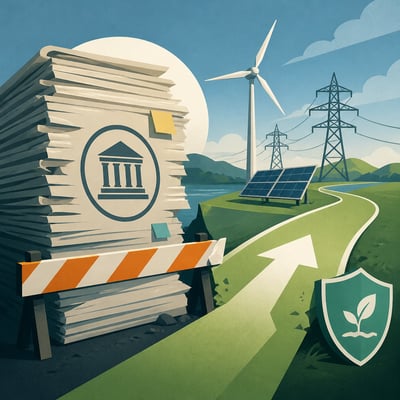
Changes to US federal permitting processes are delaying or putting at risk a large pipeline of wind, solar, and battery storage projects. Wood Mackenzie estimates that 92 GW of early-stage projects, representing more than $121 billion in potential investment, faces heightened scrutiny, while developer surveys report longer timelines and higher costs. The disruption comes as electricity demand is expected to rise, particularly from data centers and manufacturing, and as clean energy groups challenge the new review procedures in court.

First Article: 01/30/26

Latest Article: 07/07/26

Summary

  • Wood Mackenzie identifies 92 GW of early-stage wind, solar, and storage projects facing heightened federal scrutiny.
  • More than $121 billion in potential investment is exposed, while about 7 GW on federal land was already stalled or canceled in 2025.
  • Wetlands, wildlife, access-road approvals, and Army Corps reviews are major constraints for projects on or near private land.
  • Onshore wind projects face additional delays from Department of Defense airspace and military-radar reviews.
  • A survey of developers found delays averaging more than six months and widespread increases in project costs.
  • Renewable energy groups are using litigation to challenge Interior and Pentagon review policies, leaving some projects subject to injunctions and appeals.
  • The permitting uncertainty coincides with projected growth in electricity demand from data centers, manufacturing, and broader electrification.

History

07/24/2026

The story now adds a stronger legal and procedural dimension: renewable groups are actively challenging the federal review changes in court, while the current framing drops the earlier emphasis on tariffs and foreign-entity tax-credit risks. It also sharpens the permitting bottlenecks by naming Defense airspace/military-radar review and Army Corps approvals as key constraints.

07/23/2026

The story sharpens from broad permitting bottlenecks into a more specific picture of Trump-administration review changes actively slowing or jeopardizing projects, with quantified impacts on stalled capacity and costs. It also adds separate tariff and foreign-entity rules as new sources of risk for projects already underway.

Full History

Featured

Timeline: 159 Days

Jan 30Feb 27Mar 27May 8Jun 5Jul 3

Additional Articles

⭐⭐⭐⭐⭐

Latitude Media / Maeve Allsup07-06-2026
In the USA, clean energy developers face permitting blocks, tariff uncertainty, and foreign entity of concern eligibility ambiguity after July 4 as tax credit qualification risk persists.
Journal Record / Nichola Groom06-29-2026
Wood Mackenzie said U.S. federal permitting delays under Department of the Interior and Department of Defense reviews are putting $121 billion of wind, solar, and storage investment at risk.

⭐⭐⭐

energynews.pro06-29-2026
Wood Mackenzie reports 92 GW of US early-stage wind, solar, and storage projects face heightened federal scrutiny due to permitting delays and agency bottlenecks.
E&E News by POLITICO / Kelsey Tamborrino04-07-2026
Crux surveyed US solar and wind developers in February and found federal permitting delays raise costs and redirect project siting away from demand centers.
pv magazine USA / Ryan Kennedy06-29-2026
On July 15, 2025, U.S. Department of the Interior elevated review requirements for renewable permitting, exposing 92 GW to delays and investment risk and triggering court challenges and SPEED Act action.
Finance & Commerce06-29-2026
Wood Mackenzie said June 29, 2026 that U.S. federal permitting changes put $121 billion in renewable wind, solar, and storage investments at risk, slowing 92 GW of projects.
Citizens' Climate Lobby / Flannery Winchester01-30-2026
Citizens Climate Lobby leaders trained volunteers in 2025 on federal permitting reform to speed transmission and clean-energy projects across the USA.
San Diego Union-Tribune07-07-2026
A 2024 permitting reform argument in the United States links National Environmental Policy Act delays to slower transmission and clean generation needed for rising electricity demand.
Heatmap06-16-2026
Catherine Cortez Masto and Tom Cotton introduced a bipartisan Senate permitting reform bill to limit executive interference with already permitted energy projects.