Last Update: 08/01/2026 at 1:00 PM EST

Kelp Farms Show Mixed Carbon Effects

Coverage from Nature, Global Seafood Alliance, and others

Articles

4

Active Days

182

The Topic

Kelp Farms Show Mixed Carbon Effects topic image

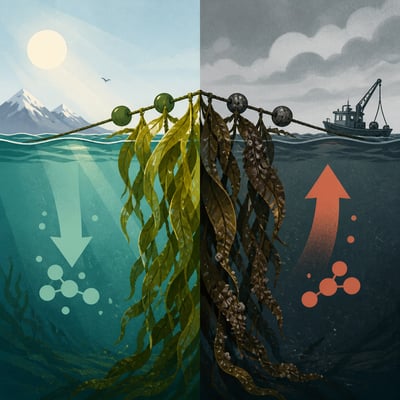
Research on kelp farming is producing mixed evidence about its climate value. An Alaska field study found one farm slightly lowered nearby CO2 while another increased it, underscoring strong site-specific effects from tides, sunlight, groundwater, and equipment fouling. Related research also points to seaweed’s carbon-capture potential through photosynthesis and alkalinity changes, but both the net benefit and scalability remain uncertain.

First Article: 01/08/26

Latest Article: 07/08/26

Summary

  • Field measurements at two Alaska kelp farms found opposite outcomes: one site slightly reduced local CO2, while the other increased it.
  • Carbon flux at the farms changed over short timescales, flipping with sunlight and time of day.
  • Local conditions such as extreme tides, groundwater flushing, farm size, species planted, and seasonal timing appear to shape results.
  • Marine growth on equipment and other site-specific biological effects added CO2 through respiration in at least one location.
  • Broader seaweed research continues to support carbon-capture potential, but net climate benefit depends on lifecycle accounting and full carbon balances.
  • Scientists involved in the Alaska work emphasize that kelp’s climate role is nuanced and should not be overstated.
  • Ongoing monitoring is planned, so the Alaska results currently represent an early-season snapshot rather than a final verdict.

History

This topic is new, but as new articles are added to it this area will summarize shifts, changes and expansions of the issues.

Featured

Timeline: 182 Days

Jan 8Feb 5Mar 19Apr 16May 28Jun 25

Additional Articles

⭐⭐⭐⭐⭐

Ocean Acidification International Coordination Center / Carolina Galdino07-08-2026
A lab study compared oxic and anoxic incubation conditions for macroalgae and found stronger dissolved inorganic carbon stabilization under anoxic respiration with limited N2O and CH4 offset.