
 Climate
 Privacy
 Bob Dylan
 Drones
 Data Centers
 AI Governance
 2026 Maine Senate Race
AI Campuses Race Against Power Constraints
Coverage from The Wall Street Journal, JD Supra, and others
Articles
33
Active Days
81
The Topic
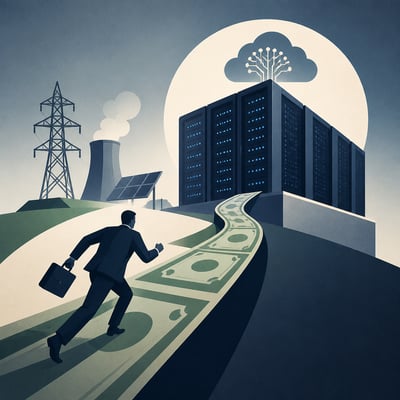
Large AI-focused data center projects are moving toward hundreds of megawatts and, in some cases, gigawatt-scale power requirements. Developers and investors are committing capital earlier through joint ventures, private debt, land facilities, GPU financing, and other structured arrangements, while utility interconnection delays, permitting, labor shortages, and community resistance slow delivery. The central question is whether power and construction capacity can arrive on schedule and whether AI demand will justify the scale of current investment.
First Article: 05/08/26
Latest Article: 07/27/26
Summary
- Power availability is repeatedly identified as the main constraint on U.S. data center development, with grid interconnections sometimes taking up to four years.
- Projects are becoming much larger, including campuses above 100 MW and a planned 300 MW European facility, increasing capital needs and delivery risk.
- Private credit, joint ventures, preferred equity, land-cost facilities, GPU financing, and forward sales are moving capital into earlier development stages.
- Bring-your-own-power and on-site generation strategies are gaining attention but add gas supply, air-permitting, transmission, and construction risks.
- Hyperscalers remain important tenants, but investors are seeking firmer offtake commitments and more balanced lease terms to manage concentration and delay risk.
- Contractors and developers are expanding capabilities and training programs as high-voltage work, fiber deployment, and skilled labor shortages pressure schedules.
- Analysts and investors remain divided over whether AI adoption will support current capital spending and future capacity requirements.
History
The story now puts greater emphasis on execution constraints and financing complexity around much larger AI data center builds, especially the growing role of contractors, structured capital, and tenant-demand discipline. It also broadens slightly with a clearer European large-project example and more explicit concern about whether AI demand will ultimately justify the spending.
The story has shifted from a finance-led boom in AI data centers to a broader infrastructure bottleneck story, with power delivery now the main gating factor. The new version emphasizes execution constraints, longer interconnection timelines, and the risk that capital could outpace durable AI demand.
Featured
Timeline: 81 Days
Hover over any logo to see coverage summary, click for full article.