
 Climate
 Privacy
 Bob Dylan
 Drones
 Data Centers
 AI Governance
 2026 Maine Senate Race
Cities Revise Data Center Rules
Coverage from Americus Times-Recorder, Lehigh Valley Public Media, and others
Articles
10
Active Days
56
The Topic
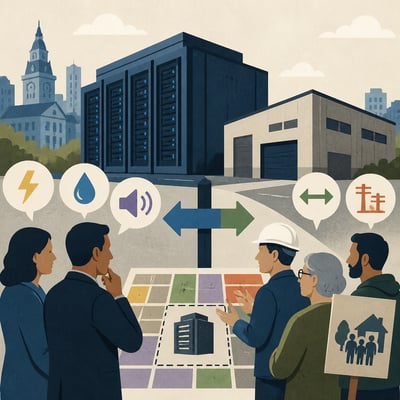
Cities in Pennsylvania, Ohio, and Georgia are tightening or considering rules for data centers as developers propose new facilities and warehouse conversions. Measures include industrial-district limits, conditional-use approvals, public hearings, setbacks, noise studies, and disclosures about water, electricity, backup power, and environmental effects. The decisions could affect whether projects proceed, how quickly they are reviewed, and who pays for mitigation or related utility work.
First Article: 06/02/26
Latest Article: 07/27/26
Summary
- Allentown is reviewing Quantm Group’s proposed conversion of a warehouse into an almost 250,000-square-foot edge data center after resident opposition and a withdrawn application.
- Akron’s planning commission approved a measure requiring future data centers to obtain conditional-use permits, disclose water and electricity use, complete noise studies, and identify backup power.
- Reading is considering limiting data centers to its Heavy Manufacturing district and may use a six-month curative-amendment moratorium to draft new rules.
- Americus is considering industrial-district siting, City Council approval, setbacks, and noise limits while officials assess possible company interest.
- Prologis received approval to convert a 1-million-square-foot warehouse in Allen Township, with closed-loop cooling and a privately funded electrical substation proposed to address infrastructure concerns.
- Across the proposals, residents and officials are focused on continuous noise, utility costs, water consumption, environmental effects, and proximity to homes, schools, parks, or childcare facilities.
History
The biggest change is that Akron’s data-center proposal has moved from planning-stage support to an approved conditional-use framework, while Allentown’s project has become more defined as a refiled edge data center after a withdrawn application. The story also sharpens around tighter siting and disclosure rules, with Americus and Reading still actively drafting restrictions.
The story has broadened from Allentown-area warehouse conversions to a wider multi-city push in Pennsylvania, Ohio, and Georgia to tighten data center zoning and approval rules. The new emphasis is on specific regulatory mechanisms—special approvals, hearings, disclosures, and moratoriums—that could slow or reshape projects already in the pipeline.
Featured
Timeline: 56 Days
Hover over any logo to see coverage summary, click for full article.