History
07/24/20260 new articles
The story now adds a third jurisdiction: Andover Township, where officials are moving to ban AI data centers outright. It also reframes the Palm Beach and Saline developments more specifically, emphasizing that one project was denied without prejudice while the other was allowed to proceed after settlement.
07/23/20260 new articles
The biggest update is that Michigan’s Saline campus now has a clearer regulatory path: state regulators conditionally approved the DTE Energy contracts, but the attorney general has appealed. The Florida fight also sharpened, with Palm Beach County’s denial now paired with a broader pause on new data center approvals.
- Michigan regulators conditionally approved DTE Energy contracts.
- The Michigan attorney general appealed that approval.
- Palm Beach County paused new data center approvals.
- Project Tango was denied after a 12-hour hearing.
07/23/20260 new articles
The main update is that the Saline Township dispute is now resolved through a settlement that explicitly lets the massive Related Digital campus move forward, while the Florida fight has shifted from a single denial to a denial plus a broader county moratorium and rulemaking effort. The story now places more emphasis on local governments trying to preserve control over siting decisions as developers respond with mitigation and utility arrangements.
- Saline Township settled the zoning lawsuit and let the campus proceed.
- The Saline campus is planned at 21 million square feet and 1.4 gigawatts.
- Palm Beach County imposed a moratorium while developing new data center rules.
- Developers are using battery storage and closed-loop cooling to reduce impacts.
07/22/202618 new articles
The story has broadened from a New Jersey zoning backlash to a clearer pattern of concrete regulatory and legal outcomes for major AI data center projects in Michigan and Florida. The biggest new development is that projects are now being actively blocked, litigated, or conditionally allowed to proceed based on local zoning, utility, water, and environmental constraints.
- Related Digital sued after Saline Township rejected rezoning.
- Settlement allowed the Saline campus to proceed.
- At least 19 Michigan municipalities adopted data center moratoria.
- Palm Beach County denied Project Tango by a 5-1 vote.
- Developers are revising cooling designs to address local concerns.
06/29/20262 new articles
The story has broadened from an Andover-specific zoning fight into a wider regional and regulatory picture, adding concrete examples of how other projects, lawsuits, and federal decisions are shaping data center siting. The biggest new development is that EPA’s retreat from nationwide standards shifts more environmental oversight to states and localities.
- Palm Beach County’s Project Tango is facing hearings, objections, and a lawsuit.
- EPA will not set nationwide AI data center environmental standards.
- Citizen suits may play a larger role in environmental enforcement.
- Regulation is now described as fragmented across local, state, and federal levels.
06/20/2026Topic Formed
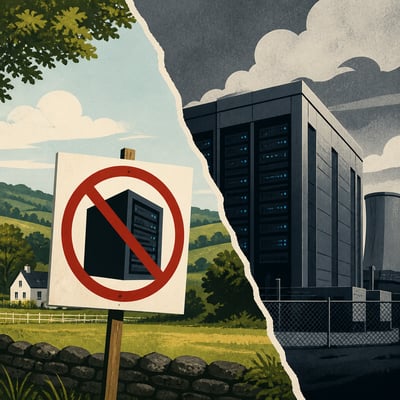
Andover Township, New Jersey is moving toward ordinances that would ban AI data centers after a contentious public meeting and widely shared video intensified local backlash. Residents have framed the project as a threat to the rural landscape, environment, and quality of life, while township officials have pointed to possible tax revenue as a competing interest. The dispute fits a broader pattern of municipalities reacting to data center proposals with moratoriums, bans, and tighter zoning rules.

 Climate
 Privacy
 Bob Dylan
 Drones
 Data Centers
 AI Governance
 2026 Maine Senate Race