History
07/23/20260 new articles
The story now places greater emphasis on Oracle’s Project Jupiter as a major fuel-cell-enabled AI campus and adds a more specific Wyoming off-take arrangement, sharpening the sense that onsite power is moving from concept to contracted deployment. It also reframes the constraints slightly, adding local moratoriums and stronger focus on cost and water tradeoffs.
07/22/20261 new articles
The story broadened from Bloom’s data-center fuel-cell deals to a wider onsite-power stack that now includes battery storage and a new Nebius deployment. It also adds more concrete execution detail, especially the first 328 MW Bloom-Nebius project expected online in 2026.
- Nebius and Bloom announced a first 328 MW fuel-cell-powered project.
- Operations are expected to begin later in 2026.
- Battery storage is being used to bridge delayed firm transmission service.
- Brookfield plans Bloom fuel cells as its preferred onsite power technology.
- Bloom cites a vendor-sponsored survey saying 61% of developers would bring their own power.
06/29/20260 new articles
The story is more concretely anchored by two specific commercial moves: a Brookfield AI infrastructure partnership and AEP’s large fuel-cell procurement tied to Wyoming. It also tightens the framing around power availability as the dominant constraint, while expanding the supporting context to include community scrutiny and other buildout friction.
06/23/2026Topic Formed
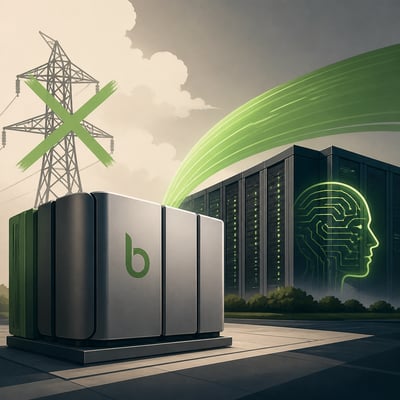
The material centers on Bloom Energy's growing role in AI data center power supply, especially through solid oxide fuel cells that can be deployed onsite faster than grid power. Major partnerships with Oracle, Brookfield, Nebius, and AEP frame Bloom as a beneficiary of electricity constraints in the AI buildout. The topic also includes broader evidence that power access, permitting, water use, emissions, and grid reliability are becoming defining constraints on data center expansion.

 Climate
 Privacy
 Bob Dylan
 Drones
 Data Centers
 AI Governance
 2026 Maine Senate Race