
 Climate
 Privacy
 Bob Dylan
 Drones
 Data Centers
 AI Governance
 2026 Maine Senate Race
PJM Faces Data Center Power Strain
Coverage from The Wall Street Journal, Reuters, and others
00/00/0000
Articles
60
Active Days
82
The Topic
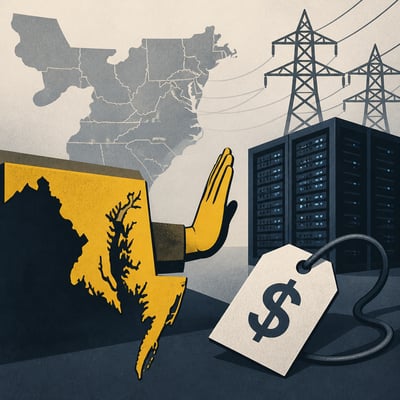
Data center demand is adding pressure to PJM Interconnection as the regional grid approaches record peaks, faces transmission congestion, and secures less reserve capacity than required by its reliability standard. The strain is increasing wholesale and industrial electricity costs while prompting emergency curtailment authority, new market rules, and scrutiny of how large loads connect to the grid. Developers and power companies are responding through project revisions, onsite generation, and acquisitions of generation-connected sites, but available capacity remains limited.
First Article: 05/07/26
Latest Article: 07/27/26
History
The story now adds concrete project-level responses to PJM stress, with data center developers revising or withdrawing plans and at least one operator pursuing a generation-linked site strategy. That shifts the narrative from systemwide strain and policy debate to how specific projects are being reshaped by congestion, costs, and grid-access constraints.
The story has shifted from a cost-allocation dispute into a broader reliability and market-stress problem: PJM is now dealing with record demand, capacity shortfalls, and emergency curtailment as data center load rises. The latest auction and price data show the issue is already driving materially higher costs for customers and industrial users.
- PJM approached or exceeded its 20-year demand record during hot weather.
- Latest PJM capacity auction left a roughly 6.8 GW reliability shortfall.
- Monitoring Analytics said data centers accounted for $6.3 billion of capacity-auction charges.
- Wholesale prices in Northern Virginia topped $2,000 per MWh during stress periods.
- Manufacturers are considering load shifting, direct natural gas, or onsite generation.
The story has broadened beyond Maryland’s FERC fight to include Ohio-specific tariff and cost-allocation responses, plus a new federal emergency step on backup power. That shifts the focus from a single regional billing dispute to a wider PJM-area effort to make data centers carry more of the infrastructure and reliability burden they create.
- Ohio electric cooperatives created a separate data center load process.
- AES Ohio proposed a new data center tariff facing criticism from manufacturers.
- DOE issued an emergency backup-generation order for data centers.
- Backup-power costs are now part of the dispute.
- Ohio stakeholders are pushing direct operator cost responsibility.
The story has narrowed from a broad PJM-wide data center grid dispute to a sharper Maryland-centered fight over who should pay transmission upgrade costs. It now adds more explicit cost estimates and elevates the jurisdictional battle among FERC, PJM, and state officials over tariff authority and reliability planning.
- $2 billion transmission cost estimate
- $1.6 billion in added Maryland bills over a decade
- PJM warning on stronger forward commitments
- Possible curtailment of unbacked large loads
- Maryland advocates pressing FERC directly
The story has narrowed from a broad PJM-wide dispute into a more concrete state-policy fight, with Maryland and Pennsylvania now the clearest places where data-center cost shifting is being turned into law and regulatory standards. The new emphasis is less on abstract grid pressure and more on specific rulemaking, tariff design, and who will absorb rising costs.
- Maryland and Pennsylvania are now the main policy front lines.
- Maryland law and regulatory filings are explicitly tied to data center cost shifting.
- Pennsylvania has moved toward model tariffs and standards for data centers.
- Data center backup generation is being used as a PJM reliability resource.
- Reform debates now include structural procurement and curtailment rules.
The story has broadened from a PJM cost-allocation fight into a more explicit regional policy response, with states and federal actors now moving on tariff design, development standards, and emergency reliability measures. The new emphasis is less on isolated disputes and more on a sustained regulatory push to shift costs and operational risk onto large data center users.
- Virginia and Senator Mark Warner enter the cost-allocation debate.
- FERC becomes a venue for PJM rule review and cost complaints.
- DOE emergency orders temporarily authorize backup generation use during PJM stress.
- States are tightening tariffs, rate classes, permitting guardrails, and development standards.
- PJM is advancing backstop auctions and potential curtailment for new large loads.
The story has become more explicitly multi-state and regulatory, with Pennsylvania and Ohio joining Maryland and PJM in active large-load rulemaking. It also adds a new federal and governance angle, as DOE emergency measures and FERC scrutiny now sit alongside the cost-allocation fight.
- Pennsylvania Governor Josh Shapiro is now a named actor in large-load rulemaking.
- Ohio electric cooperatives and Buckeye Power are developing separate cost-allocation processes.
- DOE emergency orders are allowing backup generation and curtailment measures.
- FERC scrutiny now includes PJM procurement timing and governance.
The story has broadened from a cost-allocation dispute into a fuller PJM reliability and market-design crisis driven by data center load growth. New developments add emergency operating actions, federal involvement, and more explicit state responses, raising the urgency beyond billing questions.
- DOE authorized emergency curtailment of backup-equipped large loads during PJM stress events.
- FERC is now involved in PJM cost-allocation and reliability auction disputes.
- Ohio approved a large-load tariff and cooperatives are crafting separate cost allocation rules.
- PJM is considering backstop auctions and connect-and-manage reforms.
- Reliability concerns have shifted into actual operations during hot-weather stress.
The story shifts from a broad dispute over data center-driven power prices to a more specific fight over who pays for PJM's transmission and capacity upgrades. It also adds clearer emphasis on PJM's proposed market reforms to manage scarcity and limit unbacked large-load growth.
The story has shifted from a Maryland-led dispute over PJM cost allocation to a broader, more urgent debate over how data center growth is affecting prices, reliability, and future market rules across PJM. PJM is now explicitly weighing stronger measures such as direct contracting, long-term procurement, and curtailment for large new loads.
- PJM is considering direct contracting for large data center users.
- PJM has floated curtailment rules for unbacked new large loads.
- Load growth is colliding with slower generation buildout and retirements.
- Outdated interconnection processes are now part of the reliability concern.
- Consumer advocates, not just state officials, are leading the cost-rule challenge.
The story has widened from a Maryland-specific fight over transmission cost allocation to a broader PJM-wide affordability and reliability problem tied to data center load growth. The new emphasis is on rising wholesale and capacity prices, supply constraints, and reform proposals rather than only on Maryland’s complaint.
Maryland officials are challenging PJM Interconnection’s plan to assign a large share of data center-driven transmission costs to Maryland ratepayers. The dispute centers on whether the costs should instead be charged to the states or customers where the data centers are built and whether PJM’s load forecasts justify the infrastructure spending. PJM is separately considering broader market reforms as data center demand strains grid planning and raises reliability concerns across its 13-state footprint.