History
07/25/20264 new articles
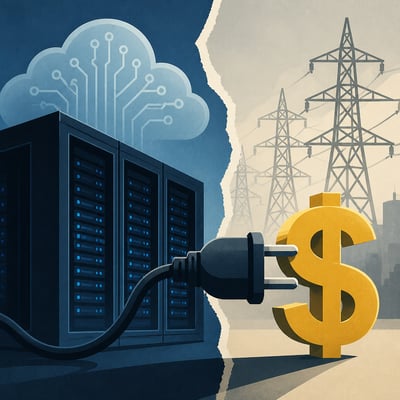
The main update is a reframing toward a broader, more explicit effort to shift data center-related power and grid costs away from households and small businesses and onto large users. The current version also emphasizes growing state-level actions and PJM’s worsening congestion and supply-demand strain as the policy debate intensifies.
07/24/20264 new articles
The story has become more specific and concrete: the White House’s ratepayer pledge was expanded and the House is now advancing related bills, while fresh grid stress data from PJM and state actions in Florida and New York sharpen the urgency. The debate is also widening from abstract cost allocation to immediate concerns about congestion, construction timing, and who bears near-term grid pressures.
- Trump expanded the Ratepayer Protection Pledge to cover 80% of U.S. power delivery.
- PJM congestion costs reached $3.2 billion in 2025.
- Florida enacted limits on passing data center energy costs to smaller customers.
- New York paused large server-warehouse construction for one year.
- House proposals now explicitly target large-load grid-upgrade cost allocation.
07/24/202622 new articles
The story has broadened from a narrow federal cost-allocation debate into a more active, multi-level policy push. In addition to congressional bills, the White House, state regulators, utilities, and tech companies are now directly shaping how data center power costs get assigned.
- White House Ratepayer Protection Pledge adds a parallel policy track.
- Several governors, utilities, and tech firms have signed nonbinding cost-sharing principles.
- Some states are adopting or considering special data-center rate classes.
- Other states are slowing or pausing large data center development.
- Critics are now emphasizing water, emissions, and local infrastructure impacts.
06/28/20266 new articles
The story has broadened from a Senate-driven cost-allocation push into a more explicit federal and state regulatory effort centered on large data centers, with a clearer 100 MW threshold and a stronger focus on making operators directly fund infrastructure. It also now includes public alignment from major tech companies, suggesting the policy direction is gaining practical acceptance.
- 100 MW is now the recurring threshold for new rules.
- House Energy and Commerce Committee is advancing the Ratepayer Protection Act.
- Google and Microsoft publicly support paying their own costs.
- State utility commissions are now key implementation actors.
- Late June 2026 saw the most active legislative movement.
06/18/2026Topic Formed
Senators Adam Schiff and Mark Warner are advancing data center legislation focused on shifting grid upgrade costs away from utility customers and onto large energy users. The proposals respond to rising electricity demand from AI and seek to improve reliability, interconnection, and cost allocation through Federal Energy Regulatory Commission and state-level rules. A recurring idea is that new data centers should bring dedicated power, storage, or flexibility to reduce strain on the electric grid.

 Climate
 Privacy
 Bob Dylan
 Drones
 Data Centers
 AI Governance
 2026 Maine Senate Race