History
07/23/20260 new articles
The story now emphasizes that several projects are already operating or approved, while the controversy has sharpened around specific local constraints on power, water, noise, and community costs. It also adds more concrete examples of generator permitting and local blocking actions, making the regulatory and neighborhood backlash more tangible.
07/22/202611 new articles
The story widened from an Illinois-focused fight over incentives and rules into a multi-state conflict over whether data center growth is worth the grid, water, land, and environmental burdens. New local and state responses now range from detailed review requirements to moratoriums and bans, while the Illinois POWER Act has become more specific about cost-shifting and disclosure obligations.
- Debate now extends across Illinois, Iowa, Indiana, and Missouri.
- ComEd warns queued loads could more than double northern Illinois peak demand by 2040.
- Aurora and Ames are reviewing energy, water, noise, and infrastructure impacts.
- Indiana projects seek permits for large diesel backup-generator fleets.
- Missouri communities have used bans or political pressure against CRG projects.
06/29/20262 new articles
Illinois has moved from a general debate over data center regulation to a more concrete policy push: the governor has paused new tax incentives while lawmakers negotiate statewide guardrails. The current focus is now on specific requirements for energy supply, water reporting, and host-community agreements, with next action likely delayed into later sessions.
- Gov. JB Pritzker paused new Illinois tax incentives for data centers.
- The POWER Act would require renewable energy supply, water-use reporting, and community benefits agreements.
- Spring-session talks stalled, extending negotiations into summer and possibly fall veto session.
- Industry groups say the proposed rules are too broad and should apply more evenly.
- Large power requests and AI-related demand are intensifying concern over Illinois infrastructure.
06/24/20265 new articles
The story has shifted from a general debate over data center growth to a more advanced, policy-specific fight centered on the POWER Act, with water, transparency, and permitting rules now explicitly in play. It also appears more urgent because spring legislation failed and negotiations have moved into a summer renegotiation phase.
- Water and wastewater rules are now central to the debate.
- Spring legislation failed before summer renegotiation began.
- Pritzker paused tax incentives while urging guardrails.
- Aurora adopted data center study and standards requirements.
- Transparency requirements became a specific policy demand.
06/20/2026Topic Formed
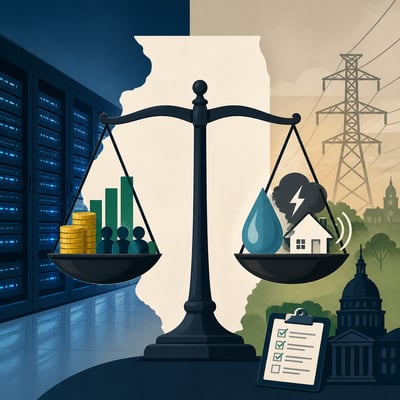
Illinois lawmakers and local governments are weighing how to manage rapid data center expansion driven by AI demand. The core dispute is whether tax revenue, jobs, and investment justify higher energy use, water demand, noise, and potential grid strain. Proposed rules such as the POWER Act and local ordinances in places like Aurora and Champaign County show a move toward stricter oversight, but the shape of statewide regulation remains unsettled.

 Climate
 Privacy
 Bob Dylan
 Drones
 Data Centers
 AI Governance
 2026 Maine Senate Race