History
07/23/20260 new articles
The core story is unchanged, but the framing has shifted toward more explicit ratepayer-protection and infrastructure-cost concerns as Louisiana develops safeguards for large-load projects. The current version also broadens the project’s operational implications by emphasizing storage, training, and community impacts alongside power buildout.
07/22/202621 new articles
The story has expanded from a disputed data-center buildout into a much larger, more concrete megaproject: Meta now plans 5 GW of compute capacity, over $50 billion in investment, and a 2036 full-operations target. The coverage also adds specific infrastructure and workforce commitments, while regulatory scrutiny now centers on how Entergy’s new power buildout will be approved and whether ratepayers are insulated.
- Planned capacity increased to 5 gigawatts.
- Investment estimate rose above $50 billion.
- Full operations are targeted for 2036.
- Meta disclosed $1.6 billion in Louisiana contracts and 7,500 peak jobs.
- Landry ordered a ratepayer-protection framework for large-load projects.
06/29/20262 new articles
The story has sharpened from a broad account of Meta’s Hyperion buildout into a more policy-centered dispute over how Louisiana will allocate power, infrastructure, and tax costs. The biggest new wrinkle is the explicit focus on Entergy’s proposed power plant purchase and PSC scrutiny of whether ratepayers are being protected.
- Entergy’s proposed power plant purchase is now a central issue.
- Tax incentives are estimated at about $3.3 billion.
- Consumer advocates are pressing for stronger cost-responsibility rules.
- Coverage raises broader grid strain and disclosure-gap concerns.
- Gov. Jeff Landry is now identified as pushing a ratepayer protection framework.
06/14/20263 new articles
The story has broadened from a general Louisiana hyperscale buildout to a more specific and sustained Meta AI data center project in Richland Parish, with clearer emphasis on long-term utility, financing, and fiscal commitments. The new version also sharpens the framing around structural public exposure, not just near-term community impacts.
05/30/20263 new articles
The story has broadened from Meta’s Hyperion campus into a wider Louisiana hyperscale data center buildout, with new large-load players and utility cost-allocation concerns now central. The most important new issue is whether infrastructure upgrades will be borne by developers or shifted partly to ratepayers.
- Amazon and Hut 8 now appear in Louisiana load-growth reporting.
- Entergy Louisiana is also building substation infrastructure.
- PILOT-based local payments are part of the incentive structure.
- Cost shifts to ratepayers are now a central concern.
- The story now covers multiple Louisiana parishes and regions.
05/19/2026Topic Formed
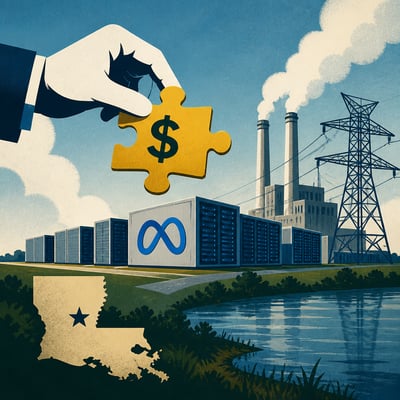
Meta is building the Hyperion AI data center campus in Richland Parish, Louisiana, with a large public incentive package and major new energy infrastructure attached to the project. Reporting centers on the estimated $3.3 billion in tax breaks, the scale of the campus, and the need for new gas-fired power plants and transmission work to serve it. The project is also generating local debate over jobs and tax revenue versus water use, energy costs, and the speed of approvals.

 Climate
 Privacy
 Bob Dylan
 Drones
 Data Centers
 AI Governance
 2026 Maine Senate Race