History
07/28/20262 new articles
The story now centers more explicitly on a coordinated nationwide protest campaign and adds President Trump as a visible pro-development counterweight. It also sharpens the policy picture with specific state responses, including New York’s proposed moratorium and Maine’s vetoed bill.
07/27/20265 new articles
The story now includes a broader set of political and stakeholder responses, with governors, lawmakers, unions, religious leaders, and even national figures weighing in on data center expansion. It also adds a stronger regulatory angle, as permitting, moratoriums, and developer commitments are becoming more central to the dispute.
- Governors and lawmakers are debating moratoriums and other limits.
- Texas officials are calling for restraint on rapid development.
- Developers and utilities face pressure for transparency and bill protections.
- Labor unions and religious leaders have joined the backlash.
- Threat researchers say foreign actors are amplifying genuine grievances.
07/25/20262 new articles
The story has shifted from general local resistance to a more organized, politically salient backlash, with coordinated protests, bipartisan election implications, and added concern about foreign amplification. The issue is now framed less as isolated permitting fights and more as a national campaign shaping state policy and 2026 electoral politics.
- HumansFirst organized protests across at least 125 U.S. locations.
- The backlash is becoming a 2026 election issue.
- Foreign-linked media and fake accounts are amplifying the controversy.
- Polling distinguishes nearby-facility opposition from national moratorium support.
07/24/20263 new articles
The story has broadened from a mostly U.S.-focused opposition wave into a more structural backlash centered on resource use, with new polling, policy responses, and host-community bargaining now shaping the narrative. It is less about isolated project fights and more about a durable, politically visible constraint on data center expansion.
- Polling now shows most Americans oppose nearby data centers.
- Developers are proposing community-benefit terms like host fees and profit sharing.
- Land prices are rising around major hyperscaler buildouts.
- Japan has joined the list of affected countries.
- State responses are moving toward formal reporting and siting standards.
07/22/2026Topic Formed
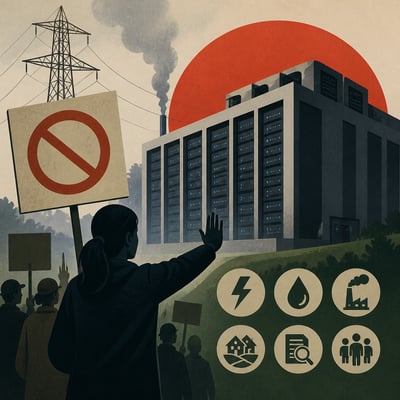
Opposition to new U.S. data centers is spreading from individual local disputes into coordinated protests, state-level policy debates, and project delays. Residents and officials are focused on electricity costs, water use, pollution, land acquisition, transparency, and whether communities receive durable benefits. The trend is creating new pressure for moratoriums, stricter approvals, environmental review, and developer accountability, while similar conflicts are emerging internationally.

 Climate
 Privacy
 Bob Dylan
 Drones
 Data Centers
 AI Governance
 2026 Maine Senate Race