
 Climate
 Privacy
 Bob Dylan
 Drones
 Data Centers
 AI Governance
 2026 Maine Senate Race
Oregon Raises Data Center Power Rates
Coverage from OPB, Utility Dive, and others
00/00/0000
Articles
39
Active Days
78
The Topic
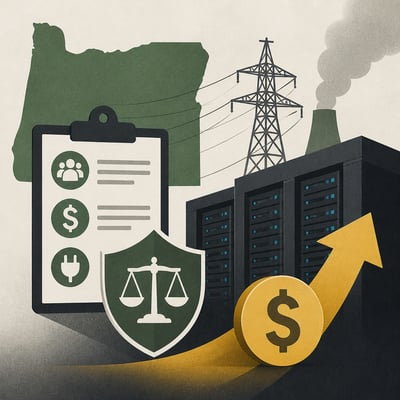
Oregon is placing data centers and other large electricity users in dedicated rate structures that raise their power costs and assign more grid-upgrade obligations to them. In the Tri-Cities region, Bonneville Power Administration rules and Washington’s carbon-free electricity requirements make very large facilities difficult and expensive to serve without new dedicated generation, transmission, storage, or nuclear power. Together, the developments indicate that electricity pricing, emissions compliance, and reliable supply are becoming central constraints on data center timelines and location decisions.
First Article: 05/08/26
Latest Article: 07/24/26
History
The story now frames the constraints more explicitly around emissions compliance and dedicated power supply needs, especially in the Tri-Cities, where very large data centers may require new generation or transmission rather than standard utility service. Oregon’s tariff changes remain the core implementation story, but the updated version broadens the emphasis from pricing and cost shifting to site feasibility and resource adequacy.
The story has broadened from Oregon’s PGE large-load tariff to a wider Pacific Northwest constraint environment, adding BPA pricing rules and Washington clean-energy limits that shape data center development in Tri-Cities. The latest version also confirms implementation timing in 2026 and frames the issue more explicitly as a regional cost-and-power-supply problem.
- Tri-Cities projects face BPA pricing rules and New Large Single Load thresholds.
- Washington clean-energy requirements complicate always-on data center power supply.
- PGE tariff implementation is taking effect in June and July 2026.
- The story now covers the broader Pacific Northwest power system.
The story has moved from a general Oregon large-load tariff framework to a more specific implementation picture, with PGE’s Schedule 96 now described as producing an average 29% rate increase and tighter cost-allocation rules. The scope also broadened beyond Oregon into Tri-Cities, Washington, where BPA-related limits are now part of the same large-load power-cost story.
- PGE large-load customers face an average 29% electricity rate increase.
- Projects above 100 MW face a 1 cent-per-kWh surcharge.
- Tri-Cities utilities face BPA limits on new large loads.
- Implementation timeline and final tariff details remain under review.
Oregon has moved from a broad push toward special data-center treatment to an approved, named tariff framework in PGE territory. The biggest new element is that Schedule 96 now formally sets higher direct-cost responsibility and extra charges for very large loads, making the policy more concrete and operational.
- Oregon regulators approved Schedule 96 for data centers over 20 MW.
- Very large projects face a new 1 cent/kWh surcharge.
- Schedule 96 includes reporting rules and minimum demand charges.
- Other Oregon utility territories still lack resolved large-load rules.
The story has tightened around Oregon specifically, with new detail that Portland General Electric is actively proposing or operating tariff structures that materially raise data-center costs while shifting more risk and infrastructure expense onto those customers. The main added wrinkle is that the framework is still being reviewed and delayed by regulators, so implementation is underway but not fully settled.
Oregon’s data-center rules have moved from general tariff direction into active implementation, with more explicit customer-specific billing, cost-allocation, and connection guardrails now in place. Pennsylvania remains part of the story, but it is now framed as a looser, less binding parallel rather than an equal regulatory driver.
The story has broadened from state tariff design to include a new regional infrastructure consequence: data center load growth is now being linked to fresh gas generation and pipeline proposals in Oregon and Washington. The regulatory piece is also more concrete, with Oregon's large-load framework described as implemented and Pennsylvania's as moving forward in model form.
- Data center demand is influencing new gas generation and pipeline proposals.
- Columbia Riverkeeper is the source linking demand growth to gas infrastructure plans.
- Washington state is now part of the infrastructure story.
- Williams Northwest Pipeline is newly named in the response.
- Oregon's framework includes long-term contracts and surcharge rules.
Oregon's approach has moved decisively from policy design into implementation, with a named tariff framework now in force for large data centers. Pennsylvania remains part of the story, but its rules are still more tentative and less operational than Oregon's.
- Oregon created Schedule 96 for large data centers.
- Oregon rules took effect in June.
- New hookups now depend on emissions-free electricity availability.
- Pennsylvania proceedings are still pending.
- Consumer-protection and reporting provisions are now part of the framework.
The story has broadened from an Oregon-only implementation update into a multi-state regulatory trend, with Pennsylvania now joining Oregon in formalizing special rules for large data centers. Oregon also appears more developed and specific, adding emissions-free power conditions and broader tariff/queue controls rather than only cost-allocation changes.
- Pennsylvania Public Utility Commission adopted a model tariff framework.
- Large-load interconnection and queue controls are now central policy tools.
- Oregon rules include emissions-free electricity requirements.
- Deposits and financial-security requirements are now explicitly mentioned.
The story has become more concrete: Oregon’s data-center rules are no longer just a broad cost-shift framework, but are now being implemented through the 2025 POWER Act and utility-specific billing changes, especially at Portland General Electric. The framing also tightened around protecting other customers from infrastructure costs and tying new connections to clean-energy and emissions conditions.
The story has moved from general regulatory tightening to clearer implementation details: Oregon is now actively applying the POWER Act through specific tariff structures, charges, and contract conditions for large data centers. A new element is that surcharge revenue may also support low-income efficiency programs, widening the policy’s downstream effects.
The story has shifted from a general description of Oregon’s data-center rate reforms to a clearer picture of active implementation under the POWER Act, with PGE’s Schedule 96 and related proceedings showing the rules are now being applied in practice. The main new emphasis is on execution and enforcement: utilities are being assigned separate customer classes, cost recovery terms, and clean-energy conditions.
Oregon regulators are putting new rules in place to make large data centers pay more directly for the electricity infrastructure and grid expansion they require. The main changes include separate rate classes, minimum payment obligations, exit fees, reporting requirements, and surcharges that help fund efficiency programs for low-income households. The framework is designed to reduce cost shifting to residential and small business customers while aligning new load growth with Oregon’s clean energy obligations.