

Last Update: 06/03/2026 at 4:01 AM EST
Shanghai Underwater Data Center Launch
Coverage from CleanTechnica, New Atlas, and others
Articles
4
Latest Article
06/01
Active Days
17
Executive Summary
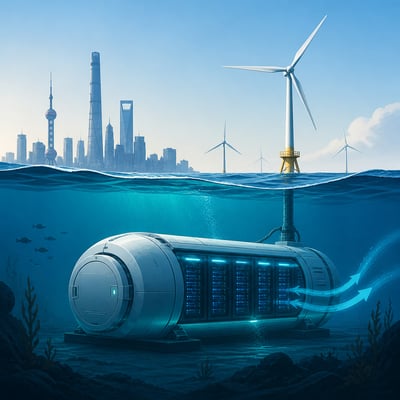
China has brought a commercial underwater data center near Shanghai into full operation, pairing subsea server modules with offshore wind power and seawater cooling. The project is being framed as a test case for reducing land use, cooling demand, and electricity intensity as AI-driven compute loads grow. It also raises unresolved questions about durability, maintenance, and marine environmental impact at commercial scale.
Key Points
- The facility near Shanghai is now operating commercially as an underwater data center powered largely by offshore wind.
- Seawater is used as a passive heat sink, reducing cooling needs compared with conventional land-based centers.
- The project is designed around about 24 MW of capacity, with current operations reported around 2.3 MW in pilot or initial use.
- The site reportedly contains roughly 192 server racks, including GPU-oriented workloads tied to AI and data processing.
- Officials and company reporting emphasize lower land use, reduced electricity consumption, and high renewable energy share.
- Engineering risks remain significant, especially corrosion, pressure sealing, subsea cable reliability, and maintenance access.
- The deployment is being treated as a practical test of whether underwater computing can scale beyond experimentation.
Featured Article
Shanghai Lingang underwater data center powered by offshore wind reached full commercial operation in 2025 after February trials and June launch near 35-meter-deep subsea modules.
Coverage Timeline: 17 Days
Hover over any logo to see coverage summary, click for full article.
Additional Articles
⭐⭐⭐⭐⭐
Microsoft Project Natick and a Shanghai Lingang commercial underwater data-center show sealed marine cooling is feasible, while maintenance, cables, and environmental risks remain deciding constraints.
⭐⭐⭐
China Communications Construction subsidiary switched on an underwater data center near Shanghai's Lin-hang Special Area after phase one completion, using offshore wind power and sealed ocean cooling.
A Lingang Special Area offshore platform off Shanghai began commercial operation of a 2.3 MW underwater data center powered by offshore wind, targeting 24 MW capacity.