History
07/23/20260 new articles
The main change is a sharper emphasis on the state-versus-locality fight over data center siting and tax benefits, alongside a clearer assertion that the Department of Commerce says Fundamental Data missed a certification deadline. The current version also broadens the political framing by highlighting lawmakers’ defense of HB 2014 amid public opposition.
07/22/20263 new articles
The story has shifted from a broad debate over HB 2014 and scattered project opposition to a more specific legal and regulatory fight centered on the Ridgeline project. The new dispute over certification timing, land control, and permit-related records makes the controversy more concrete and actionable.
- Ridgeline is described as a 5.2-gigawatt project across Tucker and Grant counties.
- Fundamental Data disputes a June 17, 2026 certification deadline.
- Advocates want DEP to review conflicting land-control records.
- West Virginia Highlands Conservancy and Sierra Club are now active opponents.
06/29/20260 new articles
HB 2014 has moved from a general state-backed certification push into enacted law, making state preemption over local data center oversight the central story. The current version also sharpens the competitive framing, with officials and developers now openly pitching West Virginia as a lower-friction destination for large campuses while local resistance stays strong.
- HB 2014 is now enacted state law.
- It limits local zoning power over high-impact facilities.
- It narrows public disclosure requirements.
- Officials are pitching West Virginia as a lower-friction siting location.
- Tax gains are shifting mainly to the state, not local governments.
06/29/20263 new articles
The story has broadened from a general push for faster data center approval into a more concrete wave of project-specific proposals across several West Virginia locations, with new developers and campus plans now driving the debate. The most important new element is that power, permitting, and local opposition are no longer abstract policy issues but are tied to named projects in Wheeling and White Hall as well as the existing Tucker and Berkeley County disputes.
- Silicon Foundation Energy LLC is pursuing a phased campus in Wheeling.
- The story now includes White Hall and Wheeling as active proposal sites.
- One proposal is framed as a brownfield redevelopment.
- Projects now cite 100 MW campuses and 600 MW power access needs.
- Transmission access and gas-fired generation are now central planning issues.
06/21/20263 new articles
The story has broadened from a general state-led data center push into a more defined regulatory-and-infrastructure fight, with West Virginia agencies now actively shaping the approval path and major grid issues becoming central. The latest version also makes the local preemption dispute more explicit, especially around zoning, disclosure, and tax control.
06/14/20264 new articles
The story has broadened from a single Berkeley County project update into a statewide policy-and-implementation narrative. The key new development is that West Virginia’s data center framework is now moving from legislation into execution, highlighted by the first microgrid certification application and growing disputes over local control and tax treatment.
- First data-center-linked microgrid certification application has been filed.
- HB 2014 is now moving through certification rules and implementation.
- Local opposition is spreading across multiple counties.
- Tax treatment and local revenue sharing remain unsettled.
- Story now includes Tucker, Putnam, Logan, and Mingo counties.
05/30/20260 new articles
The story has narrowed from a broader state-level data center push to a more specific, public-facing proposal centered on Penzance's Bedington campus, with clearer details on power, water, and permitting. The main new development is the emphasis on local infrastructure planning and the claim that the project can proceed without increasing resident electricity costs.
05/18/2026Topic Formed
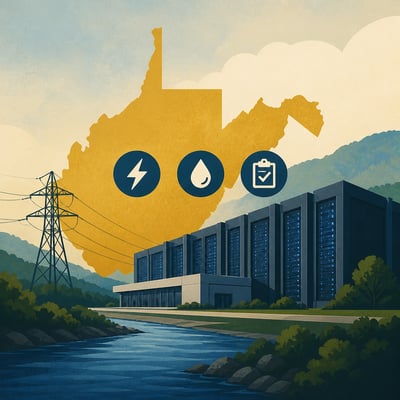
West Virginia is actively positioning itself for large-scale data center development, led by the proposed $4 billion Bedington campus in Berkeley County and additional site exploration in Marion County. The discussion centers on power availability, water sourcing, permitting, and how the state can attract investment while addressing local concerns.

 Climate
 Privacy
 Bob Dylan
 Drones
 Data Centers
 AI Governance
 2026 Maine Senate Race