History
07/23/20261 new articles
The story has broadened from spray drones mainly for crop protection to a wider commercial farm-tool category that also includes spreading and lifting, with more emphasis on larger-scale operations and precision features. The framing also tightens the main constraints around regulation, chemical labeling, insurance, weather, and operator safety, while adding Europe as a regulatory barrier zone.
07/22/20269 new articles
The story has broadened from a Midwestern custom-application niche into a larger commercial spray-drone market, driven by DJI’s new higher-capacity Agras models and wider competitive pressure. It now places more emphasis on operational and regulatory constraints that determine whether drones can scale beyond niche use.
- DJI launched the Agras T55 and T100.
- The story now includes orchard-focused spraying features.
- Competition now includes Hylio, Pegasus Robotics, Exedy, and Drone Aerotech.
- FAA compliance and insurance are now explicit adoption constraints.
- The use case expands to wet fields, steep terrain, and labor shortages.
06/29/20262 new articles
The story broadens from general U.S. Corn Belt adoption into a more specific picture of Illinois-centered custom-application work, with clearer emphasis on crop-protection and field-service use cases. It also adds a stronger training-and-drift-control frame, showing the market is now being judged as much on spray quality and compliance as on equipment scaling.
06/19/20264 new articles
The story has shifted from a general account of spray-drone use in difficult fields to a more specific picture of routine commercial adoption in the U.S. Corn Belt. The new version adds concrete operators, platforms, and field logistics showing the business is becoming operationally standardized rather than experimental.
- Illinois and Ohio operators are scaling spray-drone businesses.
- DJI and EAVision are now identified as competing platforms.
- Operators are adding trailers, generators, tanks, and landing decks.
- Service pricing is settling into per-acre models.
- Crop scouting is now part of the service mix.
06/11/2026Topic Formed
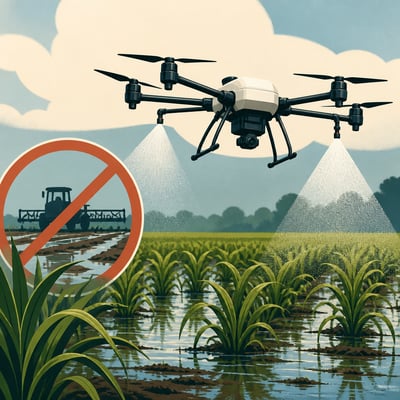
Agricultural drone services are being used to spray crops when wet ground, crop height, or field obstacles make conventional equipment less practical. The material emphasizes both the operational benefits of drone application and the training, licensing, and calibration needed to use it effectively. A small but growing service market is emerging around farm spraying, with companies framing drones as a faster, lower-drift alternative to planes or ground rigs in difficult conditions.

 Climate
 Privacy
 Bob Dylan
 Drones
 Data Centers
 AI Governance
 2026 Maine Senate Race