
 Climate
 Privacy
 Bob Dylan
 Drones
 Data Centers
 AI Governance
 2026 Maine Senate Race
New Drone Interceptors Target Shahed Threats
Coverage from European Security & Defence, EDR Magazine, and others
Articles
3
Active Days
1
The Topic
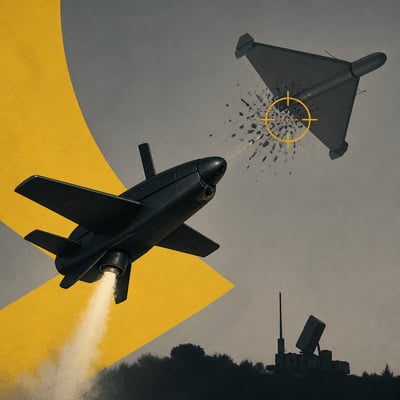
Granta Autonomy, Rafael and SpearUAV have introduced compact interceptor drones intended to engage Shahed-class strike drones, loitering munitions and other aerial threats. Black Wasp emphasizes VTOL deployment, autonomous guidance and operation during GPS disruption, while Iron Wasp is positioned as a canister-launched, vehicle-mounted interceptor within a layered defense system. The launches reflect continued efforts to provide faster, more deployable and potentially lower-cost alternatives or complements to missiles, guns and electronic warfare, but reported performance remains partly based on manufacturer claims.
First Article: 06/25/26
Latest Article: 06/25/26
Summary
- Granta Autonomy’s Black Wasp is a VTOL interceptor designed for field or rooftop launch without rails or specialized infrastructure.
- Black Wasp uses AI/ML flight control and computer-vision terminal guidance, with the company describing navigation as resilient to GPS and GNSS disruption.
- Rafael and SpearUAV’s Iron Wasp is a canister-launched interceptor intended to defend formations as part of a vehicle-mounted Force Protector C-UAS suite.
- Iron Wasp retains human supervision and an abort option during engagements, while detailed performance data have not been disclosed.
- Both systems are presented as responses to the cost and operational burden of defeating strike drones and loitering munitions with conventional air-defense resources.
- Granta says Black Wasp is undergoing or has undergone front-line testing in Ukraine and is designed for scalable manufacturing and rapid supply.
History
The story adds a more concrete operational framing: Black Wasp is now described as front-line tested in Ukraine, and Iron Wasp has a clearer integration path inside Rafael’s vehicle-mounted Force Protector system. It also introduces a new timing detail for Iron Wasp demonstrations and softens the certainty around performance by noting that key claims still rely on manufacturer assertions.
The story has broadened from Granta Autonomy’s Black Wasp alone to a wider counter-UAS trend, now including Rafael and SpearUAV’s Iron Wasp. The main shift is a reframing from one product launch to a broader emerging category of frontline drone interceptors built for cheaper, faster air defense under electronic warfare pressure.