
 Climate
 Privacy
 Bob Dylan
 Drones
 Data Centers
 AI Governance
 2026 Maine Senate Race
Bee-Nav Enables Tiny GPS-Free Drones
Coverage from Scientific American, Wisconsin State Farmer, and others
Articles
4
Active Days
32
The Topic
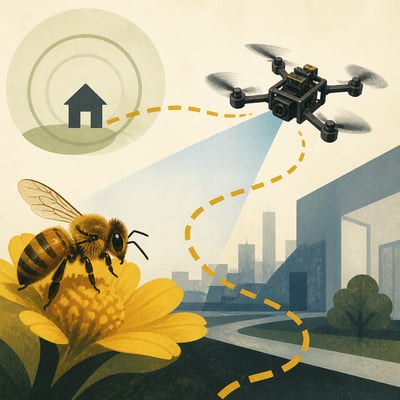
Researchers led by Delft University of Technology developed Bee-Nav, a honeybee-inspired navigation method that uses a short learning flight, panoramic images, odometry, and a very small neural network to guide lightweight drones home without GPS or detailed maps. Tests demonstrated homing over more than 600 meters with neural networks using 3.4 to 42 kilobytes of memory, but performance declined in windy conditions that changed the drone’s view. The approach could make smaller, lower-power drones more practical for greenhouse monitoring, inspection, and other GPS-denied uses, although obstacle avoidance, multi-location navigation, and broader environmental robustness remain unresolved.
First Article: 05/13/26
Latest Article: 06/13/26
Summary
- Bee-Nav combines a short learning flight with panoramic visual memories and odometry to estimate a route back to the launch point.
- Indoor demonstrations used neural networks as small as 3.4 KB, while outdoor tests used a 42 KB network.
- Trials at Unmanned Valley in the Netherlands covered more than 600 meters before the drone returned home.
- The system avoids GPS and computationally intensive mapping, reducing onboard memory, processing, weight, and power requirements.
- Indoor homing was consistently successful in reported large-space tests, while wind reduced outdoor performance to about 70% in one report.
- Wind-induced tilt changes the drone’s visual perspective, creating a key robustness problem.
- The method currently addresses homing rather than full navigation, so obstacle avoidance, route planning, and travel between multiple memorized locations remain necessary.
History
The story now has more concrete experimental detail, especially on the outdoor demonstrations: researchers reported more than 600 meters of homing and quantified a wind-related performance drop. It also sharpens the current limits by distinguishing homing from broader navigation tasks the system still cannot do.
The main change is a clearer and broader framing of Bee-Nav’s capabilities and limits: the current version adds odometry, specifies the tiny model sizes in indoor versus outdoor trials, and sharpens the remaining challenge around cluttered, dynamic environments and obstacle avoidance. It also expands the story’s research context by adding Wageningen University and publication reporting details.
Featured
Timeline: 32 Days
Hover over any logo to see coverage summary, click for full article.