History
07/22/20260 new articles
The story has broadened from Coast Guard and NOAA drone testing into more explicit 2026 operational plans, with NOAA now committing to a specific hurricane-season deployment of Saildrone Explorers and Black Swift aerial drones. The framing also shifts toward unresolved governance and effectiveness questions, not just adoption of unmanned systems.
06/29/20262 new articles
The story has shifted from a general account of autonomous maritime surveillance to a clearer operational expansion: the Coast Guard is scaling Saildrone deployments beyond the Great Lakes into the Northeast, while NOAA’s drone work is moving closer to routine hurricane-forecasting use.
05/30/20261 new articles
The story broadened from a Coast Guard-focused Great Lakes surveillance rollout to a wider U.S. government operational program that now includes NOAA using autonomous surface vehicles for hurricane and ocean research. The added missions and geography make the deployment look more established and multi-agency, while human oversight remains unchanged.
05/22/20260 new articles
The story is largely stable, but the latest version tightens the framing around a routine Coast Guard rollout and slightly narrows the mission language to surveillance, border monitoring, and weather support. It also more explicitly identifies Saildrone as the vendor behind the Voyager platforms.
05/21/20260 new articles
The story shifts from an expansion in autonomous sail-drone surveillance to confirmation that the Coast Guard is now actively deploying the systems in service on a seasonal basis. The emphasis is more operational and concrete, with added clarity on human oversight and manual control.
05/19/20260 new articles
The story is reframed from a general rollout of autonomous sail drones into a more operationally specific Coast Guard surveillance mission, with added emphasis on persistent border monitoring and collision-avoidance AI. The current version also makes the deployment sound more routine and integrated into ongoing Great Lakes coverage.
05/18/20260 new articles
The story has shifted from a broadly described expansion of Coast Guard autonomous sail drone operations to a more concrete operational rollout on the Great Lakes. The current version also narrows the mission emphasis to surveillance, cross-border traffic monitoring, and weather/safety data.
05/17/20260 new articles
The story now frames the Coast Guard effort as an expansion from a seasonal Great Lakes deployment toward a broader operational footprint, rather than just a discrete pilot. It also adds emergency-response support as a more explicit mission area alongside surveillance and weather collection.
05/16/20260 new articles
The story has shifted from a general expansion of Coast Guard autonomous surveillance to a more concrete, operational deployment with clearer evidence of contract-backed scaling. The strongest new signal is that the Great Lakes mission is now framed around specific seasonal operations, continuous oversight, and a larger potential fleet size.
05/15/2026Topic Formed
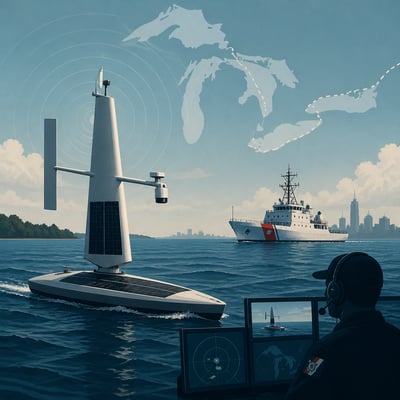
The U.S. Coast Guard is expanding use of autonomous Saildrone vessels on the Great Lakes to improve maritime domain awareness, border monitoring, and detection of suspicious activity. The systems combine wind-and-solar power with radar, cameras, AIS receivers, and AI-assisted collision avoidance, with human operators continuously overseeing the craft and stepping in when needed. The deployment reflects a broader shift toward persistent unmanned surveillance to support limited crewed patrol resources across large, busy waterways.

 Climate
 Privacy
 Bob Dylan
 Drones
 Data Centers
 AI Governance
 2026 Maine Senate Race