
 Climate
 Privacy
 Bob Dylan
 Drones
 Data Centers
 AI Governance
 2026 Maine Senate Race
Sudan Drone War Hits Civilians
Coverage from Reuters, CNN, and others
00/00/0000
Articles
14
Active Days
85
The Topic
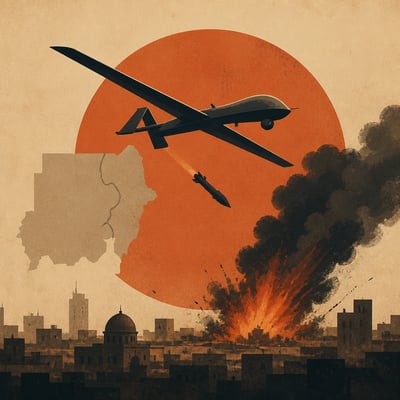
Drones have become a central means of warfare in Sudan’s civil war, used by both the Sudanese Armed Forces and the Rapid Support Forces for surveillance, battlefield strikes, and attacks on transport routes and infrastructure. El-Obeid and surrounding North Kordofan have emerged as a major flashpoint, with reported strikes affecting markets, schools, water facilities, aid shipments, and civilian vehicles. The escalation is worsening humanitarian conditions and complicating attribution, while reported foreign supplies are enabling both sides to sustain operations beyond traditional front lines.
First Article: 04/27/26
Latest Article: 07/20/26
History
The story now frames drone warfare as more operationally embedded and geographically broad, with both Sudanese factions explicitly using drones for surveillance, battlefield support, and supply-line disruption. It also adds a new tactical advantage: drone operations continuing through the rainy season when ground movement is constrained.
The story has sharpened around El-Obeid as the main drone-war flashpoint, with new reporting quantifying the civilian toll and showing the fighting is more intense and more lethal than before. The updated version also adds stronger evidence that foreign-made systems are being used by both sides, while responsibility for strikes remains contested.
- At least 15 strikes around El-Obeid were reported in June.
- Those strikes killed at least 45 civilians, according to UN reporting.
- UN figures cited by CNN said drones caused at least 880 civilian deaths in early 2026.
- Both sides reportedly use Turkish Bayraktar TB2 and Chinese FH-95 drones.
- Responsibility disputes now include allegations involving the RSF, SAF, UAE, and Ethiopia.
The story broadens from a sustained drone-warfare escalation into a sharper account of drones as a central mechanism of battlefield control and civilian disruption in Sudan. The new framing also emphasizes proxy-war dynamics and accountability problems more strongly than before.
- Drone warfare is now framed as central to Sudan’s civil war.
- Medical workers are moving treatment underground and changing procedures.
- Observers warn drones raise the risk of mass atrocities.
- Independent verification of some claims remains limited.
- The conflict is framed more explicitly as a proxy war.
The story has broadened from recurring drone strikes to a more operational picture of a two-sided drone war, where interception, foreign-supplied systems, and supply-line disruption now shape battlefield dynamics. The framing also shifts from mainly documenting civilian harm to emphasizing how drones affect territory control and ceasefire prospects.
- SAF is now explicitly tied to interception and pressure operations.
- RSF is now explicitly tied to targeted strikes and siege support.
- Medical actors are changing facility layouts because of drone risk.
- Humanitarian groups are using small drones for deliveries in hard-to-reach areas.
- Ceasefire diplomacy is described as failing to reduce drone activity.
The story has shifted from a general account of intensified drone warfare in Sudan to a more specific framing that it is now a persistent, countrywide feature of the civil war with clearer emphasis on foreign-supply accusations and accountability pressure. The current version also adds evidence of drone reuse and redeployment, suggesting the campaign is adapting rather than simply continuing.
The story has sharpened from a broad account of drone warfare into a more urgent picture of widespread civilian infrastructure disruption, with airports, hospitals, and transport routes now central to the impact. The updated version also tightens the foreign-involvement dispute by emphasizing contested attribution rather than just ongoing allegations.
The story has shifted from general intensification of drone warfare to a more specific picture of sustained, lethal strikes in 2026, with stronger evidence of civilian casualties and damage to transport and health infrastructure. Reporting now also emphasizes how responders are adapting operationally while attribution of foreign supply chains remains contested.
The story has shifted from a broad account of drone escalation to a more specific picture of drones becoming a routine, sustained feature of Sudan’s war, with stronger emphasis on 2025-2026 escalation and operational asymmetry. The latest version also sharpens the framing around foreign supply allegations and the difficulty of verifying attribution.
The story shifts from general allegations of drone supply and cross-border support to a more specific view of widening drone-enabled warfare, including more advanced capabilities and clearer pressure for sanctions enforcement. The core conflict framing is unchanged, but the operational and policy implications are more prominent.
The story is now framed more specifically as an ongoing civil-war drone campaign with stronger emphasis on civilian deaths, hospital damage, and external supply routes. It also sharpens the accountability angle by linking the escalation to possible sanctions and embargo enforcement pressure.
The story has sharpened from broad reporting on drone warfare in Sudan to a more specific picture of sustained, multi-front drone operations centered on repeated strategic and urban targets, especially airports. The current version also places greater emphasis on contested foreign-supply allegations and on the expanding operational disruption to transport and medical systems.
Drone warfare has become a defining feature of Sudan's civil war, with both the Sudanese Armed Forces and the Rapid Support Forces using drones for strikes, surveillance, and pressure on contested areas. Reporting links the rise in drone attacks to sharply higher civilian casualties, repeated attacks on health facilities and transport hubs, and growing difficulty for aid and medical responders to operate safely. The material also points to alleged foreign drone support and a widening accountability problem, while showing limited improvised adaptations by medical teams and humanitarian actors.