
 Climate
 Privacy
 Bob Dylan
 Drones
 Data Centers
 AI Governance
 2026 Maine Senate Race
Drones Test Ukraine’s Air Defenses
Coverage from Reuters, NBC News, and others
00/00/0000
Articles
70
Active Days
83
The Topic
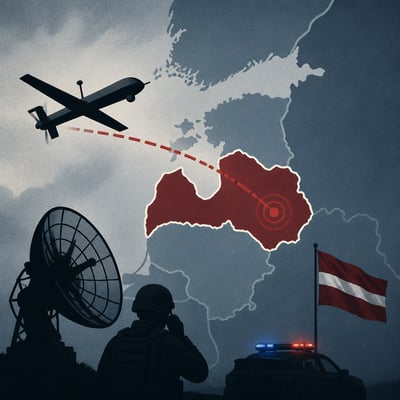
Ukraine is using mid-range drones to strike Russian logistics, fuel, air-defense sites, and command positions, while Russia is responding with concealment, air defenses, and electronic jamming aimed at disrupting Starlink-linked control. Ukrainian crews are also targeting the jamming systems themselves. At the same time, drones crossing into Romania and the Baltic region are exposing gaps in low-altitude detection and interception, prompting NATO and European governments to seek more radar, counter-drone equipment, and coordinated responses.
First Article: 05/07/26
Latest Article: 07/28/26
History
The biggest change is a more specific account of Russian electronic warfare and Ukrainian counter-strikes, including a named jammer system and the unit targeting it. The cross-border drone problem also broadens slightly, with more countries cited as affected and more emphasis on low-altitude detection and engagement authority gaps.
The story has shifted from mainly cross-border drone incidents in NATO airspace to a broader operational contest between Ukrainian deep-strike drones and Russian countermeasures. It now centers more on battlefield adaptation, with NATO/EU response still important but secondary to the drone-versus-jamming arms race.
- Ukraine is using Starlink-linked drones for deep strikes behind the front line.
- Russia is reportedly deploying the Volna Kupol Garant jammer.
- Russian logistics are being hidden in civilian vehicles and dispersed buildings.
- Ukrainian crews are prioritizing Russian jamming sites as targets.
- European officials are debating an eastern drone wall.
The story is now framed more concretely around Ukrainian strike drones being diverted by Russian electronic warfare, rather than a broader pattern of Baltic/Black Sea incursions. It also adds clearer evidence of operational response and real-world harm, including interceptions, apartment-block damage, and a Latvian political crisis.
- Ukrainian drones are explicitly identified as a major source of incursions.
- Finland is newly named among affected airspace recipients.
- A drone strike damaged an apartment block in Galati.
- Latvia suffered a political crisis tied to drone incidents.
- Romania and Poland are pursuing dedicated anti-drone systems.
The story has shifted from broad NATO/EU counter-drone planning to a more concrete picture of implemented air-defense responses and political fallout on the eastern flank. The new emphasis is on deployed counter-UAS tools, emergency-response changes, and the operational consequences of repeated incursions and spoofing.
- Romania and Latvia moved toward stronger NATO-linked air-defense support after drone incidents.
- Layered counter-UAS deployments now include radars, sensors, interceptor drones, and electronic warfare.
- Several incidents triggered ministerial resignations and inquiries into alert systems.
- Emergency-response procedures are being revised in response to drone violations.
The story has sharpened from a general counter-drone concern into an operational defense problem centered on faster NATO authority and integrated sensor-shooter response. New reporting also adds Poland and more explicit spoofing-linked airspace breaches, reinforcing that electronic warfare is now a core driver of the threat.
- NATO is seeking faster authority under Eastern Flank command structures.
- Poland has entered the incident pattern.
- Spoofing-linked airspace breaches are now explicitly highlighted.
- Ukraine is now a partner for counter-drone technology transfer.
- Low-cost interceptors and EW systems are newly emphasized in current defenses.
The story now places more emphasis on concrete policy and defense responses, especially Romania’s Galati crash prompting NATO reinforcement discussions and the EU’s continued difficulty aligning a common counter-drone approach. It also adds clearer political fallout, including resignations, inquiries, and diplomatic retaliation tied to the incidents.
The story shifts from mainly describing recurring drone incursions and defensive gaps to a more specific operational picture in which Russian electronic warfare and GNSS spoofing are the main drivers. It also adds concrete countermeasures, including Ukraine’s own EW response and discussion of low-cost interceptors.
The story has shifted from a broad account of recurring drone security incidents into a more operational and policy-specific update, with clearer emphasis on NATO and EU efforts to accelerate counter-drone integration and procurement. The latest version also adds sharper evidence of political fallout and a more explicit distinction between low-cost drone intrusions and higher-end air threats.
The story has broadened from a Latvia-centered drone problem into a wider eastern-flank security issue, with more countries and institutions now treating it as a recurring airspace-defense challenge. The framing also shifts from isolated incursions to a layered detection, attribution, and response gap, including Ukraine's electronic-warfare adaptation as a related thread.
- Drone incidents now include Lithuania, Estonia, Romania, and the wider NATO eastern flank.
- Operational fallout includes fires, shelter orders, school disruptions, and fighter-jet scrambles.
- Ukraine's Lima electronic-warfare system is newly identified as a related counter-drone capability.
- Ursula von der Leyen is a new actor linking the issue to EU security concerns.
- The story now centers on layered detection, attribution, and alerting gaps.
The story has widened from isolated Latvian drone incidents into a broader Baltic airspace-security pattern, with stronger attribution to Russian electronic warfare and a clearer move toward NATO-backed counter-drone action. The political fallout is also now more severe, including the resignation of both Latvia’s defense minister and prime minister.
- Russian electronic warfare is cited as a frequent cause of drone diversion.
- NATO air policing and interceptions are now part of the response.
- Latvia's May drone incidents triggered two top-level resignations.
- Counter-drone procurement is moving toward implementation.
- The scope now includes Lithuania and Estonia as part of the Baltic pattern.
The story is now framed more explicitly as a border-security and crisis-response issue, with added emphasis on military-adjacent incursions, counter-drone planning, and broader NATO/EU attention. The underlying event remains the same, but the current version sharpens the security framing and expands the political context.
The story now places greater emphasis on Latvia's air-defense detection weaknesses and the follow-on policy response, while adding that the incident produced direct political fallout including resignations and an inquiry. It also frames the episode more explicitly as a state air-defense modernization issue tied to NATO and EU support.
The story is slightly reframed toward a tighter focus on the crash/alert sequence and the resulting air-defense response, while keeping the core political fallout intact. The new version removes some ancillary uncertainty and makes the NATO/EU support angle more explicit.
The story has shifted from an incident-focused airspace breach to one with clearer political and defense-policy consequences. The biggest new elements are the resignations of both the defense minister and prime minister, plus concrete movement toward interceptor-drone procurement.
- The defense minister resigned after the incident.
- The prime minister later stepped down amid criticism.
- Latvia plans to procure interceptor drones.
- Andrii Sybiha said Russian electronic warfare may have diverted the drones.
- NATO and EU financing support is now central to Latvia's upgrade plans.
The story is slightly reframed from a political crisis centered on resignations to a broader airspace-security incident that included emergency alerts, response actions, and critical-infrastructure risk. It also adds school disruptions and a criminal investigation, while softening some of the earlier political emphasis.
Drones crossed into Latvian airspace from the direction of Russia, with two crashing near Rēzekne and one striking an empty oil storage facility. The incident exposed gaps in detection, warning, and response, and quickly became a political crisis that forced the defense minister and then the prime minister to resign. The episode has intensified calls for stronger air defense coordination with NATO and faster deployment of counter-drone systems.