
 Climate
 Privacy
 Bob Dylan
 Drones
 Data Centers
 AI Governance
 2026 Maine Senate Race
Europe Scales Counter-Drone Defenses
Coverage from Interesting Engineering, Dronexl, and others
Articles
13
Active Days
71
The Topic
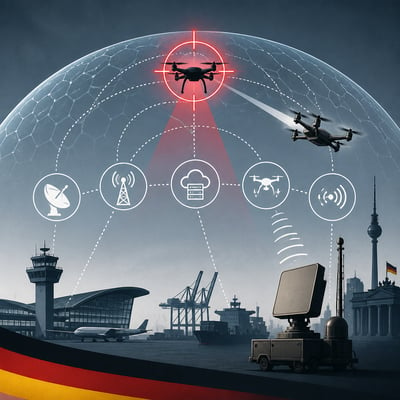
European defense companies and industrial partners are expanding counter-drone capabilities, combining radar and multisensor detection with jamming, lasers, nets, and autonomous or human-supervised interceptors. Germany is a major focal point, driven by reported drone activity around airports and critical infrastructure, while Ukraine’s battlefield experience is shaping demand for lower-cost defenses against small and mass-produced threats. The central challenge is turning prototypes and announced partnerships into affordable systems that can be manufactured at scale and legally deployed in civilian and military airspace.
First Article: 05/11/26
Latest Article: 07/20/26
Summary
- Germany is expanding counter-drone protection as suspicious drone flights affect airports, military sites, ports, and other critical infrastructure.
- European firms are pairing radar, radio-frequency, video, and acoustic sensors with jamming, lasers, nets, and interceptor drones.
- Autonomous interceptors are being developed as lower-cost alternatives to using traditional missiles against small drones.
- Tytan Technologies is targeting production of up to 3,000 interceptors per month and is considering additional European manufacturing sites.
- MBDA is developing a scalable interceptor intended to address saturation attacks, with an initial version potentially available from 2028.
- Mobile counter-drone vehicles are being explored through a Mercedes-Benz and Tytan partnership, but production volumes and timelines remain undecided.
- Civilian use creates distinct operational and legal requirements, favoring non-kinetic or recoverable options near airports and dense urban areas.
History
The story now emphasizes Germany’s sharper operational focus, tying counter-drone demand more directly to airport, port, and critical-infrastructure incursions while stressing civilian-airspace legal constraints. It also reframes the market around getting prototypes and partnerships into affordable, scalable deployment rather than just developing the technology.
The story has shifted from a general move toward production and deployments to a more specific picture of layered counter-drone defense: German firms are now pairing detection, jamming, capture, and kinetic defeat, while Germany has also tightened the state’s interception authority. The most notable new elements are the focus on mass-attack defenses and concrete industrial scaling plans.
Featured
Timeline: 71 Days
Hover over any logo to see coverage summary, click for full article.