

Last Update: 06/03/2026 at 5:00 AM EST
NASA Lunar Drone Deployment
Coverage from Fortune, Aol, and others
Articles
6
Latest Article
05/29
Active Days
33
Executive Summary
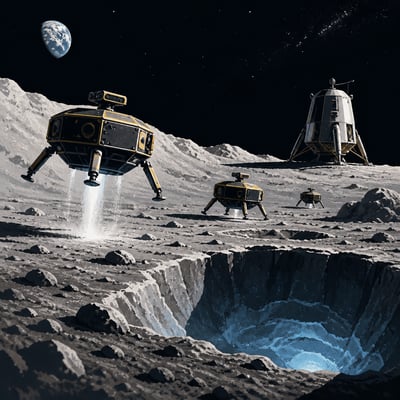
NASA is moving MoonFall from concept into funded lunar hardware, with Firefly Aerospace set to deliver four drones to the south pole for terrain mapping, site selection, and Artemis support. The main signal is a concrete shift toward robotic scouting and infrastructure preparation rather than abstract future planning.
Key Points
- MoonFall has moved into a funded mission phase with NASA, JPL, and Firefly Aerospace tied to a target launch window in 2028.
- The drones are intended for lunar south pole scouting, including terrain mapping, hazard detection, and landing-site selection.
- Operational emphasis is on short-duration flight cycles, multiple hops, and high-resolution imaging rather than long-range transport.
- A survive-the-night capability is important because lunar night conditions otherwise limit mission continuity and data return.
- The mission is being framed as support for Artemis surface operations and early base planning, not as a standalone science experiment.
- Firefly Aerospace is the main commercial delivery partner, while JPL remains the mission manager and systems integrator.
- The topic is relatively coherent and current, with little sign of fragmentation beyond differences in how perimeter, scouting, and territory-marker language is described.
Featured Article
NASA Jet Propulsion Laboratory awarded Firefly Aerospace a $75 million subcontract for MoonFall drones to map lunar South Pole water ice starting no earlier than 2028.
Coverage Timeline: 33 Days
Hover over any logo to see coverage summary, click for full article.
Additional Articles
⭐⭐⭐⭐⭐
NASA will launch MoonFall in the 2020s with JPL-built propulsive drones, landing near the lunar South Pole by 2028 via Firefly Aerospace Elytra deployment.
NASA plans the MoonFall robotic mission with JPL leadership to use four hopping sensor drones for lunar south pole reconnaissance and landing site selection ahead of Artemis operations.
⭐⭐⭐
NASA awarded lunar base contracts in the Artemis program and targets delivering first lunar drones and MoonFall perimeter drones before earliest crew landing around 2028.
NASA awarded lunar base contracts in the 2020s, scheduling Firefly Aerospace drone delivery and MoonFall corner drones ahead of planned Artemis crew landings.
Firefly Aerospace secured a $75 million JPL subcontract to deliver four drones to the lunar south pole for NASA's MoonFall mission, targeting launch no earlier than 2028.