History
07/23/20260 new articles
The story is slightly narrower and more operationally framed: AeroVironment’s counter-drone push is now described as moving into wider U.S. deployment, with a clearer emphasis on current military vulnerability to laser attacks. The biggest update is the added detail that drone survivability depends on specific mission and airframe factors, not just the existence of laser threats.
07/22/202615 new articles
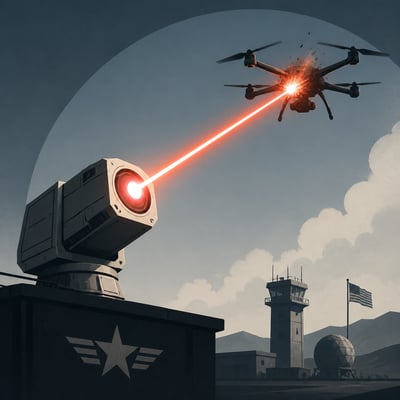
The story has shifted from Pentagon base-defense planning to AeroVironment’s commercial and military push into layered counter-drone systems, anchored by a major Air Force contract and strong financial results. It also broadens into a new vulnerability angle: how military drones themselves may be exposed to high-energy laser attacks.
- AeroVironment is expanding into counter-drone defense.
- The U.S. military awarded an $80.5 million Titan-MS contract.
- AeroVironment reported $1.2 billion funded backlog and $2.7 billion bookings.
- LOCUST reportedly intercepted drones during a maritime demonstration.
- Naval Postgraduate School found three of four naval drones vulnerable to 100-kilowatt lasers.
06/29/20262 new articles
The story is now more concrete on the operational end-state: the pilot is moving toward deployment at five bases, with added detail that NRL testing has produced a dual-use laser platform. The new reporting also sharpens the technical limits of the systems, emphasizing line-of-sight and weather dependence.
05/30/20260 new articles
The story has become more concrete: what was previously described as a move toward base installation is now framed as a five-base pilot with deployment planning underway. It also adds clearer operational detail around FAA-backed testing and the role of JIATF 401 in coordinating the rollout.
05/22/20260 new articles
The story has shifted from a general move toward limited counter-drone fielding to a more concrete deployment timeline, with installation planning now tied to specific bases and an expected year-end rollout. The added emphasis is on implementation details and the FAA/interagency clearance path needed before these directed-energy systems can operate near airspace-sensitive locations.
05/21/20260 new articles
The story has shifted from a planned Pentagon pilot toward limited fielding: the five-base counter-drone effort is now framed as entering deployment planning supported by recent FAA-backed safety trials. The emphasis is less on the existence of the pilot and more on its practical execution under airspace-safety constraints.
05/19/20260 new articles
The story is largely unchanged, but the framing has tightened around JIATF-401 as the central coordinator for the five-base directed-energy pilot. The current version also drops some earlier emphasis on prior coordination friction and named base-selection context, making the update more of a clarification than a substantive shift.
05/18/20260 new articles
The story has shifted from a general pilot concept to a more concrete rollout plan, with named bases, a 180-day deployment window, and fielding targeted before year-end. The new version also makes airspace coordination more prominent by tying execution to FAA constraints and real-world aviation conditions.
05/17/20260 new articles
The story has shifted slightly from a base-pilot announcement to a more clearly framed Pentagon deployment effort, with airspace safety now described as the main constraint. The updated version also broadens the rationale by tying the pilot to reported drone incursions over U.S. installations.
05/16/20260 new articles
The story is mostly stable, but it is now framed more explicitly as a base-level pilot program rather than a broader testing effort. The updated version also tightens the coordination and safety narrative around JIATF 401 and FAA review, while emphasizing White Sands as the main validation site.
05/12/20260 new articles
The story has advanced from a planned counter-drone testing effort to an actual fielded pilot phase at five military bases. The new framing also makes the airspace-safety and FAA-coordination requirements more concrete, rather than just preparatory.
05/11/2026Topic Formed
The cluster is centered on a Pentagon-led directed-energy counter-drone push for U.S. military base defense. Current coverage emphasizes five selected bases, the role of JIATF-401, and prior testing of laser and microwave systems with FAA involvement. The dominant pattern is operational preparation for deployment, with safety and airspace coordination remaining a central constraint.

 Climate
 Privacy
 Bob Dylan
 Drones
 Data Centers
 AI Governance
 2026 Maine Senate Race