
 Climate
 Privacy
 Bob Dylan
 Drones
 Data Centers
 AI Governance
 2026 Maine Senate Race
Police Drone Networks Expand Amid Privacy Gaps
Coverage from WIRED, American Civil Liberties Union, and others
00/00/0000
Articles
31
Active Days
91
The Topic
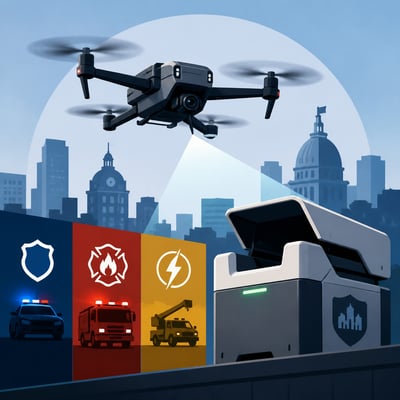
Police departments in San Francisco, St. Paul, Montgomery County, and Orlando are expanding or formalizing docked drone programs that provide rapid aerial video for 911 calls, vehicle pursuits, searches, and other high-risk incidents. These systems can shorten response times and give officers live thermal and optical views before ground units arrive, but their growth is accompanied by concerns about incidental surveillance, weak purpose logging, data retention, and access controls. The exposure of live SFPD feeds shows how operational footage can reveal bystanders, private spaces, location data, and pilot information when sharing settings are improperly configured.
First Article: 04/27/26
Latest Article: 07/26/26
History
The story shifts from broad docked-drone expansion plus a single security lapse to a clearer privacy-and-governance critique centered on how these programs collect, log, and expose sensitive data. The current version also adds Montgomery County’s paired-dock simultaneous-launch capability, indicating a more advanced operational rollout.
The story is now more concrete and security-focused: specific police departments’ docked drone rollouts are quantified, and the San Francisco feed exposure turns privacy concerns into a live operational failure. That shifts the narrative from broad expansion to questions about control, oversight, and data security.
- Orlando activated an 11-drone network across nine rooftop docks.
- St. Paul logged 365 docked-drone flights in under a month.
- An unsecured SFPD link exposed five live drone feeds and sensitive metadata.
- Security researchers Sam Curry and Maik Robert reported and archived the exposure.
- Montgomery County is replacing its fleet with Skydio drones at six locations.
The story has broadened from a few police drone rollouts and one privacy breach into a wider municipal public-safety infrastructure trend. The main new development is that dock-based drone programs are now being framed as multi-agency operational systems spanning police, fire, utilities, and real-time crime centers.
- City utilities and fire agencies now appear alongside police departments.
- Real-time crime centers are becoming the standard control layer.
- Jacksonville and Fort Collins are newly added municipal actors.
- Dock-based and hive-based systems are now the dominant deployment model.
- Use cases now include fire support and utility inspection.
The biggest change is a clearer emphasis on operational deployment and public-value uncertainty: the programs are now described as actively tied to 911 dispatch, while the story adds a stronger note that spending is substantial and the real-world benefit remains unproven. The San Francisco leak also appears more specific about the kinds of sensitive footage exposed and the privacy risks it created.
The story has shifted from a general account of docked police drone expansion to a more concrete, multi-city update anchored by named deployments and a major San Francisco security exposure. The biggest new element is that operational scaling and privacy risk are now both evidenced by specific program sizes, launch volumes, and a publicly exposed live-feed incident.
- Orlando activated an 11-drone, nine-dock emergency network.
- St. Paul reported 365 docked-drone flights in its initial period.
- Montgomery County is replacing aircraft with remotely operated Skydio docks.
- San Francisco’s unsecured link exposed five live feeds for months.
- Security researchers Sam Curry and Maik Robert documented the exposed link.
The story has narrowed from a broad multi-city drone expansion to a more specific account of municipal police departments scaling docked Drone as First Responder programs, with Fairfax County now joining St. Paul and St. Petersburg as a named example. The framing also shifts from general public-safety deployment to a more explicit tension between rapid response gains and heightened oversight concerns, including retention and state-law limits.
The story has broadened from police docked-drone response into a wider municipal public-safety tool, with fire, EMS, and utility use now part of the core narrative. It also adds stronger evidence that these programs are moving into routine operations, with very fast response times and rising flight volumes.
- Firefighting support is now part of the deployment story.
- Utility work is now included in municipal drone programs.
- Reported response times are often under 90 seconds.
- Flight volumes are rising quickly in active programs.
- Fort Collins city agencies are now part of the story.
The story has shifted from broad municipal drone adoption to a more specific and more mature picture of police first-response operations, with automated docked systems now tied directly to 911 dispatch and real-time intelligence workflows. The current version also adds new major players and commercial infrastructure, especially Axon alongside Skydio.
- Police are using docked drones for routine first-response on high-risk calls.
- Deployments now integrate directly with 911 dispatch and real-time intelligence centers.
- Thermal imaging is a highlighted operational capability.
- Axon is newly mentioned in the technology stack.
- Several departments are reporting more flights and more launch sites.
The story shifts from a general rise in municipal drone use to a more specific view of how cities are operationalizing it through docks, rooftops, and command-center workflows. The current version also adds that policy, voter approval, and FAA compliance are now central constraints as deployments scale.
The story broadens from a general municipal drone expansion into a clearer picture of city police departments scaling routine drone operations, with San Francisco newly added as a major operator. The current version also sharpens the operating model around docked systems and real-time intelligence centers, suggesting more mature, embedded deployment.
The story is slightly reframed from a narrow police-and-command-center drone deployment narrative to a broader municipal emergency-response utility, with fire and utility use now more explicit. The underlying takeaway remains the same: these programs are maturing into routine public-safety infrastructure, while Skydio's manufacturing expansion continues to signal demand.
The story now emphasizes that municipal drone use has moved beyond pilot programs into routine operational infrastructure, with live feeds embedded in command centers and dispatch workflows. It also strengthens the scaling angle by adding fleet growth, multi-agency adoption, and Skydio’s domestic manufacturing expansion.
The story is more clearly framed as routine municipal public-safety infrastructure: docked drones are now described as supporting dispatch decisions and utility work, not just pre-arrival video for police. Skydio’s domestic manufacturing expansion remains the main commercial development, reinforcing the supply-side scaling behind broader adoption.
The story now adds a stronger supply-chain and manufacturing angle through Skydio’s domestic investment, while also broadening the municipal drone rollout with more explicit emphasis on operational scale and oversight concerns. The core framing remains the same, but the current version makes the deployment model look more established and institutionally embedded.
The story shifts from broad expansion of docked public-safety drone pilots to a clearer picture of routine operational use. The new material emphasizes live dispatch integration, broader incident types, and Skydio’s role as both supplier and domestic manufacturing scaler.
The story now more explicitly centers on routine municipal deployment of docked drones, with added emphasis on privacy and FAA compliance as scaling constraints. It also sharpens the operational architecture around real-time intelligence centers and autonomous docking infrastructure.
The cluster is centered on municipal and police drone programs that are moving from pilot or limited use into routine operational deployment for emergency response, policing, and utilities. The strongest current signal is docked or station-based drones integrated with real-time command centers, dispatcher workflows, and adjacent city data sources. A secondary but related signal is domestic supply-chain expansion from Skydio.