History
07/23/20260 new articles
The update mostly sharpens the framing rather than changing the core plan: South Korea’s drone push is now described as more decentralized, with service-level responsibility and a proposed reorganized defense headquarters. It also adds uncertainty around feasibility and highlights domestic sourcing limits and Middle East battlefield lessons.
07/22/20265 new articles
The story now adds a more explicit implementation and sourcing dimension: South Korea is not only expanding drone use, but also reorganizing operations, speeding civilian-tech adoption, and constraining procurement to domestic components. It also broadens the counter-drone side by adding laser and high-power microwave defenses tied to North Korean incursions and lessons from Ukraine.
- Laser and high-power microwave defenses are now part of the plan.
- South Korea wants faster adoption of civilian drone technology.
- The plan favors 100% domestically produced components.
- Drone operations are shifting to service-level execution.
- The program is tied to demographic pressure and the 2022 airspace incursion.
06/29/20262 new articles
The story has become more specific and more implementation-oriented: South Korea’s drone push now includes explicit force-structure changes, new weapon types, and a clearer timetable for rolling out capabilities through 2027-2030. It also sharpens the domestic-industrial angle with a stronger local-content requirement and faster civilian-technology adoption.
- Additions include interceptors, loitering munitions, and swarm-capable drones.
- Roughly 60,000 drones are expected by 2029, including 11,000 in 2026.
- The government is pushing for 100% locally produced components.
- Civilian technology adoption is now described as a priority.
- Drones are being framed as routine frontline equipment.
06/26/2026Topic Formed
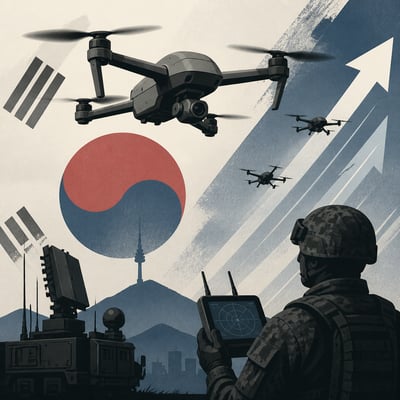
South Korea is rapidly scaling drone warfare capabilities across all branches of its military, with a plan to train 500,000 service members and field tens of thousands of unmanned systems. The program pairs offensive drone adoption with counter-drone defenses, domestic procurement, and looser acquisition rules. It reflects a direct response to North Korea's drone activity and broader lessons from recent wars where unmanned systems have become central to combat.

 Climate
 Privacy
 Bob Dylan
 Drones
 Data Centers
 AI Governance
 2026 Maine Senate Race