History
07/23/20263 new articles
The story now extends beyond aerial and ground drones to include naval systems and electronic warfare, while the central dispute has sharpened around whether Ukraine’s command structure can adapt to more data-driven, unmanned warfare. It also places greater emphasis on the operational cost imposed on Russia and on broader support functions like base protection and logistics resilience.
07/22/202639 new articles
The story has expanded from a drone-centric battlefield adaptation narrative into a broader military reform dispute centered on unmanned ground systems, command modernization, and information/cyber warfare. It also adds a stronger sense of urgency, as manpower shortages and persistent aerial surveillance are pushing Ukraine toward more unmanned missions.
- Ground robots are being used for resupply, casualty evacuation, and offensive operations.
- Manpower shortages are accelerating Ukraine’s shift toward unmanned missions.
- Military reform disputes now focus on command structures and data-driven decision-making.
- Ukraine is extending the fight into cyber and psychological operations.
- Russia is hardening shelters and dispersing assets after Ukrainian strikes.
06/29/20260 new articles
The story now emphasizes Ukraine’s drone war as a broader, multi-domain combat system, not just a mass-and-interceptor contest. It adds a stronger training and operator-skill dimension, plus clearer evidence that foreign militaries are studying Ukraine while some combat realities still outpace outside designs.
06/28/20265 new articles
The story has broadened from a Ukraine-centered drone adaptation contest into a wider ecosystem of mass strike, counter-UAS, and testing/procurement responses that now explicitly includes U.S. and NATO-linked actors. The new emphasis is less on individual battlefield adaptations and more on how electronic warfare, massed drone waves, and realistic testing environments are reshaping doctrine and development.
- Russia is emphasizing mass strike drone waves.
- U.S. Army testing is shifting toward Ukraine-like EW conditions.
- Naval drone development is now part of the story.
- Interceptors and decoys are central Ukrainian responses.
- Electronic warfare resilience is a primary design constraint.
06/23/20264 new articles
The story has sharpened from broad drone-driven adaptation into a more concrete operational contest centered on anti-drone infrastructure and interception. Ukrainian defenses are now described as scaling physical protection and sensor/interceptor systems, while Russian use of jet-powered drones is emerging as a more serious interception challenge.
- Ukraine is building physical anti-drone infrastructure along front-line roads.
- Sensors, AI, and mobile interceptor teams are being paired for drone defense.
- Jet-powered Russian UAVs are proving difficult to intercept.
- Drone manufacturers and procurement actors are newly part of the story.
- Ukraine is framed as a live testbed for drone warfare countermeasures.
06/20/2026Topic Formed
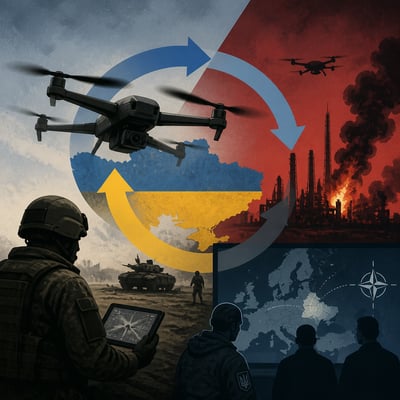
Ukraine’s war effort is increasingly organized around drones, with effects seen on the front line, in deep strikes against Russian infrastructure, and in the structure of command, training, and production. The material shows a fast-moving feedback loop between battlefield use, industrial adaptation, and changing doctrine on both sides.
A common thread is that drones are not replacing conventional war so much as reshaping it: making exposed ground movement more costly, expanding strike reach into Russia, and forcing commanders to disperse units and command centers. The topic also includes growing Western attention to Ukraine’s methods as a model for future air defense and force design.
The cluster is coherent around one central development, but it spans several linked layers: tactical battlefield change, strategic strike pressure, and institutional learning for Ukraine, Russia, and NATO.

 Climate
 Privacy
 Bob Dylan
 Drones
 Data Centers
 AI Governance
 2026 Maine Senate Race