History
07/27/20261 new articles
The story now places heavier emphasis on special forces adaptation and the Firefly program’s move toward scaled production, while specifying broader maritime pressure around Crimea and the Sea of Azov. The civilian toll claim is also sharpened with a first-half-2026 casualty benchmark.
07/25/20264 new articles
The story has broadened from frontline drone saturation to a wider multi-domain campaign spanning maritime, logistics, infrastructure, and rear-area targets on both sides of the war. It also adds a clearer implementation angle, with Ukraine fielding the Firefly guidance kit and more explicitly changing tactics around the expanded drone threat.
- Ukraine is extending drone operations to Russian shipping, bridges, ports, and infrastructure.
- The Firefly guidance kit targets munitions weighing roughly 2 to 20 pounds.
- Bridge strikes are increasingly aimed at disrupting fuel, ammunition, and reinforcement flows.
- UN reporting now notes increased casualties inside Russia.
- Russian and Ukrainian drone activity is now described across maritime and rear-area domains.
07/24/20263 new articles
The story has shifted from general Ukrainian drone operations to a more specific picture of a saturated front line where FPV and fiber-optic drones are reshaping tactics and weakening electronic warfare. It also adds a new civilian-impact dimension, with rising harm in areas beyond the front line and continued refinement of heavy bomber drone precision kits.
- FPV drones are the dominant battlefield drone type.
- Fiber-optic FPVs reduce the usefulness of electronic warfare.
- Ground robots support logistics and casualty evacuation near the front.
- Civilian harm from drone and glide-bomb attacks is rising.
- New guidance kits improve heavy bomber drone precision.
07/22/2026Topic Formed
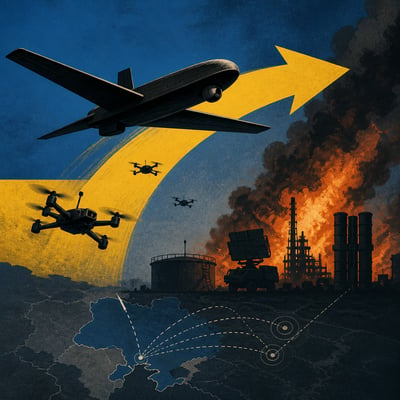
Ukraine is using drones across the battlefield and at extended ranges to strike Russian logistics, air-defense systems, energy infrastructure, and weapons-production facilities. Low-cost guided kits, heavy bomber drones, FPV systems, and longer-range platforms are expanding the precision and reach of these operations while Russia adapts with decoys, new frequencies, and continued drone attacks. The campaign can disrupt supply and fuel networks, but the reporting also indicates that drones do not fully replace the destructive power and penetration of ballistic missiles.

 Climate
 Privacy
 Bob Dylan
 Drones
 Data Centers
 AI Governance
 2026 Maine Senate Race