
 Climate
 Privacy
 Bob Dylan
 Drones
 Data Centers
 AI Governance
 2026 Maine Senate Race
Ukraine Expands Long-Range Drone Strikes
Coverage from The Guardian, PBS News, and others
00/00/0000
Articles
145
Active Days
94
The Topic
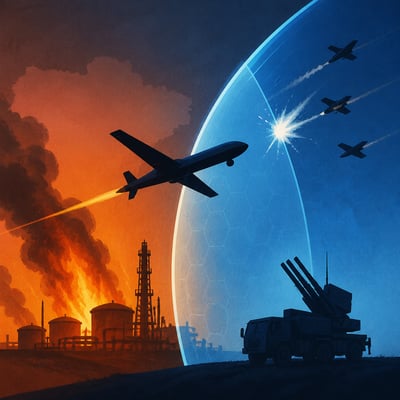
Ukraine is using increasingly long-range drones to strike Russian refineries, fuel infrastructure, vessels supplying Crimea, and selected commercial facilities. The campaign is intended to disrupt Russia’s war-related fuel and logistics networks while demonstrating that targets deep inside Russia remain vulnerable. Reported effects include fires, casualties, fuel restrictions, transport disruption, and increased pressure on Russian air defenses, although damage claims and military effects remain unevenly verified.
First Article: 04/26/26
Latest Article: 07/28/26
History
The story narrows slightly from broad attacks on Russian fuel and logistics infrastructure to a sharper focus on Crimea-linked transport and selected commercial facilities. The main new wrinkle is stronger emphasis that the drone campaign may be stressing Russian air defenses, while verification of damage and military impact remains mixed.
The campaign has widened materially in geography and target set, reaching deeper into Russia and adding more commercial and maritime infrastructure to the list of affected assets. The current version also strengthens the argument that the strikes are forcing Russia to stretch air defenses and fuel logistics, while confirming some damage but leaving overall impact disputed.
- Strikes reached targets near Moscow, in Siberia and across additional Russian regions.
- The Moscow refinery was reported to supply a substantial share of the capital’s fuel.
- Ukraine is now hitting ships and transport routes in the Sea of Azov and Black Sea approaches.
- Civilian deaths, injuries and environmental risks are now reported consequences.
- Independent verification confirms some vessel and facility damage.
The story now includes a broader target set, notably Ukrainian drone strikes on major retail warehouses in addition to energy and Crimea-linked logistics. The framing also shifts toward contested legality and uncertainty over the military value and damage assessments of individual strikes.
- Ukrainian strikes now include major retail warehouses.
- The warehouse attacks sparked a legality dispute over dual-use goods.
- Fire Point is named as a reported drone developer.
- Current reporting questions the precise drone systems used.
- Damage and vessel-hit claims are now described as substantially contested.
The story now emphasizes a broader, more mature strike campaign: Ukraine is hitting not just refineries and Crimea supply routes, but also military-industrial sites and maritime routes, with added concern over civilian and cross-border airspace risks. The framing also shifts from contested operational damage to a wider pressure campaign on Russian logistics and defenses.
- Ukraine is now striking military-industrial sites, not just refineries and transport routes.
- The campaign now raises risks in nearby NATO-border areas.
- The 414th Separate Unmanned Strike Aviation System Brigade is newly identified.
- Newer jet-powered drone systems are cited as part of the attacks.
- Civilian casualties and airport closures are now reported outcomes.
The story has broadened from repeated refinery strikes inside Russia to a wider campaign against the supply network sustaining occupied Crimea, including maritime routes and critical infrastructure. It also now emphasizes larger raids and contested but more widely reported knock-on effects like shortages, outages, and logistics disruption.
- Ukrainian strikes now target vessels supplying occupied Crimea.
- Campaign scope extends into the Sea of Azov and Black Sea.
- Crimea has reported fuel shortages and power outages.
- Nearly 200 drones were reportedly used in a Moscow-area raid.
- Independent verification supports only some damage claims.
The story now places greater emphasis on tangible pressure inside Russia: fuel restrictions, airport disruptions, and reported strain on fuel availability, not just repeated refinery damage. It also broadens the geography of the campaign to explicitly include deep-inside-Russia targets near Moscow and in Siberia.
The story has become more specific and operational: it now centers on repeated refinery and fuel-logistics strikes with clearer evidence of persistent damage, disruptions, and deeper-range reach. It also adds a smaller but notable maritime-drone component against Tuapse-area targets.
- Several Russian facilities were hit more than once.
- Reported impacts include pipeline damage and worker injuries.
- Ukrainian naval drones struck maritime targets near Tuapse.
- SSU and the Ukrainian Navy are now identified as operators.
- Rosneft, Lukoil, and Transneft are newly named as connected entities.
The story is now more clearly framed as Ukraine's sustained deep-strike campaign against Russian energy and defense industry targets, not just a general pattern of drone warfare. The new version adds explicit Ukrainian justification, wider disruption effects, and a broader target set beyond refineries.
The story has broadened from repeated refinery strikes to a wider, more specific energy-logistics campaign, with new evidence tying attacks to marine terminals, dispatch facilities, tanker logistics, and named operators. The updated version also strengthens the attribution chain through additional confirmation and adds a clearer picture of deep-strike reach and maritime drone use.
The story now emphasizes a more sophisticated drone campaign: Ukrainian strikes are not just continuing, but reportedly becoming more coordinated and harder to stop, with multiple drone types and naval drones added to the pattern. The geographic and operational scope also widened, with explicit mention of longer-range hits deep inside Russia and continued adaptation against air defenses and electronic warfare.
- Recent strikes reportedly use multiple drone types, decoys, and coordinated systems.
- Reported Ukrainian drone hits exceed 1,500 km from the border.
- Naval drones struck a tanker near Tuapse.
- Both sides are adapting tactics around air defenses and electronic warfare.
The story now places greater emphasis on deeper Russian territory being struck, especially Moscow-area targets, which strengthens the sense that Ukraine’s drone campaign is expanding in reach and intensity. The framing also shifts slightly from repeated refinery attacks to a broader energy-and-industrial infrastructure campaign with sustained Russian counterclaims of interception.
- Moscow-area targets are now included among strike locations.
- Chemical facilities are newly named as targets.
- Naval drone attacks are linked to sanctioned tankers near Tuapse.
- Russian drone attacks are now described as hitting residential neighborhoods.
- The story now explicitly emphasizes escalation in range and frequency.
The story is now framed more explicitly as a sustained, coordinated campaign against Russian energy logistics, with clearer emphasis on strikes getting through despite interception claims and causing concrete disruptions and injuries. It also broadens slightly to include worker harm and attacks on refinery-linked dispatch systems, not just refinery fires.
The story now has stronger evidence and a broader frame: several drone strikes are independently corroborated, and Russian drone attacks on Ukraine are now part of the same reciprocal campaign. The current version also emphasizes wider geographic reach and clearer operational effects on fuel output and transport.
The story is slightly reframed from a broad pattern of drone strikes into a more specific campaign against Russia's fuel logistics and defense-support network, with stronger emphasis on repeated hits to dispatch and transport nodes. The current version also adds clearer evidence of ancillary naval-drone activity and deep-strike effects near Moscow.
The main shift is a clearer expansion in scope: the campaign now explicitly includes naval drones alongside long-range UAVs, and the strikes are being framed as reaching deeper into Russia with more systematic capability growth. The current version also emphasizes contested damage assessments and Russian interception claims more explicitly than before.
The story now places greater emphasis on Ukraine's increasingly deep-reach domestic drone capability, with more explicit linkage to named Ukrainian systems and an added naval-drone strand. It also broadens slightly beyond oil infrastructure to include more defense-industrial and transport targets inside Russia.
The story now places greater emphasis on Ukraine’s deeper, domestically produced strike capability and names specific drone systems behind the attacks. It also sharpens the operational pattern, especially repeated hits on Tuapse and expanded deep strikes into Russia’s interior.
The story broadens from mainly oil-infrastructure attacks to a somewhat wider strike set that now more explicitly includes Moscow-region industrial targets and defense-production sites, while also adding Ukrainian Navy-linked maritime drone activity. The overall pattern is still the same, but the current version gives a clearer sense of geographic reach and target diversity.
The story broadens from repeated strikes on oil infrastructure to a wider deep-strike campaign that now clearly includes defense-industrial and dual-use facilities. The new version also adds naval-drone activity and sharpens the framing around export revenue and military supply chains.
The story is materially broader and more concrete: beyond repeated refinery hits, the current version adds clearer evidence of knock-on disruptions and explicitly frames the campaign as targeting war-supporting industry deep inside Russia. It also newly surfaces secondary Russian UAV attacks inside Ukraine, though they remain peripheral.
The story now places stronger emphasis on a sustained, long-range campaign against Russian energy infrastructure, while adding Cheboksary and other industrial targets as part of that pattern. It also sharpens the framing around corroboration quality, with Russian interception and debris-fire claims recurring but not uniformly verified.
The story now emphasizes more concrete strike effects on Russian energy infrastructure, not just repeated targeting: reporting adds fires, damaged processing units, burned tanks, and temporary shutdowns. It also broadens the set of repeatedly hit sites, with Yaroslavl and the Leningrad region now joining the core pattern.
The cluster is primarily about Ukraine’s sustained drone campaign against Russian energy, logistics, and defense-industrial targets, with repeated strikes on refineries, pumping stations, and related infrastructure deep inside Russia. The dominant pattern is repeated, publicly claimed damage to oil processing and transport nodes, paired with Russian interception claims and incomplete verification in some cases. A smaller but related thread covers Russian UAV attacks on Ukrainian cities. The overall narrative is operational rather than speculative: demonstrated or claimed strike effects, repeated targeting of the same facilities, and evidence of expanding Ukrainian reach.